
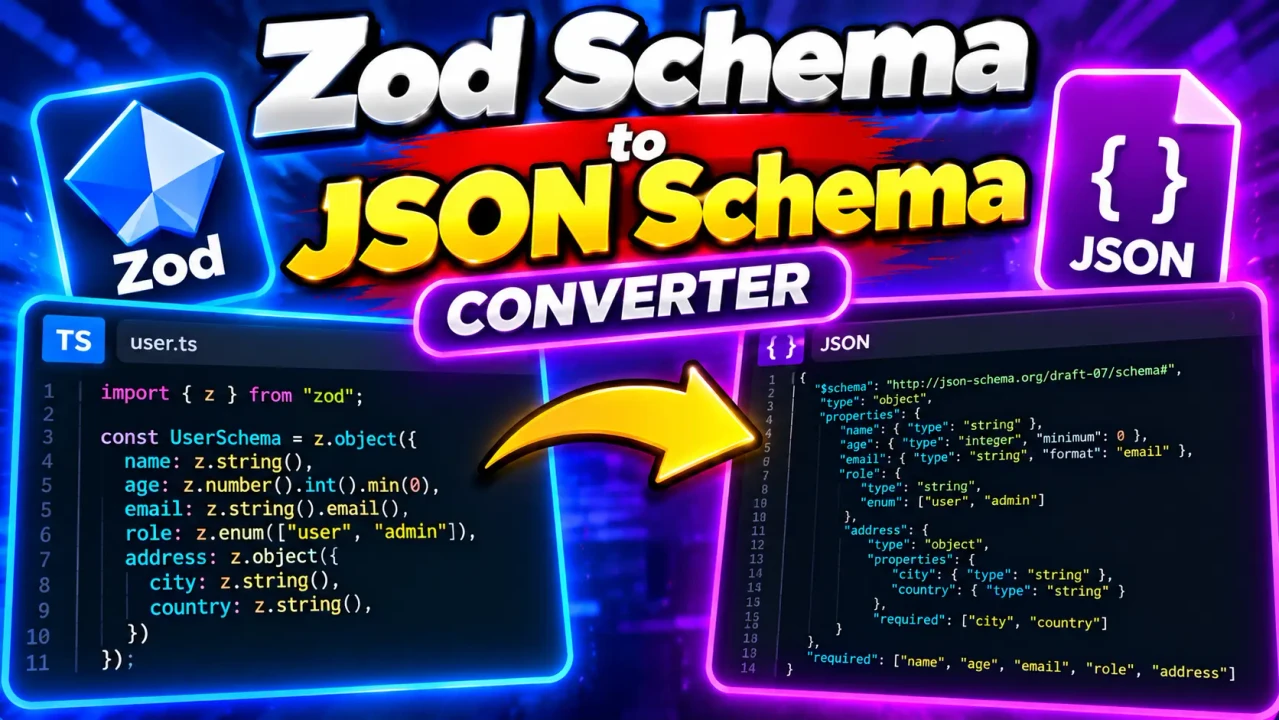
Zod Schema to JSON Schema Converter
Quick answer: The Zod Schema to JSON Schema Converter transforms supported Zod schema definitions into JSON Schema, making validation rules and data structure definitions easier to reuse in JSON Schema-based tooling.
TL;DR / Key Takeaways
- Primary Function: Convert Zod schema definitions into JSON Schema.
- Key Input: Zod schema syntax such as
z.object(),z.string(), andz.number(). - Core Output: A JSON Schema representation of the supported Zod structure and constraints.
- Best Suited For: Developers moving validation schemas between Zod-based TypeScript applications and JSON Schema consumers.
What Does the Zod Schema to JSON Schema Converter Do?
The Zod Schema to JSON Schema Converter is a developer utility for translating Zod schema definitions into JSON Schema. This is useful when a TypeScript application defines its data rules with Zod but another system expects a JSON Schema representation.
Zod's JSON Schema conversion model maps representable schema types and checks to their closest JSON Schema equivalents. For example, a Zod object containing string and number fields can become a JSON Schema object with properties, required, and appropriate primitive type declarations.
The resulting schema can be useful for documentation, schema interchange, API tooling, validation systems, and other workflows that consume JSON Schema. The exact result depends on the Zod constructs used in the input.
How to Use Zod Schema to JSON Schema Converter?
- Enter the Zod schema: Provide a valid Zod schema definition using supported Zod syntax.
- Convert the schema: Run the converter to translate the representable Zod structure into JSON Schema.
- Review the result: Check object properties, required fields, constraints, formats, and other generated keywords.
- Copy the JSON Schema: Use the generated schema in a JSON Schema-compatible workflow after reviewing its limitations.
What Should I Enter?
Use actual Zod schema code rather than a JSON object instance. A simple object schema is a useful starting point:
import * as z from "zod";

const User = z.object({
  name: z.string(),
  age: z.number(),
});
What Does the Output Look Like?
A corresponding JSON Schema representation can describe the object structure like this:
{
  "type": "object",
  "properties": {
    "name": {
      "type": "string"
    },
    "age": {
      "type": "number"
    }
  },
  "required": [
    "name",
    "age"
  ],
  "additionalProperties": false
}
This illustrates an important conversion relationship: z.object() becomes a JSON Schema object, while z.string() and z.number() become JSON Schema string and number types. Zod's documented conversion behavior also represents the default plain-object behavior with additionalProperties: false. :contentReference[oaicite:0]{index=0}
Zod to JSON Schema Type Mapping
| Zod Construct | JSON Schema Representation | Conversion Note |
|---|---|---|
z.string() |
{"type":"string"} |
Basic string value. |
z.number() |
{"type":"number"} |
Numeric value. |
z.int() |
{"type":"integer"} |
Integer constraint. |
z.boolean() |
{"type":"boolean"} |
Boolean value. |
z.null() |
{"type":"null"} |
Explicit JSON null. |
z.array(schema) |
{"type":"array","items":...} |
The nested schema describes array items. |
z.email() |
{"type":"string","format":"email"} |
Uses the JSON Schema email format. |
z.uuid() |
{"type":"string","format":"uuid"} |
Uses the UUID format. |
z.iso.date() |
{"type":"string","format":"date"} |
Represents an ISO date string. |
z.url() |
{"type":"string","format":"uri"} |
Represents a URI-style string. |
These mappings follow Zod's documented JSON Schema conversion behavior. Zod documents additional conversions for string formats, numeric constraints, nullable schemas, file schemas, and other representable constructs. :contentReference[oaicite:1]{index=1}
How Does Zod to JSON Schema Conversion Work?
The conversion process examines the Zod schema's structure and translates representable types and checks into JSON Schema keywords. Primitive Zod types become primitive JSON Schema types, object fields become properties, required fields are represented through required, and applicable validations can become JSON Schema constraints.
For example, Zod's documented conversion of an email schema produces a string with format: "email". Integer schemas can produce type: "integer", while an ISO date can produce a string with the date format. :contentReference[oaicite:2]{index=2}
Zod also supports conversion targets such as JSON Schema Draft 2020-12, Draft 7, Draft 4, and OpenAPI 3.0 through its documented conversion API. Whether a particular ToolHox interface exposes each target as an option depends on the tool implementation, so the generated result should be treated as the authoritative output of the converter rather than assuming every Zod conversion option is available in the interface. :contentReference[oaicite:3]{index=3}
Important Edge Cases and Limitations
Unrepresentable Zod Types
Not every Zod construct has a direct JSON Schema equivalent. Zod's documentation identifies constructs such as z.bigint(), z.symbol(), z.undefined(), z.void(), z.date(), z.map(), z.set(), z.transform(), z.nan(), and z.custom() as unrepresentable by default in its native JSON Schema conversion. :contentReference[oaicite:4]{index=4}
This distinction matters because converting a validation schema is not always a lossless operation. A Zod schema may express runtime behavior that JSON Schema cannot encode directly. Zod documents an unrepresentable option for deciding whether such constructs should cause an error or be represented as unconstrained JSON Schema, but a converter interface may expose only part of that behavior. :contentReference[oaicite:5]{index=5}
Transforms and Input/Output Types
Zod schemas can describe transformations where the accepted input and resulting output types differ. Zod's native conversion API therefore provides an io option for choosing whether the input or output side of such schemas is represented. This is particularly important for pipelines, defaults, and coerced primitives. :contentReference[oaicite:6]{index=6}
Objects and Additional Properties
A plain Zod object is documented as producing additionalProperties: false in the default output representation, reflecting Zod's default behavior for stripping additional properties. Loose and strict object schemas have different documented handling, so the distinction should be preserved when interpreting generated JSON Schema. :contentReference[oaicite:7]{index=7}
Nullable Versus Optional
Nullable and optional values should not be treated as interchangeable. A nullable string permits a JSON null value, while an optional property concerns whether the property itself is present. Zod documents separate JSON Schema representations for these concepts. :contentReference[oaicite:8]{index=8}
Cycles and Reused Schemas
Recursive Zod schemas can require references rather than simple inline definitions. Zod's documented converter can represent cycles with $ref, while reused schemas can either be inlined or extracted into $defs depending on conversion options. :contentReference[oaicite:9]{index=9}
Technical limitation: Always inspect generated JSON Schema when the source uses transforms, recursive structures, custom checks, non-JSON values, or other advanced Zod features. A syntactically valid JSON Schema does not necessarily preserve every runtime behavior expressed by the original Zod schema.
Related Technical Reference
Zod's official JSON Schema documentation is the primary reference for native conversion behavior, supported targets, representability rules, metadata, cycles, reused schemas, and format mappings. :contentReference[oaicite:10]{index=10}
Author: Jordan Mitchell, Software Engineer specializing in TypeScript validation and schema tooling.
Technical Review: This page's technical explanations were reviewed against Zod's published JSON Schema conversion documentation, with particular attention to type mappings, representability limitations, object behavior, formats, and recursive schemas.