
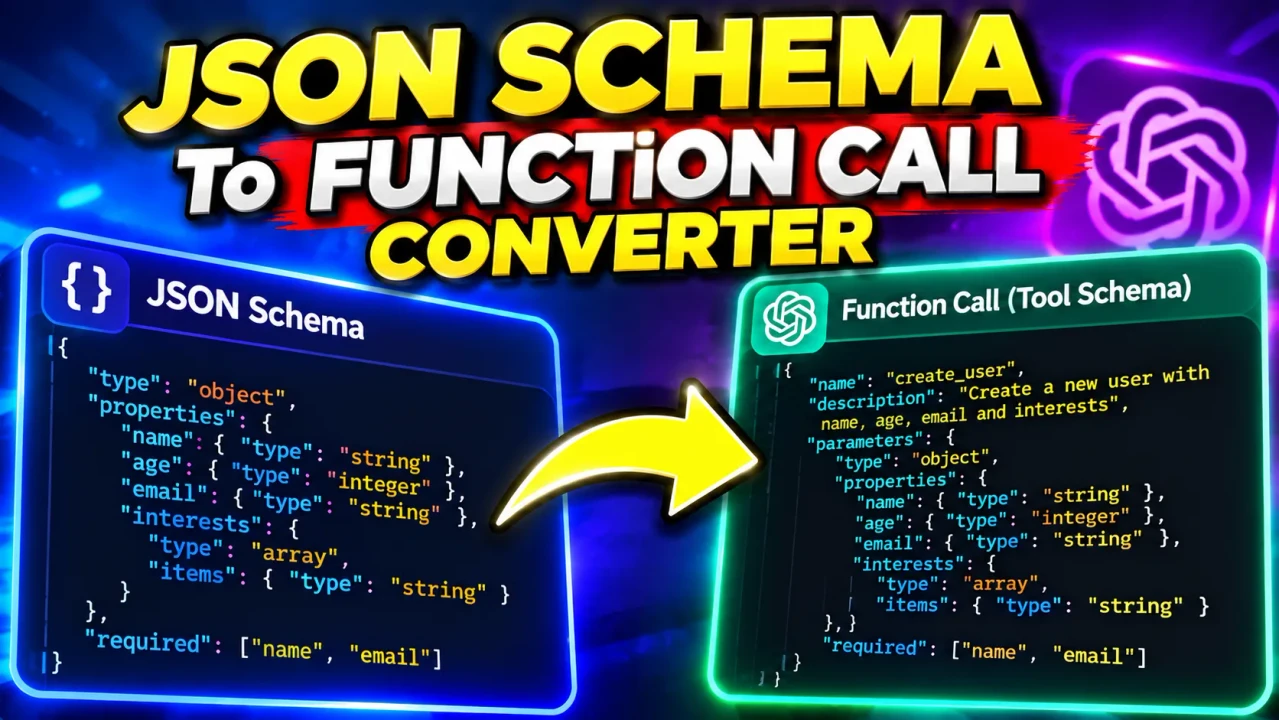
Json Schema To Function Call Converter
Quick answer: The Json Schema To Function Call Converter transforms a JSON Schema describing function arguments into a function-call definition that can be used as structured tool metadata for AI integrations.
The Json Schema To Function Call Converter is a developer utility for turning a JSON Schema into the structured definition expected by a function-calling interface. JSON Schema describes the shape and validation rules of JSON data; a function tool definition adds the callable function identity and uses a JSON Schema object to describe its input arguments.
For OpenAI-style function tools, the core definition includes type, name, description, and parameters, with strict available to control schema adherence. The parameters value is itself a JSON Schema object, so properties, types, descriptions, enums, nested objects, arrays, and required fields can form the argument contract.
TL;DR / Key Takeaways
- Primary Function: Convert JSON Schema into a function-call definition.
- Key Input: A JSON Schema object describing function arguments.
- Core Output: Structured function/tool JSON with an argument schema.
- Best Suited For: Developers building AI agents, API integrations, and structured tool-calling workflows.
How to Use Json Schema To Function Call Converter?
Start with a valid JSON Schema whose root describes the arguments your function should receive. A typical schema uses type: "object", a properties object, and an optional required array. JSON Schema defines properties as named child schemas and uses required to identify properties that must appear in a valid instance.
The converter's job is to preserve that argument contract inside the function definition. A current OpenAI Responses-style function tool can be represented in this general form:
{
  "type": "function",
  "name": "get_weather",
  "description": "Get current weather for a location.",
  "parameters": {
    "type": "object",
    "properties": {
      "location": {
        "type": "string",
        "description": "City and country"
      },
      "units": {
        "type": "string",
        "enum": ["celsius", "fahrenheit"]
      }
    },
    "required": ["location", "units"],
    "additionalProperties": false
  },
  "strict": true
}
When strict function calling is enabled, OpenAI documents additional schema requirements: object schemas use additionalProperties: false, and properties are marked required; optional values can instead allow null.
Input and Output Example
Input
{
  "type": "object",
  "properties": {
    "customer_id": {
      "type": "string",
      "description": "Unique customer identifier"
    },
    "include_orders": {
      "type": "boolean",
      "description": "Whether to include recent orders"
    }
  },
  "required": ["customer_id"]
}
Output
{
  "type": "function",
  "name": "get_customer",
  "description": "Look up a customer.",
  "parameters": {
    "type": "object",
    "properties": {
      "customer_id": {
        "type": "string",
        "description": "Unique customer identifier"
      },
      "include_orders": {
        "type": "boolean",
        "description": "Whether to include recent orders"
      }
    },
    "required": ["customer_id"]
  }
}
The important transformation is not the invention of new argument rules; it is the placement of the supplied JSON Schema in the function's parameter contract, alongside the function metadata.
Technical Reference: JSON Schema to Function Arguments
| JSON Schema element | Function-definition role | Practical effect |
|---|---|---|
type |
Defines the schema value type | Establishes whether an argument is an object, string, number, boolean, array, or another supported schema type. |
properties |
Defines named arguments | Each property becomes part of the function's structured input contract. |
required |
Defines mandatory arguments | Identifies properties that must be present in a valid argument object. |
description |
Documents a field or function | Provides semantic guidance about how the function or argument should be used. |
enum |
Restricts allowed values | Useful for arguments such as units, modes, categories, or status values. |
items |
Defines array elements | Describes the schema applied to values inside an array argument. |
additionalProperties |
Controls extra object members | false prevents undeclared properties under JSON Schema validation and is important for strict function schemas. |
JSON Schema's additionalProperties keyword applies to properties not covered by properties or patternProperties. The JSON Schema specification also identifies 2020-12 as the current specification version.
How the Conversion Works
The transformation can be understood as a small set of structural operations:
- Read the supplied JSON Schema as the function's argument contract.
- Retain the schema structure that defines argument names, types, constraints, and descriptions.
- Place that schema under the function definition's
parametersfield. - Combine it with the function's name and description according to the target function-tool format.
For OpenAI's current function-tool model, the callable object uses type: "function", a function name, optional description, a JSON Schema parameters object, and optional strict behavior.
Edge Cases and Limitations
Strict schemas
A schema intended for strict function calling can require more than merely being valid JSON Schema. OpenAI documents that strict mode requires additionalProperties to be false for each object and requires every property to be present in required; optionality can be represented through nullable types.
Missing function metadata
A JSON Schema describes arguments, not the complete identity of a callable function. A usable function definition also needs a function name, while a description is used to explain when and how the function should be called.
Advanced JSON Schema keywords
JSON Schema supports substantially more than simple object properties, including composition, references, pattern-based properties, and other vocabularies. The supplied tool information does not verify how this converter handles every advanced keyword, so generated output should be reviewed before production use rather than assuming every schema construct is preserved or normalized.
Invalid or ambiguous input
A malformed JSON document is not equivalent to a valid JSON Schema, and a syntactically valid schema can still be unsuitable for a particular function-calling target. Validate both the source schema and the generated function definition against the requirements of the API or SDK where the output will be used.
Privacy and processing
The supplied tool information does not verify whether conversion is performed locally in the browser, whether input is transmitted to a server, or whether conversion data is stored. No stronger privacy or security claim should be inferred without implementation-level verification.
Technical References: OpenAI Function Calling documentation and JSON Schema specification.
Author: Ethan Miller, Software Engineer specializing in JSON Schema, API contracts, and developer tooling.
Technical Review: Technical terminology, JSON Schema relationships, and function-tool examples were reviewed against the JSON Schema specification and current function-calling documentation.