
Storm Water Storage Tank Sizing Tool Calculator Guide
Estimate stormwater tank capacity from catchment area, rainfall depth, and runoff assumptions. Review the calculation carefully before finalizing your design.
Please complete this field to continue.
Please complete this field to continue.
Please complete this field to continue.
Please complete this field to continue.
Please complete this field to continue.
Results
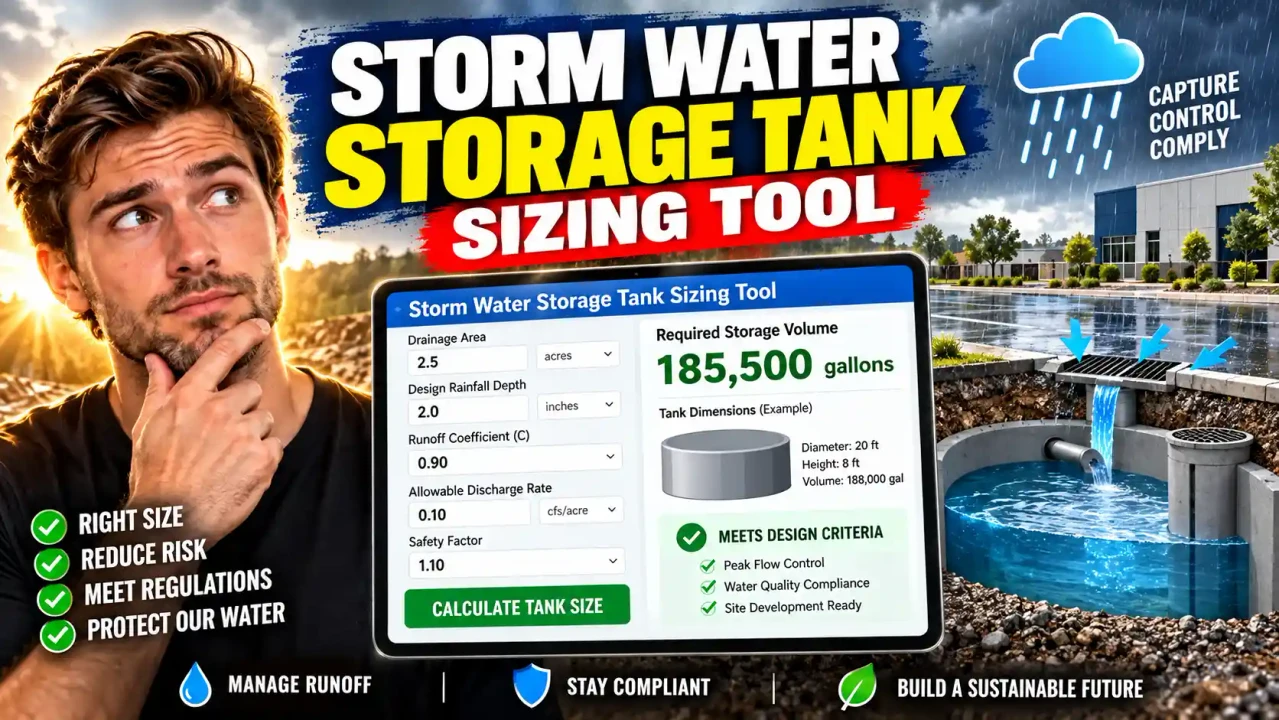
Storm Water Storage Tank Sizing Tool
Quick answer: The Storm Water Storage Tank Sizing Tool is an engineering calculator intended to help estimate the storage capacity needed to collect stormwater runoff. Tank sizing depends on contributing drainage area, design rainfall depth, runoff characteristics, and the volume that must be retained or reused. The final capacity must account for site conditions and applicable drainage requirements.
Stormwater storage tank sizing is the process of estimating how much rainwater a tank must accommodate during a selected rainfall event. The required capacity depends on how much rain falls on the contributing catchment, how much becomes runoff, and whether water is released, infiltrated, or reused while the storm is occurring.
This tool is intended for preliminary planning by civil engineers, drainage designers, architects, construction professionals, property developers, and building owners evaluating rainwater harvesting or stormwater detention systems. The exact input fields and output options depend on the calculator implementation.
Key Takeaways
- Primary function: Estimate the storage volume required for stormwater collection.
- Key design inputs: Catchment area, rainfall depth, and runoff coefficient, where supported.
- Core engineering relationship: Effective rainfall depth multiplied by contributing area estimates runoff volume.
- Important distinction: Detention tanks, retention tanks, and rainwater harvesting tanks can have different operational requirements.
- Best practice: Verify the design rainfall, discharge conditions, usable storage, and overflow provisions before selecting a tank.
How to Use Storm Water Storage Tank Sizing Tool?
Use the calculator by entering the project information requested by its interface. For a preliminary storage estimate, gather the following information before starting:
- Contributing drainage area: Measure the roof, pavement, parking area, or other surfaces that drain into the proposed tank. Use consistent area units.
- Design rainfall depth: Determine the rainfall depth applicable to the location, storm duration, and required design event.
- Runoff coefficient: If requested, select a justified coefficient representing the fraction of rainfall that becomes surface runoff.
- Tank configuration: Where supported, provide relevant dimensions, usable capacity, or storage assumptions.
- Review the result: Check the calculated volume, units, assumptions, and whether the output represents total runoff or net storage demand.
Do not substitute annual average rainfall for a design-storm depth without a suitable engineering method. A storage tank intended to manage a specified storm event needs rainfall data that matches the design objective.
Stormwater Storage Tank Sizing: Input and Output Example
The following worked example demonstrates the underlying runoff-volume calculation. It is an illustrative engineering example, not a claim about the calculator's default settings or verified output interface.
Example inputs
- Contributing roof area: 1,000 m²
- Design rainfall depth: 50 mm
- Runoff coefficient: 0.90
- Assumed initial and continuing storage losses: excluded
- Additional inflow or outflow during the event: excluded
Calculation
Step 1: Convert rainfall depth to metres.
50 mm ÷ 1,000 = 0.05 m
Step 2: Calculate the rainfall volume over the catchment.
Rainfall volume = Area × Rainfall depth
= 1,000 m² × 0.05 m = 50 m³
Step 3: Estimate runoff volume.
Runoff volume = Area × Rainfall depth × Runoff coefficient
= 1,000 × 0.05 × 0.90 = 45 m³
Illustrative result
The estimated runoff volume is 45 m³, or 45,000 litres. A tank intended to capture this entire runoff volume without any simultaneous discharge or reuse would need at least 45 m³ of usable storage under these assumptions. The actual tank's nominal capacity may need to be greater to accommodate freeboard, unusable volume, operating levels, and other design constraints.
Stormwater Storage Tank Sizing Formula
A simple event-based runoff-volume estimate is:
V = A × P × C
- V = estimated runoff volume, in cubic metres (m³).
- A = contributing catchment area, in square metres (m²).
- P = design rainfall depth, in metres (m).
- C = dimensionless runoff coefficient.
The formula assumes that rainfall depth is uniform over the contributing area and uses a simplified runoff coefficient. It does not independently calculate a rainfall hydrograph, peak inflow rate, infiltration over time, or a dynamically changing tank water level.
When a catchment contains multiple surface types, a weighted runoff coefficient may be estimated as:
Cw = Σ(Ai × Ci) ÷ ΣAi
Here, Ai is the area of each surface type and Ci is its selected runoff coefficient. The coefficient values should come from applicable local design guidance or justified project assumptions.
Stormwater Tank Sizing Reference Table
The table below provides illustrative runoff-volume estimates for a 50 mm rainfall event. It assumes a runoff coefficient of 0.90, no simultaneous discharge or reuse, and no additional storage losses. Values are calculated from the same volume formula.
| Catchment Area | Rainfall Depth | Runoff Coefficient | Estimated Runoff Volume |
|---|---|---|---|
| 100 m² | 50 mm | 0.90 | 4.5 m³ |
| 250 m² | 50 mm | 0.90 | 11.25 m³ |
| 500 m² | 50 mm | 0.90 | 22.5 m³ |
| 1,000 m² | 50 mm | 0.90 | 45 m³ |
| 2,000 m² | 50 mm | 0.90 | 90 m³ |
How to interpret this table: Under the stated assumptions, doubling the catchment area doubles the estimated runoff volume. Increasing rainfall depth also increases the estimated volume proportionally. A lower runoff coefficient reduces the calculated runoff, but it should not be chosen merely to obtain a smaller tank.
How Storm Water Storage Tank Sizing Works
Tank sizing starts with the relationship between rainfall, catchment area, and runoff. A rainfall depth of 1 mm falling on 1 m² corresponds to 1 litre of rainfall volume before accounting for runoff losses. Consequently, a convenient form of the simplified calculation is:
Runoff volume (litres) = Area (m²) × Rainfall (mm) × Runoff coefficient
For example, a 100 m² roof receiving 20 mm of rain with a coefficient of 0.90 produces an estimated 1,800 litres of runoff.
The required tank capacity is not always identical to the estimated runoff volume. If water is released through a controlled outlet during the storm, the necessary storage may be lower. If the tank must remain partially full for reuse, has a restricted outlet, or receives additional runoff from other areas, the usable storage requirement may change.
For a detention system, engineers may need to compare inflow and outflow over time. For rainwater harvesting, demand, available empty capacity, and the frequency of rainfall events may also matter. A simple volume formula should not be treated as a substitute for those analyses where they are required.
Technical Edge Cases and Limitations
Mixed catchment surfaces
Roofs, concrete pavement, landscaped ground, and permeable surfaces may produce different runoff volumes. Use appropriate surface-specific assumptions and consider a weighted coefficient when a single simplified coefficient is justified.
Rainfall units and catchment area
Mixing millimetres with feet or square metres with square feet can produce major errors. Convert all inputs to a consistent unit system before calculating. A rainfall depth in millimetres must be divided by 1,000 to obtain metres.
Zero or negative values
A zero catchment area or zero rainfall depth produces zero runoff in the simplified formula. Negative area, rainfall depth, or runoff coefficients are not physically meaningful inputs for this calculation and should be rejected or corrected.
Design rainfall selection
Rainfall depth must correspond to the required storm duration, recurrence interval or return period, and location. Local drainage regulations may specify a particular design event. A generic rainfall assumption is not sufficient for final engineering design.
Overflow and outlet design
Storage capacity alone does not establish whether the system can safely convey peak inflow, limit discharge, or prevent flooding. Overflow routes, outlet capacity, pipe sizing, water levels, structural loads, and maintenance access require separate consideration where applicable.
Usable and nominal tank capacity
Nominal capacity is not necessarily fully available for stormwater. Freeboard, sediment accumulation, dead storage, and water already in the tank may reduce the effective volume available when a storm begins.
Supported Methodology and Engineering Considerations
The runoff-volume equation in this reference is a simplified estimation method. The exact features implemented by the Storm Water Storage Tank Sizing Tool must be confirmed from its interface and calculation logic; this page does not assume that it performs hydrologic simulation or automated code compliance checks.
- Suitable preliminary use: Estimating event runoff volume from a known catchment area and rainfall depth.
- Requires project-specific verification: Runoff coefficients, design rainfall, available storage, outlet assumptions, and overflow requirements.
- Not established here: Automated location-based rainfall lookup, dynamic routing, structural design, regulatory certification, or automatic export and download functions.
For broader stormwater analysis, consult the US EPA National Stormwater Calculator documentation. For rainfall-frequency estimates in locations covered by the service, consult the NOAA Precipitation Frequency Data Server. Use the relevant local standards and government drainage guidance for the project jurisdiction.
Technical Disclaimer: Stormwater storage estimates are preliminary and depend on input accuracy, hydrologic assumptions, local rainfall data, and system configuration. A qualified civil or drainage engineer should verify the required design event, tank capacity, structural suitability, outlet and overflow arrangements, and compliance with applicable regulations before construction.
Author: Daniel Carter — Civil Engineering Specialist focused on drainage and stormwater design.
Technical Review: Review should confirm the consistency of the runoff-volume equation, unit conversions, storage assumptions, and the distinction between estimated runoff volume and final usable tank capacity before this content is published as a description of the functioning calculator.