
Solar Street Light Distance Calculator For Pole Spacing
Estimate solar street light pole spacing from mounting height and layout assumptions. Review distance examples and plan a layout before photometric verification.
Please complete this field to continue.
Please complete this field to continue.
Please complete this field to continue.
Please complete this field to continue.
Please complete this field to continue.
Results
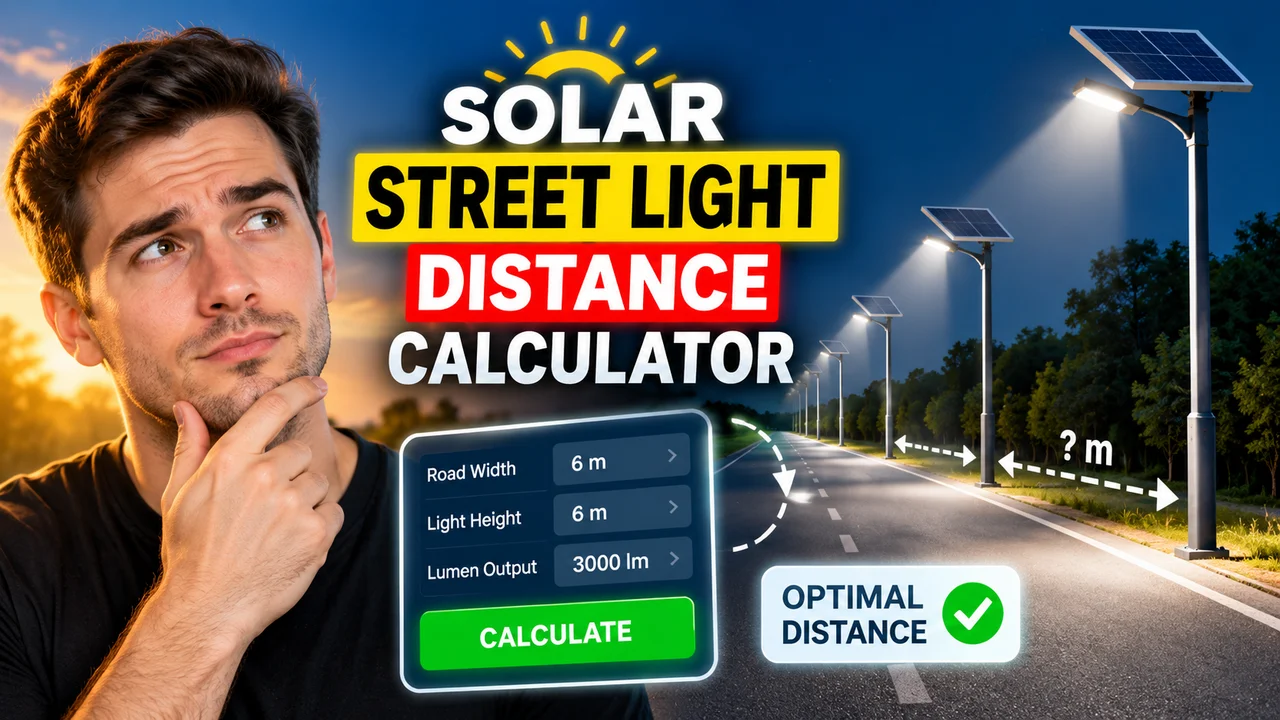
Solar Street Light Distance Calculator
A Solar Street Light Distance Calculator is an engineering planning calculator for estimating the distance between solar street light poles. It helps contractors, lighting designers, municipal planners, and property owners develop an initial pole-spacing layout based on mounting height and roadway requirements.
Quick answer: Solar street light pole spacing depends on mounting height, road width, luminaire light distribution, target illuminance, and pole arrangement. A spacing-to-height ratio can provide a preliminary estimate, but photometric verification is needed to establish suitable spacing for a real installation.
The Solar Street Light Distance Calculator is intended to help users understand the relationship between pole height and the distance between adjacent lights. Correct spacing helps distribute illumination along a road, pathway, parking area, or residential street while avoiding excessive gaps between illuminated areas.
Why Is Solar Street Light Distance Important?
Solar street lights operate independently of the electrical grid, but their physical placement must still provide appropriate nighttime visibility. If poles are too far apart, the road may contain dark patches. If poles are placed too close together, the project may require more poles, solar panels, batteries, foundations, and luminaires than necessary.
Spacing also affects the amount of light reaching the road between fixtures. The correct distance is not determined by LED wattage alone. Two lights with the same rated wattage can have different luminous output and beam distributions, so the actual fixture photometric data matters.
How to Use Solar Street Light Distance Calculator?
Use the calculator's available input fields to estimate an appropriate pole-to-pole distance. The exact inputs and outputs depend on the calculator's implemented controls.
- Identify the installation: Determine whether the lights will serve a narrow lane, residential road, pathway, parking area, or wider roadway.
- Determine mounting height: Measure the vertical distance from the road surface to the luminaire's mounting position.
- Consider the lighting arrangement: Identify whether poles are installed on one side, on alternating sides, or opposite one another.
- Review the calculated distance: Treat the result as a preliminary planning value and check it against the required lighting performance.
What Determines the Distance Between Solar Street Lights?
- Mounting height: Taller poles can distribute light over a larger area, but increasing height can also reduce illuminance at the road surface.
- Road width: Wider roads may require different pole positions, additional lighting rows, or luminaires with suitable optical distributions.
- Luminaire output: Delivered lumens and beam shape influence how much light reaches the area between adjacent poles.
- Illuminance requirement: The required light level depends on the road's use, classification, and applicable local requirements.
- Arrangement: Single-sided, staggered, and opposite-side layouts distribute light differently and cannot automatically use identical spacing.
- Maintenance allowance: Dirt accumulation, ageing, and other light-loss factors can reduce maintained illumination over time.
Solar Street Light Distance Formula
A simple preliminary method uses the spacing-to-mounting-height ratio:
Estimated pole spacing (S) = Mounting height (H) × Spacing ratio (R)
Where:
- S: Distance between adjacent poles, in metres or feet.
- H: Vertical luminaire mounting height above the illuminated surface, in the same unit.
- R: Selected spacing-to-height ratio, a dimensionless planning factor.
This relationship is a rule-of-thumb method, not a complete lighting-design equation. The appropriate ratio depends on the luminaire's photometric characteristics, road geometry, pole arrangement, and required illumination uniformity.
Worked Example: Estimate Pole Spacing
Suppose a preliminary layout uses a mounting height of 6 metres and a selected spacing ratio of 3.0.
Input values
- Mounting height: 6 m
- Illustrative spacing ratio: 3.0
Calculation
Spacing = 6 m × 3.0 = 18 m
Preliminary result: An estimated pole spacing of 18 metres.
This example demonstrates the formula only. It does not establish that 18 metres is suitable for every 6-metre solar street light. The selected spacing must be checked against the actual luminaire's light distribution and the project's lighting requirements.
Solar Street Light Pole Spacing Reference Table
The following examples show how the spacing-to-height formula behaves at different mounting heights. A ratio of 3.0 is used consistently to make the calculations easy to compare.
| Mounting Height | Spacing Ratio | Calculated Spacing | Application Note |
|---|---|---|---|
| 4 m | 3.0 | 12 m | Potential starting point for narrow paths or lanes |
| 5 m | 3.0 | 15 m | Preliminary residential-area layout |
| 6 m | 3.0 | 18 m | Preliminary community-road layout |
| 8 m | 3.0 | 24 m | Preliminary wider-road layout |
| 10 m | 3.0 | 30 m | Preliminary large-road layout |
Important: These are calculated examples, not universally approved spacing recommendations. Road width, lighting class, optical distribution, and required uniformity may require shorter distances or a different pole arrangement.
How Does Pole Spacing Affect Solar Street Lighting?
Pole spacing affects both the physical layout and the overall lighting system. For a fixed road length, increasing the spacing usually reduces the number of poles required. However, excessive spacing can create insufficient illumination between fixtures.
For an approximate straight-line layout, the number of pole intervals can be estimated by dividing the road length by the selected spacing and rounding up to a whole interval. If the road length is 180 metres and the selected spacing is 18 metres, the calculation gives 10 intervals. The actual pole count depends on whether poles are required at both endpoints and how the layout is arranged.
This distinction matters when preparing a bill of quantities. Pole intervals, pole count, and the number of luminaires are related but are not always identical, particularly for staggered or opposite-side installations.
Technical Limitations and Design Considerations
- Insufficient input data: Mounting height alone cannot determine the final suitable spacing for every installation.
- Different luminaire optics: Lights with different beam distributions may produce different illumination patterns at the same pole height and spacing.
- Road width and arrangement: A single-sided layout may not perform like a staggered or opposite-side layout.
- Units: Mounting height and spacing must use the same unit in the spacing-ratio formula.
- Lighting compliance: A distance estimate does not independently demonstrate compliance with a road-lighting standard.
- Solar-system sizing: Pole spacing does not determine battery capacity, solar panel rating, autonomy, or charging performance. Those require separate energy calculations.
For a detailed lighting design, use the manufacturer's photometric files and a suitable point-by-point lighting calculation. The Illuminating Engineering Society publishes roadway-lighting guidance in its official technical resources. In India, the applicable road-lighting requirements and project specifications should also be reviewed before finalizing a layout.
Technical Disclaimer: This calculator's spacing examples are for preliminary planning. Final pole positions should be verified using actual luminaire photometry, required illuminance and uniformity criteria, site geometry, and applicable local standards by a qualified lighting professional.
Frequently Asked Questions
What is the correct distance between solar street lights?
There is no single correct distance for every installation. Pole spacing depends on mounting height, road width, fixture output, beam distribution, pole arrangement, and the required lighting performance. Use a preliminary estimate and verify the proposed layout photometrically.
How do I calculate street light pole spacing?
For a preliminary estimate, multiply the luminaire mounting height by a selected spacing-to-height ratio. For example, a 6-metre mounting height multiplied by a ratio of 3.0 gives 18 metres. This estimate must be checked against actual lighting requirements.
Does higher mounting height always allow greater spacing?
No. Increasing mounting height changes the distribution of light and may reduce illuminance on the road surface. The fixture's optics, road width, and required uniformity determine whether a wider spacing remains appropriate.
Does LED wattage determine solar street light distance?
No. Wattage describes electrical power consumption, not the complete ground-level light distribution. Delivered lumens, optical design, mounting height, and lighting requirements are also important.
Can this spacing calculation guarantee road-lighting compliance?
No. A spacing-ratio calculation is a planning estimate. Compliance requires evaluation against the applicable road-lighting criteria, including illuminance and uniformity, using appropriate photometric data and the project's governing requirements.
Author Information
Author Name: Daniel Brooks
Author Description: Technical Writer specializing in outdoor lighting calculations and engineering documentation.
Technical Review: The spacing formula, unit consistency, worked example, and limitations should be reviewed by a qualified lighting professional before the content is used to specify a real installation.