
Solar System Payback Calculator For Non-Profits
Estimate solar payback for nonprofits using project costs, grants, and annual energy savings. Explore investment recovery and plan your solar project with care.
Please complete this field to continue.
Please complete this field to continue.
Please complete this field to continue.
Please complete this field to continue.
Please complete this field to continue.
Please complete this field to continue.
Results
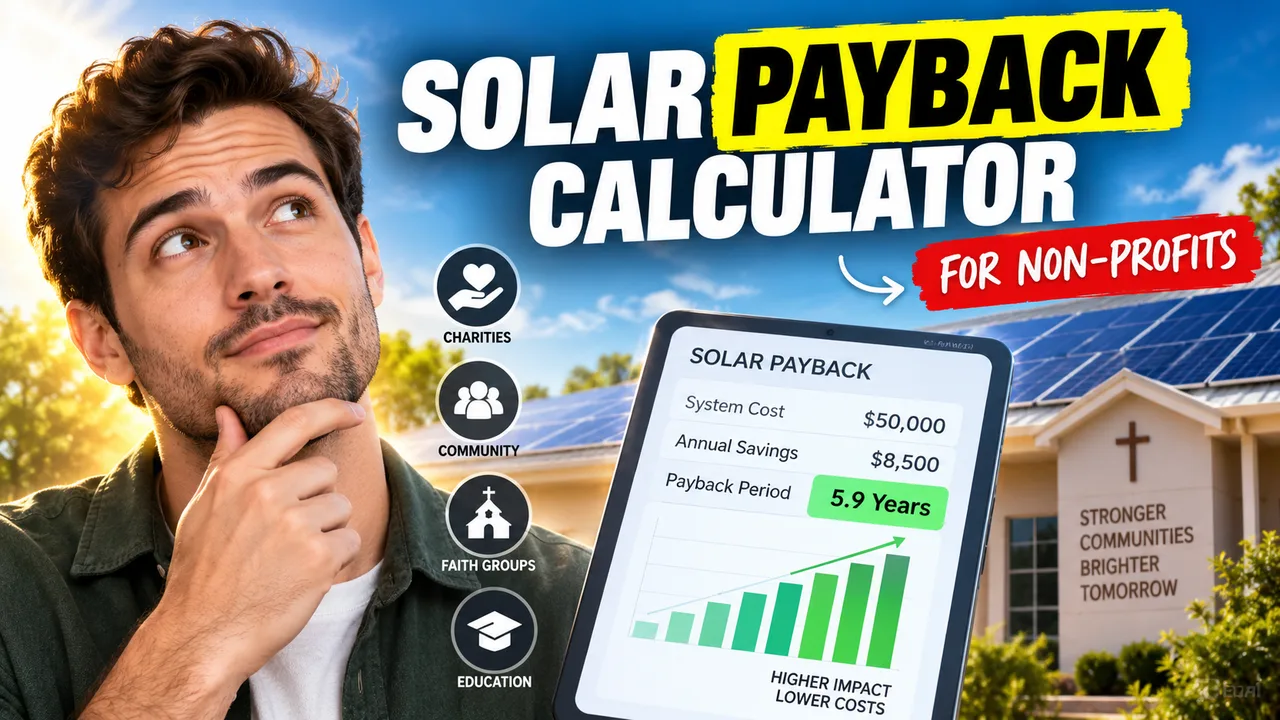
Solar System Payback Calculator For Non-Profits
Quick answer: The Solar System Payback Calculator For Non-Profits is a financial calculator concept designed to help nonprofit organizations estimate the payback period of a solar energy investment. It can be used to evaluate project costs, potential electricity-bill savings, available incentives, and the time required for accumulated savings to recover the initial investment. The exact calculation depends on the inputs and methodology implemented in the calculator.
Nonprofit organizations often operate under fixed budgets, donor funding, grants, and long-term facility expenses. Electricity costs can consume funds that would otherwise support community programs, education, healthcare, housing, and other charitable activities. A solar investment may reduce grid electricity purchases, but the financial benefit depends on the installation cost, electricity consumption, utility rates, solar production, and applicable incentives.
The Solar System Payback Calculator For Non-Profits is intended to support preliminary financial planning for these projects. It helps frame the central investment question: how long might a nonprofit need to operate a solar energy system before its cumulative financial benefits recover the initial investment?
Key Takeaways
- Primary purpose: Evaluate the financial payback of a solar installation for a nonprofit facility.
- Core metric: Estimated payback period, expressed in years or months.
- Important financial variables: Net installation cost, annual electricity savings, incentives, and ongoing expenses.
- Best suited for: Nonprofit financial managers, facility administrators, sustainability coordinators, and project planners.
- Important limitation: Actual results depend on the calculator's implemented formula, the quality of the inputs, local electricity tariffs, and project-specific conditions.
How to Use Solar System Payback Calculator For Non-Profits?
Use the calculator's available input fields to describe the proposed solar project. The following workflow is a general planning guide; the actual fields and controls depend on the implemented tool interface.
- Determine the project cost. Identify the quoted installed cost of the solar system, including panels, inverters, mounting equipment, electrical work, installation labor, and other applicable project expenses.
- Identify available incentives. Record confirmed grants, donations restricted to the project, rebates, or other eligible funding that reduces the organization's required investment. Do not assume that a nonprofit qualifies for a particular tax incentive.
- Estimate annual savings. Use the expected reduction in electricity bills rather than the solar system's total electricity production alone. Account for self-consumption, exported electricity compensation, utility charges, and applicable tariff structures where relevant.
- Review the payback result. Compare the estimated recovery period with the organization's funding horizon, equipment life, cash-flow requirements, and alternative uses of capital.
What Inputs Matter for a Nonprofit Solar Payback Estimate?
The reliability of a payback estimate depends on using consistent financial figures. A quotation may describe gross installation cost, while a funding proposal may refer to the amount remaining after grants. Likewise, projected energy savings may represent avoided electricity purchases rather than total utility-bill reductions. These values should not be treated as interchangeable.
| Input or factor | Meaning | Effect on payback |
|---|---|---|
| Gross installation cost | Total project cost before eligible funding deductions | Higher costs generally increase payback time. |
| Eligible grants and incentives | Confirmed funding that reduces the nonprofit's investment | Greater eligible funding generally shortens payback. |
| Net initial investment | Cost remaining after applicable upfront deductions | Forms the initial investment amount used in a simple payback calculation. |
| Annual electricity-bill savings | Expected yearly reduction in electricity expenses | Higher savings generally shorten payback. |
| Annual operating expenses | Recurring maintenance and other relevant system costs | Higher expenses reduce net annual financial benefits. |
| Electricity-price changes | Potential increases or decreases in future grid electricity prices | Can change future savings and cumulative cash flow. |
| Solar degradation | Gradual reduction in solar energy production over time | May reduce annual savings in later years. |
These are relevant project-planning variables, not a verified inventory of the calculator's current input fields. Use only the fields actually supported by the implemented calculator.
Solar Payback Formula and Methodology
A common preliminary approach is simple payback, which estimates how long the initial investment takes to recover through annual net financial savings.
Net Initial Investment
Net Initial Investment = Gross Installed Cost − Eligible Upfront Funding
Annual Net Savings
Annual Net Savings = Annual Electricity-Bill Savings − Annual Operating Costs
Simple Payback Period
Payback Period (years) = Net Initial Investment ÷ Annual Net Savings
This method assumes that annual net savings remain approximately constant. It does not automatically account for financing costs, changing electricity prices, solar degradation, replacement equipment, or the time value of money. These factors require a more detailed financial model.
Worked Example: A Nonprofit Community Center
Consider a hypothetical community center evaluating a rooftop solar installation. The figures below illustrate the simple payback calculation; they are not results from a verified execution of this calculator.
| Financial item | Example amount |
|---|---|
| Gross installed cost | $60,000 |
| Confirmed upfront grant | $15,000 |
| Net initial investment | $45,000 |
| Annual electricity-bill savings | $9,000 |
| Annual operating costs | $1,000 |
| Annual net savings | $8,000 |
Calculation:
Net Initial Investment = $60,000 − $15,000 = $45,000
Annual Net Savings = $9,000 − $1,000 = $8,000
Payback Period = $45,000 ÷ $8,000 = 5.625 years
Illustrative result: The initial investment would be recovered in approximately 5.63 years, or about 5 years and 7.5 months, assuming annual net savings remain constant.
How Should Nonprofits Interpret Solar Payback Results?
A shorter payback period can indicate a faster recovery of the initial investment, but it does not by itself establish that a project is the best financial choice. Nonprofits should consider the total cost over the system's expected operating life, cash-flow constraints, maintenance obligations, and the reliability of projected energy savings.
Simple payback also differs from return on investment (ROI), net present value (NPV), and internal rate of return (IRR). Payback measures the approximate recovery time. ROI compares financial gain with investment cost over a specified period. NPV discounts future cash flows to present value, while IRR estimates the discount rate at which project NPV equals zero.
Technical Reference: Payback Scenarios
| Scenario | Net investment | Annual net savings | Simple payback |
|---|---|---|---|
| Small nonprofit office | $20,000 | $4,000 | 5 years |
| Community center | $45,000 | $8,000 | 5.625 years |
| Large charitable facility | $100,000 | $12,500 | 8 years |
| Grant-supported installation | $30,000 | $7,500 | 4 years |
All amounts in this table are hypothetical illustrations calculated using net investment divided by annual net savings. They are not industry benchmarks or guaranteed project outcomes. Compare scenarios only when their cost and savings assumptions use consistent currencies, time periods, and accounting treatment.
Edge Cases and Limitations
- Zero annual net savings: If annual net savings equal zero, the simple payback formula cannot produce a finite recovery period.
- Negative annual net savings: If operating expenses exceed electricity savings, the project does not recover its initial investment through those annual net savings alone.
- Missing incentives: Do not subtract unapproved grants, unconfirmed rebates, or funding that the organization cannot use.
- Currency mismatches: Project costs, grants, savings, and expenses must be expressed in the same currency.
- Energy production versus savings: Solar generation in kilowatt-hours is not equivalent to financial savings. Electricity rates, export compensation, and self-consumption determine the monetary value.
- Financing: Loan interest, repayments, fees, and ownership arrangements can materially affect cash flow. A simple payback formula may omit them.
- Long-term changes: Electricity prices, equipment performance, maintenance expenses, and utility rules may change over the project's life.
The actual calculator's validation behavior, supported fields, rounding rules, and treatment of these cases must be confirmed against its implementation. Do not assume that a basic payback output incorporates discounted cash flows or long-term degradation.
Authoritative Solar Planning Resources
- U.S. Department of Energy: Homeowner's Guide to Going Solar — Background on evaluating solar installations, costs, and electricity-bill savings.
- National Renewable Energy Laboratory: Solar Energy Research — Technical research and resources relating to solar energy technologies and performance.
These resources provide general solar-planning context. They do not certify the calculator's formulas, confirm a nonprofit's eligibility for incentives, or replace a site-specific financial assessment.
Technical Disclaimer
This calculator's intended use is preliminary financial planning. Verify project costs, expected energy savings, utility compensation, grants, financing terms, and applicable tax rules before committing funds. Nonprofit eligibility for tax credits and other incentives depends on the jurisdiction and the specific program. Consult qualified solar professionals and financial or tax advisers for project-specific decisions.
Author Information
Author Name: Michael Anderson
Author Description: Renewable Energy Financial Analyst focused on solar project economics, energy cost modelling, and financial feasibility assessment.
Technical Review: The methodology described here uses a conventional simple-payback framework for preliminary solar investment evaluation. The calculator's actual implementation and validation behavior should be checked before its outputs are relied upon for financial decisions.