
Gram Force To Newton Converter - Accurate Force Units
Convert gram-force (gf) to newtons (N) using the standard gravity factor. Explore the formula, worked examples, and conversion table for accurate force calculations.
Please complete this field to continue.
Results
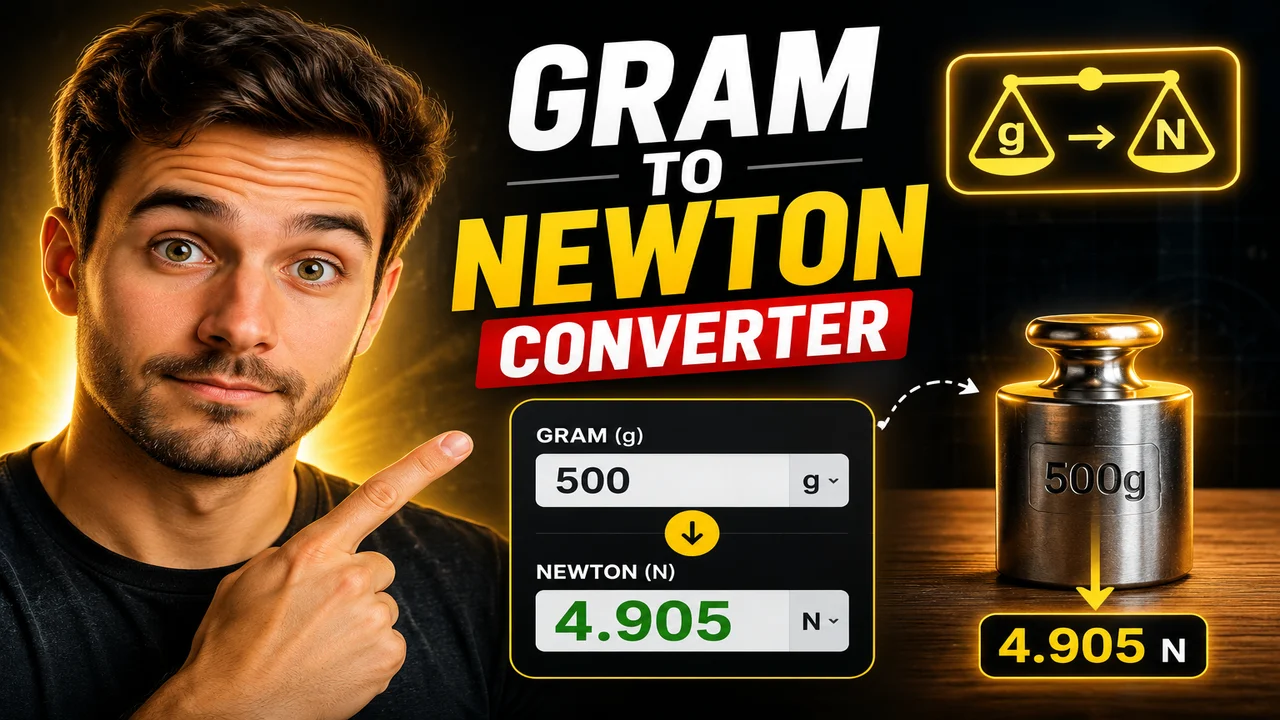
Gram Force To Newton Converter
Quick answer: The Gram Force To Newton Converter is a force-unit converter that converts gram-force (gf) values into newtons (N), the SI unit of force. It uses the standard gravity conversion factor of 9.80665 m/s² to calculate the equivalent force.
The Gram Force To Newton Converter helps students, engineers, technicians, and science enthusiasts translate small force measurements into the SI unit used in physics and engineering. Gram-force is a gravitational force unit, while the newton is the standard SI unit of force. Converting between them makes measurements easier to compare, document, and use in calculations.
TL;DR / Key Takeaways
- Primary function: Convert gram-force (gf) to newtons (N).
- Input: A numerical force value in gram-force.
- Output: The equivalent force in newtons.
- Conversion basis: Standard gravity of exactly 9.80665 m/s².
- Typical uses: Laboratory measurements, physics exercises, sensor specifications, and small-load calculations.
How to Use Gram Force To Newton Converter?
- Enter the gram-force value. Identify the force measurement you want to convert, such as 1 gf, 25 gf, or 500 gf.
- Check the input. Enter a numerical value representing force rather than mass in grams or kilograms. The distinction matters because grams measure mass and gram-force measures force.
- Run the conversion. Use the converter's available calculation control to obtain the equivalent force in newtons.
- Read the result. Interpret the result in N and retain sufficient decimal places for your application.
The supplied tool information identifies the converter's name but does not specify its exact interface controls, rounding settings, or export features. The steps above describe the standard conversion workflow without assuming additional functionality.
Input and Output Example
Suppose a small mechanical component applies a force of 250 gram-force. To express that force in newtons, multiply the input by the gram-force-to-newton conversion factor.
Input:
250 gf

Conversion factor:
1 gf = 0.00980665 N

Calculation:
250 × 0.00980665 = 2.4516625 N

Result:
2.4516625 N
Therefore, 250 gf corresponds to 2.4516625 N under the standard-gravity definition. If a report requires three significant figures, the result can be written as 2.45 N.
Gram Force to Newton Formula
The conversion formula is:
Force in newtons = Force in gram-force × 0.00980665
In symbols:
F(N) = F(gf) × 0.00980665
- F(N): Force expressed in newtons.
- F(gf): Input force expressed in gram-force.
- 0.00980665: Number of newtons equivalent to one gram-force under standard gravity.
One gram-force is the force exerted by a mass of one gram under standard acceleration due to gravity. Since one gram equals 0.001 kilogram and standard gravity is 9.80665 m/s², the relationship is:
1 gf = 0.001 kg × 9.80665 m/s² = 0.00980665 N
This follows the SI relationship between force, mass, and acceleration: F = m × a. The conversion factor is exact under the conventional definition of gram-force based on standard gravity.
Gram Force to Newton Conversion Table
Use this reference table to convert common gram-force values without recalculating each result. Values are based on the factor 1 gf = 0.00980665 N.
| Gram-force (gf) | Newtons (N) | Typical interpretation |
|---|---|---|
| 0.1 | 0.000980665 | Very small force |
| 0.5 | 0.004903325 | Fractional gram-force |
| 1 | 0.00980665 | One gram-force |
| 5 | 0.04903325 | Small test load |
| 10 | 0.0980665 | Small applied force |
| 25 | 0.24516625 | Component or sensor test |
| 50 | 0.4903325 | Small mechanical load |
| 100 | 0.980665 | Laboratory measurement |
| 250 | 2.4516625 | Measured component force |
| 500 | 4.903325 | Higher small-load measurement |
| 1000 | 9.80665 | One kilogram-force |
| 5000 | 49.03325 | Five kilogram-force |
The interpretations in the table are illustrative examples, not standardized application categories. The numerical conversions follow the stated factor.
How the Conversion Works
Gram-force and newton both describe force, but they are different units. The newton is defined in SI as the force required to accelerate one kilogram of mass at one metre per second squared. Gram-force is a non-SI gravitational unit tied to the conventional standard acceleration of gravity.
The converter applies a fixed multiplier to the input. For example, multiplying 10 gf by 0.00980665 produces 0.0980665 N. To reverse the conversion, divide the newton value by 0.00980665, or multiply it by approximately 101.9716213 to obtain gram-force.
For an authoritative reference, the NIST Guide to the SI conversion factors documents force-unit relationships, including the kilogram-force-to-newton conversion. NIST also explains the role of standard gravity in its guide to measuring gravity.
Edge Cases and Limitations
- Zero input: Zero gram-force converts to zero newtons.
- Fractional values: Decimal inputs such as 0.25 gf can be converted using the same multiplier.
- Negative values: A negative result can represent a signed force in a mathematical convention. Confirm that the application permits signed input.
- Very large values: The conversion factor remains the same, but numerical precision and display formatting may matter for extreme inputs.
- Mass versus force: A value in grams is a mass measurement. It should not be treated as gram-force unless the intended quantity is explicitly gravitational force under the conventional definition.
- Rounding: The exact calculated value may contain more decimal places than are useful for a report. Round only to the precision justified by the measurement and application.
- Local gravity: Gram-force is conventionally defined using standard gravity, not the exact local gravitational acceleration at every location.
The supplied information does not establish how this particular implementation handles empty input, non-numeric characters, overflow, or automatic rounding. Check the displayed result and the requirements of your measurement system when precision is important.
Technical Disclaimer
This converter is intended for unit conversion and educational reference. For calibration, regulated testing, or safety-critical engineering, verify the conversion factor, measurement uncertainty, instrument calibration, and applicable technical requirements independently.
Author and Technical Review
Author Name: Daniel Mercer
Author Description: Science and engineering technical writer focused on measurement units, applied physics, and technical reference content.
Technical Review: The conversion methodology is based on the conventional definition of gram-force and standard gravity. Users applying the result to laboratory or engineering work should account for instrument precision and measurement uncertainty.