
Hvac Thermostat Compatibility Checker Tool Online
Check HVAC thermostat compatibility by comparing system type, wiring, stages, heat-pump controls, and power requirements before choosing a thermostat.
Please complete this field to continue.
Please complete this field to continue.
Please complete this field to continue.
Please complete this field to continue.
Please complete this field to continue.
Please complete this field to continue.
Please complete this field to continue.
Please complete this field to continue.
Please complete this field to continue.
Please complete this field to continue.
Please complete this field to continue.
Please complete this field to continue.
Please complete this field to continue.
Please complete this field to continue.
Results
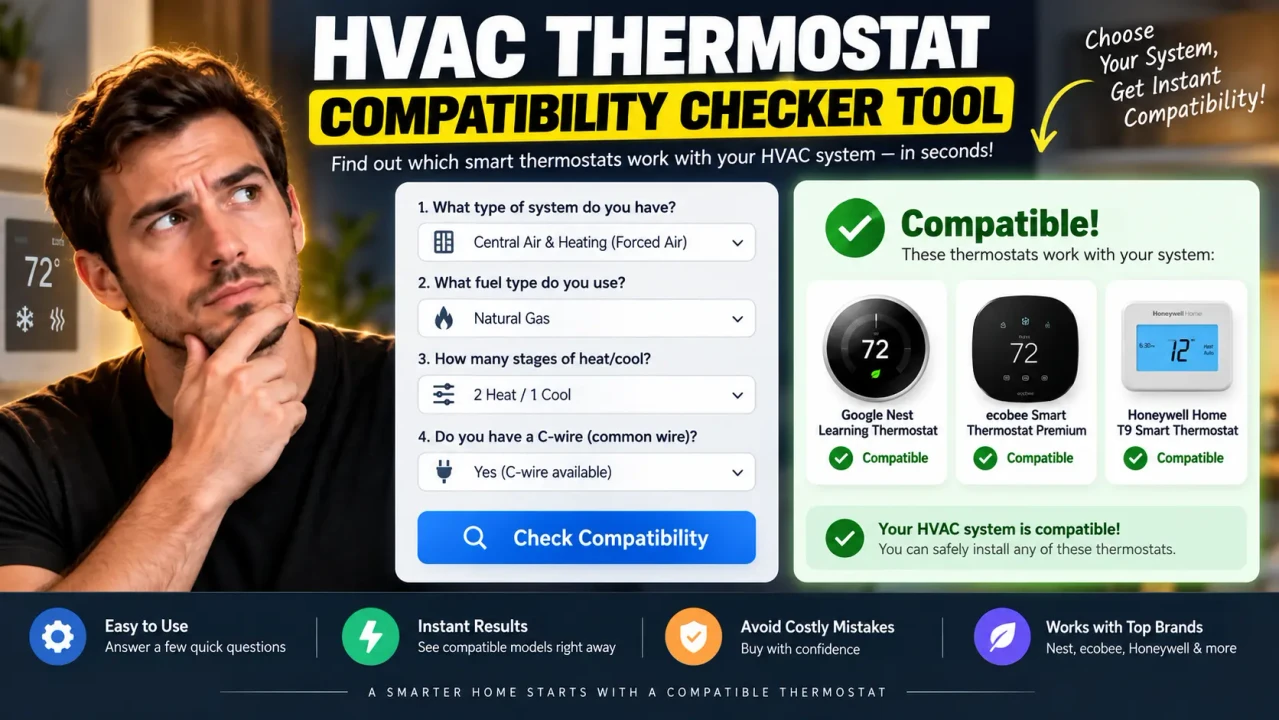
Hvac Thermostat Compatibility Checker Tool Online
Quick answer: The Hvac Thermostat Compatibility Checker Tool Online is a compatibility-checking utility designed to help determine whether a thermostat is suitable for an HVAC setup by comparing relevant system and thermostat characteristics.
Thermostat compatibility depends on more than the number of wires visible behind an existing thermostat. The HVAC equipment type, heating and cooling stages, heat-pump configuration, auxiliary or emergency heat, available terminals, control voltage, and thermostat requirements can all affect whether a replacement thermostat is appropriate. This checker is intended to organize those compatibility considerations into a practical online check.
TL;DR / Key Takeaways
- Primary Function: Check thermostat and HVAC compatibility.
- Key Inputs: HVAC system characteristics and thermostat compatibility information.
- Core Output: A compatibility assessment based on the information supplied.
- Best Suited For: Homeowners, installers, HVAC technicians, and buyers comparing thermostat options.
How to Use Hvac Thermostat Compatibility Checker Tool Online?
Start by identifying the HVAC equipment and the thermostat configuration you are trying to match. Where available, use the labels printed on the existing thermostat terminals rather than relying only on wire colors. Terminal labels can provide useful information about heating, cooling, fan, common, reversing-valve, and auxiliary-heat functions.
What should I check before replacing a thermostat?
First identify whether the system is conventional heating and cooling or a heat pump. Then check the number and labels of the connected terminals, the number of heating and cooling stages, and whether auxiliary or emergency heat is present. A C-wire can also matter for thermostats that require continuous power.
ENERGY STAR notes that smart-thermostat compatibility depends on the home's HVAC system and that most smart thermostats use low-voltage wiring. It also notes that a missing C-wire does not automatically rule out a smart thermostat, but it can affect which models work or whether an adapter is required.
Why do heat pumps require extra compatibility checks?
Heat pumps commonly use an O/B terminal to control the reversing valve, and systems can also have auxiliary or emergency heat. Manufacturer wiring documentation therefore needs to be considered when a heat-pump configuration is involved. Resideo documentation, for example, distinguishes heat-pump wiring from conventional heating applications and warns against using the W terminal incorrectly in supported heat-pump configurations.
Input and Output Example
A practical compatibility check might begin with information such as:
HVAC type: Heat pump
Heating stages: 2
Cooling stages: 1
Auxiliary heat: Yes
Visible thermostat terminals: R, C, Y, G, O/B, AUX
The tool can use those characteristics as compatibility inputs. The resulting assessment should be interpreted as a compatibility indication rather than a substitute for the thermostat manufacturer's installation instructions or a professional inspection when wiring is uncertain.
Technical Reference: Thermostat Terminal Functions
| Terminal | Typical Function | Compatibility Consideration |
|---|---|---|
| R | 24-volt power | Commonly associated with HVAC control power. |
| C | Common | Provides a continuous return path and is commonly required by powered smart thermostats. |
| G | Indoor fan | Used for fan control on many conventional systems. |
| Y | Cooling/compressor call | Used for compressor control; multi-stage systems may use additional Y terminals. |
| W | Heating call | Common on conventional heating systems, but heat-pump applications can use different terminals for auxiliary heat. |
| O/B | Heat-pump reversing valve | Important when evaluating heat-pump thermostat compatibility. |
| AUX/E | Auxiliary or emergency heat | Requires a thermostat that supports the relevant heat-pump heating configuration. |
Terminal names are not sufficient by themselves to guarantee compatibility. Manufacturers can use different terminal conventions, and the same letter can have different implications depending on the equipment configuration. Always compare the existing equipment wiring with the prospective thermostat's official wiring documentation.
How Thermostat Compatibility Is Determined
A compatibility assessment can be thought of as a series of matching checks rather than a single wire-count test:
- Equipment type: Determine whether the HVAC system is conventional, heat pump, or another supported configuration.
- Control requirements: Identify the heating, cooling, fan, reversing-valve, auxiliary-heat, and common connections that are relevant to the system.
- Stage count: Check whether the thermostat supports the required number of heating and cooling stages.
- Power requirements: Determine whether the thermostat requires a C-wire or another compatible power arrangement.
- Thermostat support: Compare those requirements against the thermostat's documented compatibility specifications.
This approach is particularly important for variable-speed, multi-stage, zoned, and heat-pump equipment. ENERGY STAR recommends checking compatibility before purchasing a smart thermostat and notes that some variable-speed, multi-stage, or zoned systems may require a thermostat designed to handle those configurations.
Edge Cases and Limitations
- No C-wire: A missing C-wire does not universally mean a thermostat is incompatible, but it can limit available thermostat choices or require an adapter.
- Heat pumps: Heat-pump systems need specific consideration of O/B and auxiliary or emergency heat connections.
- Multiple stages: A thermostat must support the number and type of heating and cooling stages required by the HVAC equipment.
- Line-voltage systems: Thick line-voltage wiring can indicate a system that is not suitable for a typical low-voltage smart thermostat.
- Unusual wiring: Legacy, proprietary, or differently labeled wiring should be checked against the equipment and thermostat manufacturer's documentation.
- Ambiguous wiring: Do not infer a connection solely from wire color. Terminal labels and manufacturer diagrams are more useful for compatibility decisions.
Technical limitation: A compatibility result depends on the information supplied to the checker and the compatibility rules represented by the tool. A positive indication should not be treated as authorization to connect unfamiliar HVAC wiring without verifying the manufacturer's installation documentation.
Technical Disclaimer: HVAC controls involve electrical equipment and equipment-specific control logic. Use the checker as a preliminary compatibility aid. When wiring, voltage, equipment configuration, or manufacturer requirements are uncertain, consult the thermostat and HVAC equipment documentation or a qualified HVAC professional.
Frequently Asked Questions
Does having a C-wire guarantee thermostat compatibility?
No. A C-wire addresses one power-related requirement, but compatibility can also depend on HVAC type, heating and cooling stages, heat-pump functions, auxiliary heat, and the thermostat's supported equipment configuration.
Can a thermostat work without a C-wire?
Some thermostats can operate without a dedicated C-wire, while others require continuous power. ENERGY STAR notes that the absence of a C-wire does not necessarily prevent smart-thermostat installation, although it can affect which models work or whether an adapter is needed.
Why is O/B important for a heat pump?
O/B is commonly used for the heat-pump reversing valve. The thermostat must support the appropriate reversing-valve configuration for the equipment, so heat-pump compatibility cannot be determined from conventional heating terminals alone.
Does the number of thermostat wires determine compatibility?
No. Wire count is only one factor. The functions assigned to the terminals, HVAC equipment type, number of stages, power requirements, and thermostat capabilities also matter.
Are smart thermostats compatible with every HVAC system?
No. Compatibility varies by HVAC design. ENERGY STAR identifies differences involving conventional systems, heat pumps, variable-speed equipment, multi-stage systems, zoned systems, line-voltage heating, and systems that require specialized controls.
Should I rely on wire colors when checking compatibility?
No. Wire colors can be useful clues, but terminal labels and the manufacturer's wiring diagram are more reliable for determining what each connection actually controls.
Author: Daniel Brooks, HVAC Controls Engineer
Technical Review: This page was technically reviewed from an HVAC-controls perspective with emphasis on thermostat terminal functions, heat-pump control considerations, C-wire requirements, and the limitations of compatibility checks.