
Grams To Teaspoons Yeast Converter For Baking Recipes
Convert yeast grams to teaspoons for baking with a clear formula and practical reference chart. Check active dry and instant yeast estimates before measuring.
Please complete this field to continue.
Please complete this field to continue.
Results
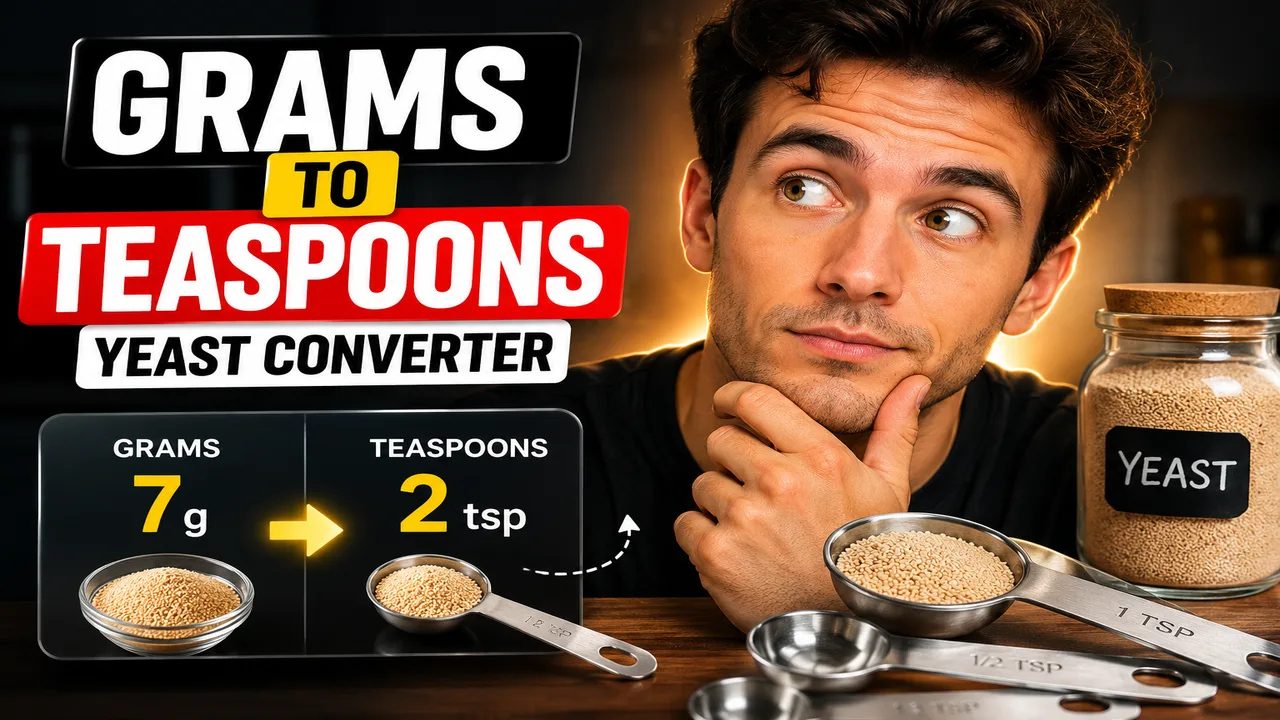
Grams To Teaspoons Yeast Converter
Quick answer: The Grams To Teaspoons Yeast Converter helps bakers convert a measured weight of yeast in grams into an approximate volume in teaspoons. The result depends on the yeast type and the grams-per-teaspoon value used for the calculation.
Yeast is commonly measured by weight in grams on recipe scales and packaging, while some baking recipes specify teaspoons. Converting between these units is useful when preparing bread, pizza dough, rolls, buns, and other yeast-raised recipes. Because grams measure mass and teaspoons measure volume, the conversion must use an ingredient-specific reference value rather than a universal grams-to-teaspoons formula.
The Grams To Teaspoons Yeast Converter is intended to make that calculation easier. Enter the amount of yeast in grams, use the appropriate yeast reference value, and interpret the result as an approximate number of level teaspoons. Since active dry yeast and instant yeast can differ in granule size and bulk density, identifying the type of yeast is important for a useful estimate.
Key Takeaways
- Input: Yeast quantity in grams.
- Output: Approximate teaspoon measurement.
- Method: Divide the gram amount by the selected grams-per-teaspoon value.
- Best suited for: Converting yeast quantities in bread and baking recipes.
- Accuracy: Use a kitchen scale for small or precision-critical quantities.
How to Use Grams To Teaspoons Yeast Converter?
- Identify the yeast type. Check whether the recipe uses active dry yeast or instant yeast. Do not assume that every yeast product has identical volume-to-weight characteristics.
- Enter the weight. Use the quantity shown in the recipe or measured on a kitchen scale, in grams.
- Apply the reference value. For an illustrative calculation, active dry yeast can be estimated at approximately 3.1 grams per level teaspoon and instant yeast at approximately 3.3 grams per level teaspoon. Use the reference value supported by the actual converter implementation.
- Read the result. The calculated teaspoon quantity is a practical estimate. Measure with a level spoon if using volume, or weigh the yeast directly when precision matters.
Input: A non-negative yeast weight expressed in grams. The exact input controls, supported decimal precision, and validation behavior depend on the deployed converter interface.
Output: A teaspoon equivalent calculated from the entered mass and the selected yeast reference. The result should be treated as approximate because the way granules settle into a spoon can affect the measured mass.
Grams to Teaspoons Yeast: Input and Output Example
Consider a recipe requiring 7 grams of active dry yeast. Using an illustrative reference value of 3.1 grams per level teaspoon, the conversion is:
Input:
Yeast type = Active dry yeast
Amount = 7 g
Reference = 3.1 g per teaspoon

Formula:
Teaspoons = Grams ÷ Grams per teaspoon

Calculation:
7 ÷ 3.1 = 2.258...

Approximate result:
2.26 teaspoons
About 2¼ teaspoons
This example demonstrates the calculation method rather than confirming the exact internal settings or rounding rules of the deployed tool. If a converter uses a different reference value, the displayed answer will differ accordingly.
Yeast Grams to Teaspoons Reference Table
The following table uses illustrative reference values of 3.1 g per teaspoon for active dry yeast and 3.3 g per teaspoon for instant yeast. Results are rounded to two decimal places. Use the values as a kitchen reference, not as a universal measurement standard for every brand.
| Yeast weight | Active dry yeast | Instant yeast |
|---|---|---|
| 1 g | 0.32 tsp | 0.30 tsp |
| 3 g | 0.97 tsp | 0.91 tsp |
| 5 g | 1.61 tsp | 1.52 tsp |
| 7 g | 2.26 tsp | 2.12 tsp |
| 10 g | 3.23 tsp | 3.03 tsp |
| 14 g | 4.52 tsp | 4.24 tsp |
| 20 g | 6.45 tsp | 6.06 tsp |
The values above are calculated using the stated assumptions. Other references may use different yeast densities, so the results can vary slightly. A package's stated weight remains more dependable than trying to infer the exact mass from a spoonful.
How Does the Yeast Conversion Formula Work?
The calculation is a simple mass-to-volume conversion:
Teaspoons = Grams ÷ Grams per teaspoon
- Grams: The mass of yeast specified by the recipe or entered into the converter.
- Grams per teaspoon: The assumed mass of one level teaspoon of the selected yeast type.
- Teaspoons: The calculated volume equivalent.
For example, 10 grams of active dry yeast divided by 3.1 grams per teaspoon gives approximately 3.23 teaspoons. For instant yeast, dividing 10 grams by 3.3 gives approximately 3.03 teaspoons. The difference comes from the reference weight used for each type.
To convert in the opposite direction, multiply the number of teaspoons by the chosen grams-per-teaspoon value. These formulas only convert measurement units; they do not calculate yeast substitution ratios or guarantee identical fermentation behavior when changing yeast types.
Why Yeast Type and Spoon Technique Matter
Active dry yeast generally has coarser granules than instant yeast. Granule size, how yeast settles, and whether the spoon is level or heaped can affect the mass held by a teaspoon. The difference is particularly relevant for small amounts, where a fraction of a gram can represent a noticeable proportion of the total ingredient.
A standard dry-yeast packet is often labelled as approximately 7 grams and commonly corresponds to about 2¼ teaspoons in recipe references. Treat this as a practical kitchen approximation: package size, product formulation, and measuring technique can affect the correspondence.
Edge Cases and Limitations
- Zero grams: The mathematical result is zero teaspoons.
- Decimal weights: Small quantities such as 0.5 g can be calculated, but their practical measurement depends on the precision of the scale and the converter.
- Negative values: Negative yeast quantities are not meaningful for ordinary baking and should not be used as recipe measurements.
- Different yeast types: Changing from active dry to instant yeast may change both the volume estimate and the recipe's substitution requirements.
- Heaped teaspoons: The reference values assume level teaspoons; heaped spoons are not directly comparable.
- Fresh yeast: Compressed fresh yeast has different physical properties. Do not apply a dry-yeast grams-per-teaspoon value to fresh yeast without an appropriate reference.
- Rounding: A displayed value such as 2.26 teaspoons is a calculated estimate, not necessarily a convenient spoon measurement. Rounding to ¼ teaspoon changes the quantity slightly.
The supplied tool name and image identify the converter, but do not establish its precise interface, validation rules, processing location, or internal conversion constants. Those implementation details should be documented only after checking the live tool. No claim about local processing, data storage, or privacy is made here.
Authoritative Baking References
For practical yeast measurements, compare the converter's assumptions with reputable baking guidance and the yeast manufacturer's package instructions. The following references provide additional context on yeast conversion and measurement:
- Baking Resources: Yeast Converter — a reference for comparing active dry, instant, and fresh yeast quantities.
- Grams of Yeast to Teaspoons Calculator — explains approximate grams-per-teaspoon values for active dry and instant yeast.
Technical Disclaimer: This converter provides an approximate kitchen measurement conversion, not a guarantee of equivalent fermentation strength. Follow the yeast manufacturer's instructions and use weight measurements when recipe precision is important.
Author Name: Daniel Brooks
Author Description: Food measurement and culinary reference writer focused on baking conversions, recipe scaling, and ingredient measurement methods.
Technical Review: The conversion formula, unit definitions, example calculations, and rounding assumptions should be checked against the deployed converter before publication. This content does not claim that the live implementation has been independently tested.