
Gram Calorie To Joule Calculator For Energy Conversion
Convert gram-calories (cal) to joules (J) with the Gram Calorie To Joule Calculator. Apply the 4.184 factor, review examples, and check energy conversions.
Please complete this field to continue.
Results
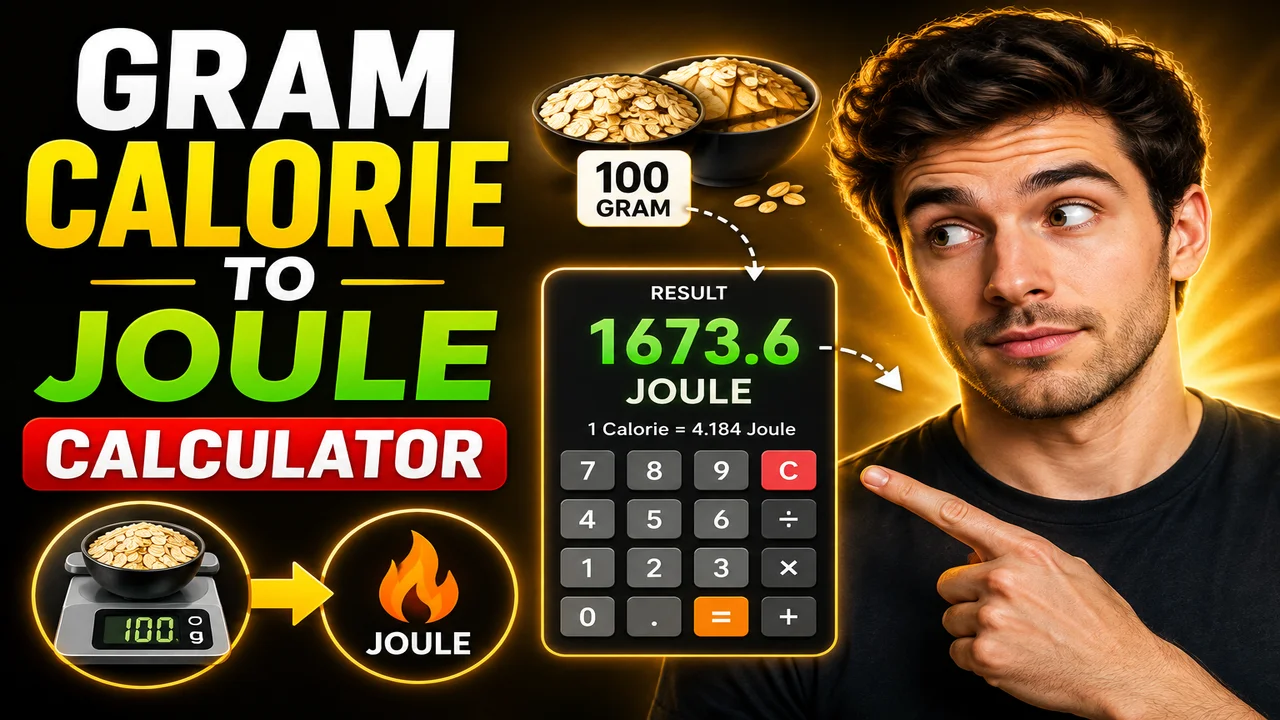
Gram Calorie To Joule Calculator
Quick answer: The Gram Calorie To Joule Calculator converts energy from gram-calories (cal) to joules (J). One gram-calorie, also called a small calorie, equals exactly 4.184 joules. Multiply the calorie value by 4.184 to calculate the equivalent energy in joules.
The Gram Calorie To Joule Calculator is an energy unit conversion calculator for students, teachers, science enthusiasts, and anyone working with measurements of heat or energy. It converts small calories into joules using the standard thermochemical relationship between these units.
A gram-calorie represents the small calorie unit, written as cal. It should not be confused with the dietary kilocalorie, written as kcal or often called a food Calorie with a capital C. Understanding this distinction helps prevent errors when converting nutritional energy, laboratory measurements, and physics calculations.
TL;DR / Key Takeaways
- Primary Function: Convert gram-calories (cal) into joules (J).
- Conversion Factor: 1 cal = 4.184 J.
- Input: An energy value expressed in gram-calories.
- Output: The equivalent energy value in joules.
- Best Suited For: Basic physics, heat calculations, chemistry exercises, and energy-unit reference.
How to Use Gram Calorie To Joule Calculator?
Use the calculator's input field to enter the energy quantity measured in gram-calories. Apply the conversion to obtain the equivalent value in joules. If the calculator provides a reset or clear control, use it before entering another value.
- Enter the calorie value: Type the numerical energy quantity in gram-calories (cal).
- Run the conversion: Use the calculator's conversion control, if provided.
- Read the result: Interpret the output as joules (J).
- Check the units: Confirm that the original input is in small calories, not dietary kilocalories.
What should I enter?
Enter a numerical quantity representing energy in gram-calories. For example, an input of 25 means 25 small calories, not 25 food Calories. The actual available input controls and validation behavior depend on the calculator implementation.
What does the output mean?
The output expresses the same energy quantity in joules. A joule is the SI unit of energy, work, and heat. The numerical value increases when converting gram-calories to joules because one small calorie corresponds to more than one joule.
Input and Output Example
Suppose a laboratory exercise specifies an energy quantity of 25 gram-calories. To express the same energy in joules, multiply 25 by the conversion factor 4.184.
Input:
Energy = 25 cal

Conversion factor:
1 cal = 4.184 J

Calculation:
25 × 4.184 = 104.6 J

Output:
104.6 joules (J)
The conversion changes the unit, not the amount of energy represented. The input and output describe the same physical quantity in different units.
Gram Calorie To Joule Conversion Formula
The conversion formula is:
Joules = Gram-calories × 4.184
In mathematical notation:
J = cal × 4.184
- J: Energy expressed in joules.
- cal: Energy expressed in gram-calories, or small calories.
- 4.184: The number of joules equivalent to one thermochemical calorie.
The conversion factor is exact for the thermochemical calorie, defined as 4.184 joules. Because multiplication by a constant is a linear conversion, doubling the calorie input doubles the joule output. Likewise, dividing the input by two divides the output by two.
Worked calculation
Convert 150 gram-calories into joules:
J = cal × 4.184
J = 150 × 4.184
J = 627.6 J
Therefore, 150 cal equals 627.6 J using the thermochemical calorie definition.
Gram Calorie To Joule Conversion Reference Table
Use the following reference values to check common conversions without calculating each value manually.
| Gram-calories (cal) | Calculation | Joules (J) |
|---|---|---|
| 0.1 | 0.1 × 4.184 | 0.4184 |
| 0.5 | 0.5 × 4.184 | 2.092 |
| 1 | 1 × 4.184 | 4.184 |
| 2 | 2 × 4.184 | 8.368 |
| 5 | 5 × 4.184 | 20.92 |
| 10 | 10 × 4.184 | 41.84 |
| 25 | 25 × 4.184 | 104.6 |
| 50 | 50 × 4.184 | 209.2 |
| 100 | 100 × 4.184 | 418.4 |
| 250 | 250 × 4.184 | 1,046 |
| 500 | 500 × 4.184 | 2,092 |
| 1,000 | 1,000 × 4.184 | 4,184 |
Understanding Gram-Calories, Joules, and Kilocalories
The gram-calorie and joule are units used to quantify energy. The gram-calorie is a non-SI energy unit, while the joule is the SI derived unit for energy and work. The conversion factor provides a consistent way to express a quantity in either unit.
The term calorie can be ambiguous because different calorie definitions exist. For ordinary introductory calculations, the thermochemical calorie is commonly represented by the relationship 1 cal = 4.184 J. Other historical calorie definitions can have slightly different conversion factors, so technical work should use the definition specified by the source or measurement standard.
Food energy introduces another important distinction. A dietary Calorie, capitalized as Calorie, generally represents one kilocalorie (kcal), equivalent to 1,000 small calories.
1 small calorie (cal) = 4.184 J
1 kilocalorie (kcal) = 1,000 cal
1 kilocalorie (kcal) = 4,184 J
For example, 10 kcal corresponds to 41,840 J, not 41.84 J. Check whether a source uses cal, kcal, or dietary Calories before entering a value.
How the Conversion Works
The calculator's mathematical basis is a fixed unit relationship. It takes an energy quantity in small calories and multiplies it by 4.184 to express the same energy in joules. No measurement of mass, temperature, or time is needed for this unit conversion because those variables are not part of the formula.
The conversion can also be reversed if needed:
Gram-calories = Joules ÷ 4.184
For example, 100 joules divided by 4.184 is approximately 23.9 cal. When reversing the calculation, the displayed result may be rounded depending on the required precision.
Technical Edge Cases and Limitations
| Input scenario | Mathematical handling | Practical note |
|---|---|---|
| Zero calories | 0 × 4.184 = 0 J | Zero energy remains zero. |
| Positive decimal | Multiply by 4.184 | Keep sufficient decimal places for the task. |
| Negative value | The formula produces a negative result. | Confirm that a signed energy quantity is meaningful in the intended context. |
| Very large value | Multiply by 4.184 | Check numeric precision and the calculator's accepted input range. |
| Blank or non-numeric input | No valid numerical conversion can be calculated. | Enter a valid numeric value; exact error handling depends on the implementation. |
| Dietary Calories | Convert kcal to cal first, or multiply kcal by 4,184. | Do not treat one dietary Calorie as one small calorie. |
The formula assumes that the input is measured in thermochemical gram-calories. The calculator should not be treated as a substitute for checking the unit definition used in a scientific dataset, laboratory procedure, or technical specification.
Rounding and significant figures
The factor 4.184 is exact for the thermochemical calorie definition, but a calculated result should still reflect the precision of the original measurement. If the input is 2.5 cal, the direct product is 10.46 J. Depending on the measurement's significant figures, a final report may need fewer digits.
Do not round intermediate values unnecessarily. Calculate using the full conversion factor, then round the final result to suit the precision required by the exercise or measurement.
Technical References
- NIST Special Publication 811: Guide for the Use of the International System of Units (SI) — guidance on SI units and unit conversions.
- NIST Reference on Constants, Units, and Uncertainty — reference material for measurement units and physical constants.
Technical Disclaimer: This calculator provides a unit conversion based on the stated calorie definition. For laboratory reporting, nutrition analysis, or engineering calculations, verify the original energy unit, its definition, and the required reporting precision before using the result.
Author: Daniel Mercer, Physics and Measurement Science Writer
Author Description: A technical content specialist focused on physics calculations, energy units, and scientific measurement education.
Technical Review: The conversion methodology is based on multiplying the input in thermochemical gram-calories by 4.184 joules per calorie. Confirm the implemented calculator's input validation, rounding behavior, and output formatting against its actual code before publication.