
Gram Molecular Volume Calculator Online - Gas Volume
Use the Gram Molecular Volume Calculator Online to calculate gas volume from moles, mass, molar mass, temperature, and pressure with clear formula guidance.
Please complete this field to continue.
Please complete this field to continue.
Please complete this field to continue.
Please complete this field to continue.
Results
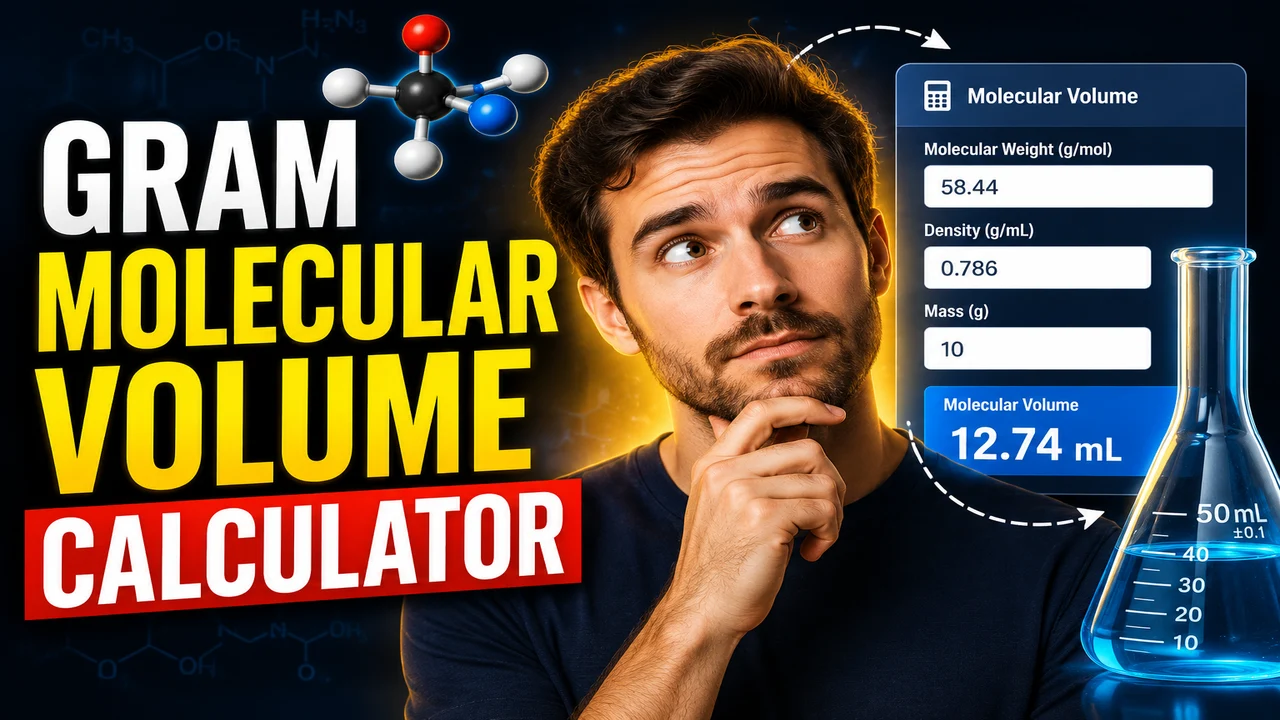
Gram Molecular Volume Calculator Online
Quick answer: The Gram Molecular Volume Calculator Online is a chemistry calculator intended to determine the volume occupied by a specified amount of a gas using its molar quantity and the applicable molar volume. For an ideal gas, volume can be calculated from the number of moles, temperature, and pressure using the ideal gas law. The correct result depends on the calculation method and the conditions supplied.
The Gram Molecular Volume Calculator Online is intended for chemistry students, teachers, laboratory learners, and science professionals who need to understand the relationship between the mass of a substance, its molar mass, the amount of substance in moles, and gas volume. Gram-molecular terminology is associated with one mole of a molecular substance. For gases, the volume occupied by one mole depends on temperature, pressure, and whether the gas behaves approximately ideally.
Because the exact input fields and calculation implementation of this particular calculator have not been provided, the formulas and examples below describe the standard chemistry methods relevant to gram-molecular volume. They should not be interpreted as a verified specification of the calculator's actual interface or supported options.
What Is Gram Molecular Volume?
Gram molecular volume commonly refers to the volume occupied by one gram-molecule, or one mole, of a gaseous substance at specified temperature and pressure. Unlike molar mass, which is expressed in grams per mole, molar volume is expressed in units such as litres per mole or cubic metres per mole.
For an ideal gas, one mole occupies approximately 22.414 litres at 0 °C and 1 atmosphere of pressure. At 25 °C and 1 atmosphere, the corresponding ideal-gas molar volume is approximately 24.466 litres per mole. These values differ because gas volume changes with temperature and pressure.
Key Takeaways
- Primary concept: The volume associated with one mole of a substance, particularly a gas.
- Mass relationship: Moles equal sample mass divided by molar mass.
- Gas relationship: Ideal-gas volume depends on moles, absolute temperature, and absolute pressure.
- Important distinction: A molar volume must be associated with specified conditions.
How to Use Gram Molecular Volume Calculator Online?
Use the calculator according to the input fields displayed on the actual page. If the calculator accepts mass and molar mass, the amount of substance can be calculated first. If it accepts gas quantity and molar volume, those values can be used to determine volume. If it requests temperature and pressure, use absolute temperature and absolute pressure in the ideal gas law.
- Identify the known quantities. Determine whether the problem gives mass, molar mass, number of moles, molar volume, temperature, or pressure.
- Check the units. Convert mass to grams when using molar mass in g/mol. Use kelvin for temperature and compatible pressure units for gas calculations.
- Enter the supported values. Supply the required values in the calculator's actual input fields. Do not assume that unlisted inputs are supported.
- Calculate and review. Check the numerical result, volume units, and gas conditions before using it in a chemistry problem.
Formula for Gram Molecular Volume
The appropriate formula depends on the known variables and the gas conditions. Three standard relationships are especially useful.
1. Volume from moles and molar volume
V = n × Vₘ
- V: Total gas volume, usually in litres.
- n: Amount of substance, in moles.
- Vₘ: Molar volume, in litres per mole.
Use this equation when the molar volume for the relevant conditions is known.
2. Moles from mass and molar mass
n = m / M
- n: Amount of substance, in moles.
- m: Sample mass, in grams.
- M: Molar mass, in grams per mole.
Combining the equations gives V = (m / M) × Vₘ. This method is appropriate when the sample mass, molar mass, and applicable molar volume are known.
3. Ideal gas law
PV = nRT
Rearranging for volume gives V = nRT / P.
- P: Absolute gas pressure.
- V: Gas volume.
- n: Amount of gas, in moles.
- R: Gas constant, chosen to match the units.
- T: Absolute temperature in kelvin.
When pressure is in atmospheres and volume is in litres, a suitable gas constant is approximately 0.082057 L·atm·mol⁻¹·K⁻¹. The ideal gas law is generally a useful approximation, but real gases can deviate from ideal behaviour, particularly at high pressure or low temperature.
Worked Example: Calculating Gas Volume
Suppose a chemistry problem contains 16.0 g of oxygen gas (O₂), with a molar mass of approximately 32.00 g/mol. Assume ideal-gas behaviour at 0 °C and 1 atm.
Step 1 — Calculate moles:
n = 16.0 g / 32.00 g/mol = 0.500 mol
Step 2 — Apply the molar volume:
V = 0.500 mol × 22.414 L/mol
Result: V ≈ 11.21 L
This is the expected ideal-gas volume under the stated conditions. It is an illustrative chemistry calculation, not a verified output from the specific online calculator.
Molar Volume Reference Table
| Gas conditions | Temperature | Pressure | Ideal molar volume |
|---|---|---|---|
| Traditional STP convention | 273.15 K (0 °C) | 1 atm | Approximately 22.414 L/mol |
| Room-temperature example | 298.15 K (25 °C) | 1 atm | Approximately 24.466 L/mol |
| SI standard-pressure example | 273.15 K (0 °C) | 100 kPa | Approximately 22.711 L/mol |
Why the conditions matter: STP conventions are not universal. Some textbooks use 1 atm, while modern standard-pressure definitions may use 100 kPa. Always match the reference molar volume to the temperature and pressure stated in the question.
Common Chemistry Examples
| Substance | Molar mass | Amount in a 1 g sample | Approximate ideal volume at 0 °C and 1 atm |
|---|---|---|---|
| Hydrogen (H₂) | 2.016 g/mol | 0.4960 mol | 11.12 L |
| Nitrogen (N₂) | 28.014 g/mol | 0.03570 mol | 0.8004 L |
| Oxygen (O₂) | 31.998 g/mol | 0.03125 mol | 0.7005 L |
| Carbon dioxide (CO₂) | 44.01 g/mol | 0.02272 mol | 0.5099 L |
These figures illustrate how equal masses of different gases occupy different volumes because their molar masses differ. Values are approximate and assume ideal-gas behaviour at the stated conditions.
Edge Cases and Limitations
- Zero mass: A zero-mass sample corresponds to zero moles and zero ideal-gas volume under the model.
- Negative mass or pressure: Negative physical sample mass and negative absolute pressure are not valid inputs for an ordinary gas-volume calculation.
- Zero molar mass: Dividing by a zero molar mass is undefined. A chemically meaningful molar mass must be supplied.
- Temperature conversion: Convert Celsius to kelvin using
T(K) = T(°C) + 273.15. Do not insert Celsius directly into the ideal gas law. - Unit mismatch: The pressure, gas constant, and volume units must be compatible. Mixing pascals with a gas constant expressed in L·atm units produces an incorrect result unless units are converted.
- Real gases: The ideal gas law may be insufficient when intermolecular interactions or high-pressure effects are significant.
- Missing conditions: A unique gas volume cannot be determined from the number of moles alone unless the molar volume or the required temperature and pressure conditions are also known.
Authoritative Chemistry References
- IUPAC Compendium of Chemical Terminology (Gold Book) — authoritative terminology for chemical quantities and concepts.
- NIST Fundamental Physical Constants — reference values for physical constants, including the gas constant.
Technical Disclaimer: These formulas describe standard ideal-gas calculations. Verify the calculator's actual inputs, units, and output conventions before relying on its results for laboratory work or engineering decisions. Use an appropriate real-gas model when ideal-gas assumptions are inadequate.
Author: Daniel Mercer
Author Description: Chemistry educator and science-content specialist with a focus on chemical calculations, dimensional analysis, and introductory physical chemistry.
Technical Review: The equations, unit relationships, and illustrative gas-volume calculations in this explanatory content are presented using standard ideal-gas methodology. The specific calculator implementation has not been independently verified.