
Gram Equivalent Weight Calculator Online - Chemistry
Calculate gram equivalent weight from molar mass and n-factor. Understand the formula, reaction-specific values, and chemistry applications. Try the calculator.
Please complete this field to continue.
Please complete this field to continue.
Results
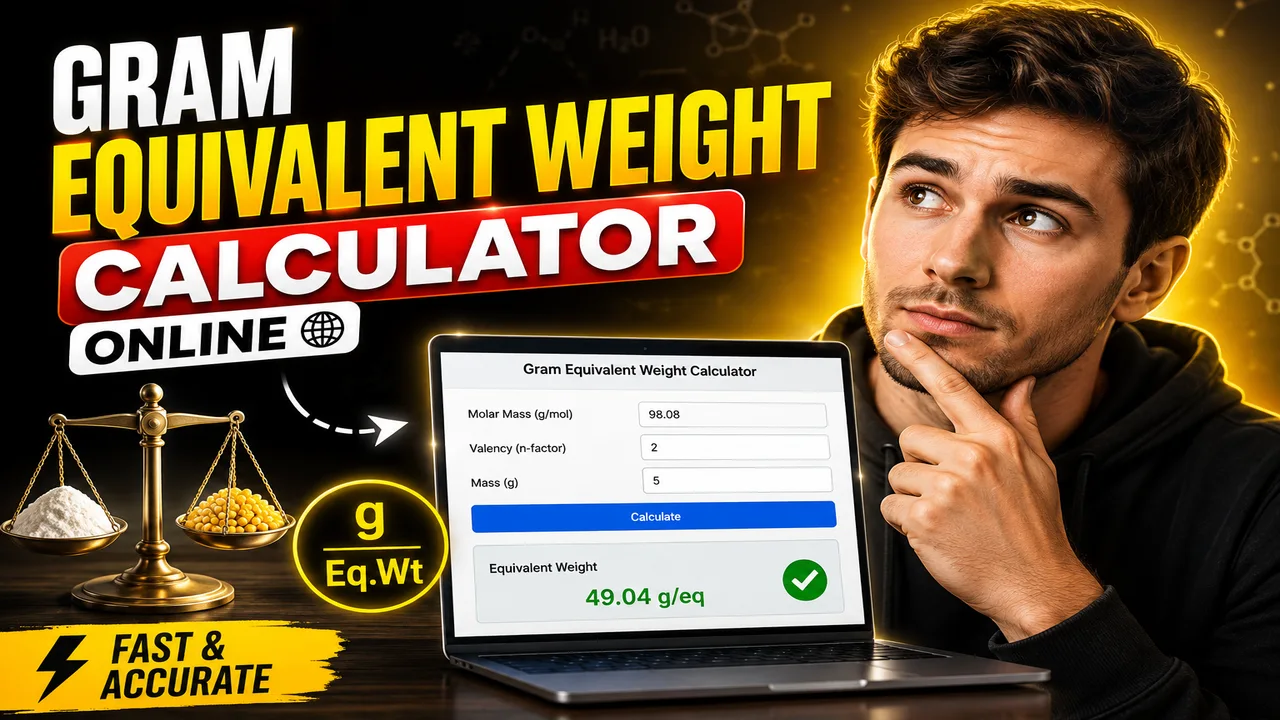
Gram Equivalent Weight Calculator Online
Quick answer: The Gram Equivalent Weight Calculator Online is a chemistry calculator for determining the equivalent weight of a substance in grams per equivalent. The calculation depends on the substance's molar mass and its n-factor, which varies with the chemical reaction or process.
The Gram Equivalent Weight Calculator Online helps students, chemistry educators, laboratory learners, and researchers calculate equivalent weight using molecular or molar mass and an appropriate equivalence factor. Equivalent weight is useful in acid-base chemistry, redox reactions, precipitation reactions, and quantitative analytical chemistry.
Equivalent weight is not always a fixed property of a chemical formula. For many substances, it depends on how the substance reacts. An acid's n-factor may reflect the number of ionizable protons participating in a particular reaction, while a redox substance's n-factor reflects the number of electrons transferred per formula unit.
Key Takeaways
- Primary function: Calculate equivalent weight from molar mass and n-factor.
- Required values: Molar mass in g/mol and a valid, reaction-specific n-factor.
- Expected result: Equivalent weight in g/eq.
- Typical applications: Normality calculations, titration preparation, acid-base reactions, and redox stoichiometry.
How to Use Gram Equivalent Weight Calculator Online?
- Enter the molar mass. Provide the substance's molar mass in grams per mole (g/mol), using a reliable chemical reference or a calculation based on its formula.
- Enter the n-factor. Supply the number of reactive equivalents per mole for the specific reaction. Do not assume that every compound has the same n-factor in every reaction.
- Calculate equivalent weight. Apply the formula by dividing molar mass by n-factor.
- Review the result. Read the calculated value in grams per equivalent (g/eq) and verify that the inputs match the intended chemical process.
The actual input fields and available options depend on the calculator implementation. If the page provides additional substance-selection or unit options, use them according to their displayed labels rather than assuming they are supported.
Formula for Gram Equivalent Weight
The standard relationship between equivalent weight, molar mass, and n-factor is:
Equivalent weight = Molar mass ÷ n-factor
In symbols:
E = M / n
- E = equivalent weight, expressed in g/eq.
- M = molar mass, expressed in g/mol.
- n = number of equivalents per mole for the specified reaction; it is a positive, dimensionless value.
Dimensional analysis gives (g/mol) ÷ (eq/mol) = g/eq. In this relationship, n represents the number of equivalents per mole, so its chemical meaning must be established before performing the calculation.
Worked Example: Sulfuric Acid in Complete Acid-Base Neutralization
For complete neutralization, one mole of sulfuric acid (H2SO4) can supply two moles of hydrogen ions. Using a molar mass of approximately 98.08 g/mol and an n-factor of 2:
- Molar mass = 98.08 g/mol
- n-factor = 2
- Calculation = 98.08 ÷ 2
- Equivalent weight = 49.04 g/eq
This result applies to complete neutralization. If a reaction uses only one acidic proton per molecule, the appropriate n-factor may be different, and the equivalent weight must be recalculated for that reaction.
Equivalent Weight Reference Table
The following examples illustrate how the formula works when the stated n-factor is appropriate for the reaction. Approximate molar masses are shown for educational use.
| Substance and reaction context | Approximate molar mass (g/mol) | n-factor | Equivalent weight (g/eq) |
|---|---|---|---|
| HCl, complete acid-base neutralization | 36.46 | 1 | 36.46 |
| H2SO4, complete acid-base neutralization | 98.08 | 2 | 49.04 |
| NaOH, complete neutralization of one hydroxide | 40.00 | 1 | 40.00 |
| Ca(OH)2, complete neutralization of two hydroxides | 74.09 | 2 | 37.05 |
| Na2CO3, complete acidification to carbonic acid / carbon dioxide and water | 105.99 | 2 | 53.00 |
| KMnO4, reduction to Mn2+ in acidic solution | 158.03 | 5 | 31.61 |
Important: The table is a chemistry reference, not a claim that the calculator automatically identifies these substances or selects their n-factors. The user must use a factor appropriate to the specified reaction unless the tool explicitly provides verified automatic selection.
How Does Equivalent Weight Differ from Molar Mass?
Molar mass describes the mass of one mole of a substance. Equivalent weight describes the mass corresponding to one equivalent in a specified reaction. Molar mass is generally determined by chemical composition, whereas equivalent weight can change with the reaction because the n-factor can change.
| Property | Molar mass | Equivalent weight |
|---|---|---|
| Meaning | Mass of one mole | Mass corresponding to one equivalent |
| Typical unit | g/mol | g/eq |
| Calculation | Sum of atomic molar masses in the formula | Molar mass divided by n-factor |
| Reaction-dependent | Usually no | Yes, when the n-factor varies by reaction |
Applications of Gram Equivalent Weight
- Acid-base titration: Calculate the mass corresponding to one acid-base equivalent for the specified neutralization reaction.
- Redox chemistry: Determine equivalent weight from the electrons transferred per formula unit in the balanced redox reaction.
- Normality: Relate solution concentration in equivalents per litre to mass concentration when the reaction and equivalent definition are established.
- Laboratory preparation: Estimate the mass needed for a target number of equivalents, provided purity, hydration state, and reaction stoichiometry are accounted for.
How the Calculation Works
The calculation has two main steps: establish the molar mass and determine the correct n-factor. The calculator then divides the first quantity by the second. It cannot produce a chemically meaningful result from the numerical inputs alone if the n-factor is inappropriate for the reaction.
For example, in a redox reaction, the n-factor is determined from the electron balance for the species being considered. In acid-base chemistry, it depends on the number of protons donated or accepted in the reaction. In precipitation reactions, it may depend on the ionic charge and the stoichiometry of the reaction.
Edge Cases and Limitations
- Zero n-factor: Division by zero is undefined. A zero n-factor is not valid for this calculation.
- Negative inputs: Molar mass and n-factor should be positive for the standard calculation. Negative values usually indicate an input or interpretation error.
- Wrong n-factor: The arithmetic can be correct even when the chemical result is wrong. Always verify the reaction context.
- Hydrates and salts: Include the full formula and appropriate molar mass, including waters of crystallization where present.
- Purity and commercial reagents: The basic formula calculates theoretical equivalent weight for the specified substance; it does not independently correct for impurities or assay percentage.
- Rounding: Keep sufficient significant figures in the molar mass and n-factor calculation, then round the displayed answer to match the precision of the inputs.
- Unknown implementation details: Automatic chemical lookup, unit conversion, downloadable reports, input validation, and processing location should not be assumed unless the live calculator explicitly documents those features.
Technical Disclaimer: Equivalent weight depends on the chemical reaction and the definition of an equivalent used. Verify the balanced reaction, molar mass, reagent purity, and preparation requirements before using a calculated value for laboratory work.
Frequently Asked Questions
1. What is the formula for gram equivalent weight?
Gram equivalent weight equals molar mass in g/mol divided by the reaction-specific n-factor. The resulting unit is g/eq.
2. How do I find the n-factor of a compound?
Determine the n-factor from the balanced reaction. For acids, consider the protons participating in the reaction; for redox species, count the electrons transferred per formula unit.
3. Can equivalent weight change for the same chemical?
Yes. If a substance participates in different reactions with different equivalent factors, its equivalent weight can differ between those reactions.
4. What is the equivalent weight of sulfuric acid?
For complete neutralization, sulfuric acid has an approximate molar mass of 98.08 g/mol and an n-factor of 2, giving an equivalent weight of 49.04 g/eq.
5. Is equivalent weight the same as molar mass?
No. Molar mass is expressed in g/mol, while equivalent weight is expressed in g/eq and depends on the applicable n-factor.
6. Can I use equivalent weight to calculate normality?
Yes. When the reaction-specific equivalent definition is established, normality in eq/L equals molarity in mol/L multiplied by the n-factor. For a mass concentration in g/L, divide by equivalent weight in g/eq to obtain eq/L.
Author Information
Author Name: Daniel Mercer
Author Description: Chemistry and laboratory calculations educator focused on stoichiometry, analytical chemistry, and quantitative problem-solving.
Technical Review: The formula, units, reaction-specific n-factor interpretation, and worked examples should be checked against the balanced reaction and authoritative chemistry references before laboratory use.