
Grams To Moles Nacl Calculator - Nacl Conversion Tool
Grams To Moles Nacl Calculator converts sodium chloride mass in grams to moles using 58.44 g/mol. Enter a value to simplify chemistry and stoichiometry calculations.
Please complete this field to continue.
Results
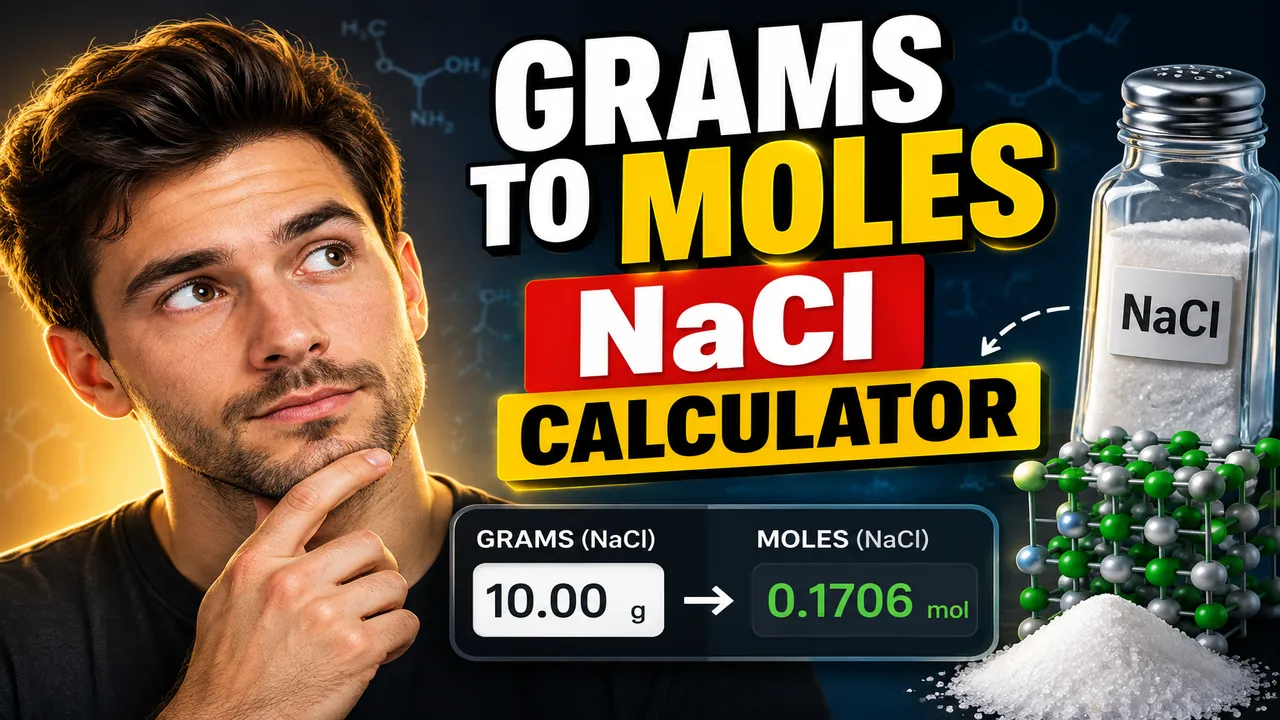
Grams To Moles Nacl Calculator
Quick answer: The Grams To Moles Nacl Calculator converts a given mass of sodium chloride (NaCl), measured in grams, into moles using its molar mass of approximately 58.44 g/mol. It is useful for chemistry homework, laboratory calculations, solution preparation, and stoichiometry problems.
The Grams To Moles Nacl Calculator helps users determine the amount of sodium chloride represented by a measured mass. Instead of manually dividing grams by molar mass, users can use the calculator to work out the corresponding quantity in moles. This conversion is fundamental to chemical calculations because laboratory measurements are often recorded in grams, while chemical equations use amounts of substances expressed in moles.
Sodium chloride, commonly known as table salt, has the chemical formula NaCl. Each formula unit contains one sodium atom and one chlorine atom. Its molar mass is approximately 58.44 grams per mole, calculated by adding the standard atomic masses of sodium and chlorine. Using this value, a measured mass of NaCl can be converted into an amount of substance.
What Does the Calculator Calculate?
The calculator uses the mass of sodium chloride as its input and calculates the corresponding number of moles. The result represents the amount of NaCl in the sample, assuming the specified mass refers to sodium chloride itself.
- Input: Mass of sodium chloride in grams (g).
- Conversion factor: Approximately 58.44 grams per mole (g/mol).
- Output: Amount of sodium chloride in moles (mol).
- Primary uses: Stoichiometry, chemistry exercises, reagent calculations, and introductory laboratory work.
How to Use Grams To Moles Nacl Calculator?
- Determine the mass of sodium chloride in grams.
- Enter the measured mass into the calculator's input field.
- Run the calculation using the available calculator control.
- Read the resulting amount in moles and review the calculation if needed.
Enter the mass in grams rather than milligrams or kilograms unless the calculator explicitly supports other units. If the original measurement uses another unit, convert it to grams before applying the formula. For a solid NaCl sample, the mass should represent the sodium chloride portion, not the total mass of a mixture or solution containing salt.
Grams to Moles NaCl Formula
The standard formula for converting the mass of sodium chloride to moles is:
Moles of NaCl = Mass of NaCl (g) ÷ Molar Mass of NaCl (g/mol)
Using the approximate molar mass of 58.44 g/mol:
n(NaCl) = m(NaCl) ÷ 58.44
- n(NaCl): Amount of sodium chloride, measured in moles (mol).
- m(NaCl): Mass of sodium chloride, measured in grams (g).
- 58.44 g/mol: Approximate molar mass of sodium chloride.
The units cancel correctly: dividing grams by grams per mole produces moles. The conversion is linear, so doubling the mass of pure NaCl doubles the calculated number of moles. Likewise, half the mass produces half the number of moles.
Grams to Moles NaCl: Worked Examples
Example 1: Convert 58.44 Grams of NaCl to Moles
Input: 58.44 g NaCl
Calculation: 58.44 g ÷ 58.44 g/mol = 1 mol
Result: 1 mole of NaCl.
Example 2: Convert 10 Grams of NaCl to Moles
Input: 10 g NaCl
Calculation: 10 ÷ 58.44 ≈ 0.1711 mol
Result: Approximately 0.1711 mol of NaCl.
Example 3: Convert 25 Grams of NaCl to Moles
Input: 25 g NaCl
Calculation: 25 ÷ 58.44 ≈ 0.4278 mol
Result: Approximately 0.4278 mol of NaCl.
NaCl Grams-to-Moles Reference Table
The following reference values use a molar mass of 58.44 g/mol. Results are rounded to four decimal places where appropriate.
| NaCl Mass (g) | Calculation | Amount (mol) |
|---|---|---|
| 1 | 1 ÷ 58.44 | 0.0171 |
| 5 | 5 ÷ 58.44 | 0.0856 |
| 10 | 10 ÷ 58.44 | 0.1711 |
| 25 | 25 ÷ 58.44 | 0.4278 |
| 50 | 50 ÷ 58.44 | 0.8556 |
| 58.44 | 58.44 ÷ 58.44 | 1.0000 |
| 100 | 100 ÷ 58.44 | 1.7112 |
How the NaCl Conversion Works
A mole is the SI unit for amount of substance. One mole contains exactly 6.02214076 × 10²³ specified elementary entities. For sodium chloride, those entities are formula units rather than individual molecules, because solid NaCl forms an ionic crystal lattice.
The molar mass connects a measurable mass to an amount of substance. Sodium contributes approximately 22.99 g/mol, while chlorine contributes approximately 35.45 g/mol. Adding these values gives an approximate NaCl molar mass of 58.44 g/mol.
For example, a sample containing 117 g of pure NaCl corresponds to approximately 2.00 mol because 117 ÷ 58.44 is approximately 2.00. The result is an amount of substance; it is not a concentration. To calculate molarity, the amount in moles must also be related to the solution volume in liters.
Important Input Conditions and Limitations
- Zero grams: A mass of zero corresponds to zero moles.
- Negative mass: Negative values do not represent a physically meaningful sample mass and should not be used for ordinary laboratory calculations.
- Non-numeric input: Text, missing values, and malformed numbers cannot be evaluated by the formula and should be corrected before calculation.
- Unit mismatch: The formula expects grams. Convert milligrams to grams by dividing by 1,000, or kilograms to grams by multiplying by 1,000.
- Impure samples: If the measured mass includes other substances, the formula returns the NaCl-equivalent amount only when the input is the actual mass of NaCl, not the total mixture mass.
- Rounding: Keep additional digits during intermediate calculations and round the final result according to the precision of the original measurement.
- Different chemical compounds: Do not use the NaCl molar mass for other salts or chemicals. Each compound requires its own molar mass.
The calculation assumes that the supplied mass is the mass of sodium chloride and uses a molar mass of approximately 58.44 g/mol. It does not independently determine sample purity, water content, or the composition of a mixture. For analytical laboratory work, use an appropriate molar mass convention and measurement precision for the application.
Scientific References
- IUPAC Periodic Table of Elements — reference information for the elements used to calculate molar mass.
- NIST: SI Units for Amount of Substance — background on the mole as an SI unit.
Frequently Asked Questions
How many moles are in 1 gram of NaCl?
One gram of sodium chloride corresponds to approximately 0.01711 mol, calculated as 1 ÷ 58.44.
What molar mass should I use for NaCl?
Use approximately 58.44 g/mol for routine calculations. This value is the sum of the atomic masses of sodium and chlorine at commonly used precision.
Can I convert milligrams of NaCl directly to moles?
Convert milligrams to grams first. For example, 500 mg equals 0.500 g, which corresponds to approximately 0.00856 mol of NaCl.
Does this calculator calculate molarity?
No. It calculates the amount of NaCl in moles from its mass. Molarity additionally requires the volume of the solution in liters and is calculated as moles divided by liters.
Can I use this formula for salt mixtures?
Only if the input mass is the actual mass of NaCl in the sample. If a mixture contains other salts or impurities, its total mass alone does not establish the amount of NaCl.
How should I round the answer?
Retain sufficient digits during the calculation, then round the result based on the significant figures and uncertainty of the measured mass.
Author: Dr. Michael Anderson, Chemist specializing in analytical chemistry and quantitative laboratory calculations.
Technical Review: The conversion method is based on the standard mass-to-amount relationship using the approximate molar mass of sodium chloride. Verify the input unit, sample composition, and measurement precision before using the result in laboratory work.