
Mg To Gram Converter For Liquid Medication
Convert milligrams to grams with the Mg To Gram Converter For Liquid Medication. Check mass equivalents and understand when concentration data is needed.
Please complete this field to continue.
Results
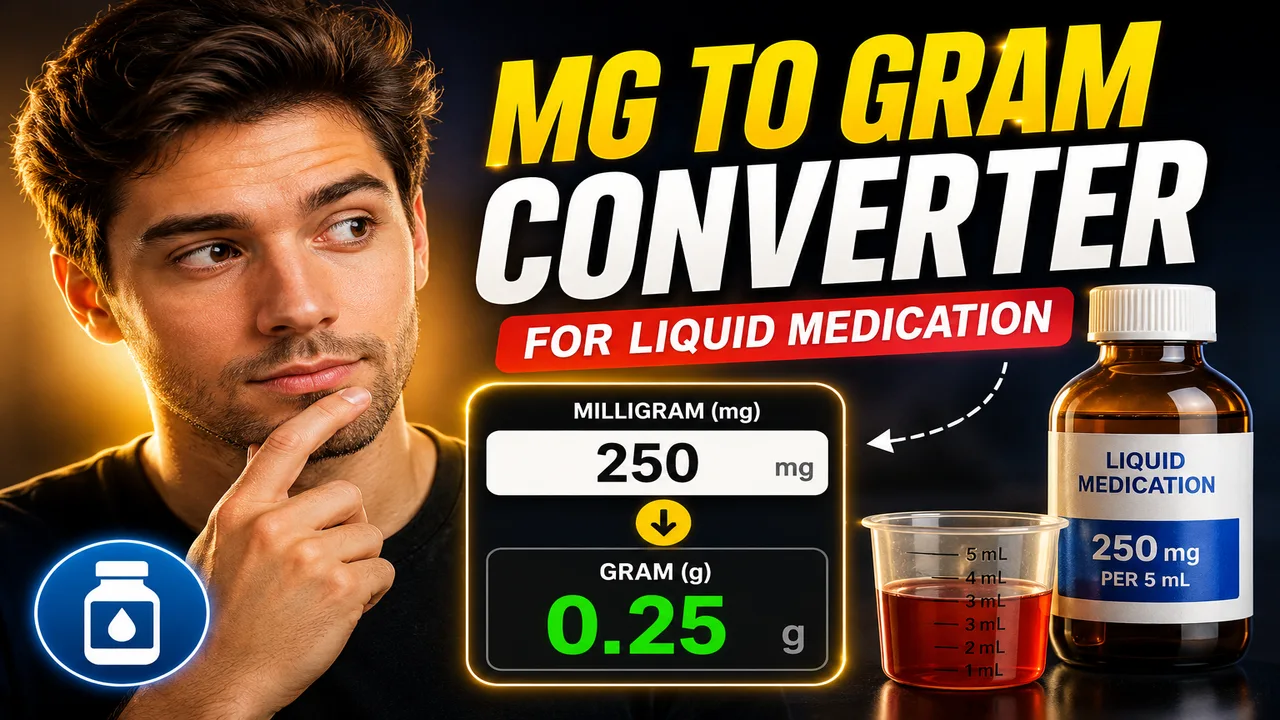
Mg To Gram Converter For Liquid Medication
Quick answer: The Mg To Gram Converter For Liquid Medication is a unit conversion utility designed to convert milligrams (mg) into grams (g). It helps users understand mass measurements used in medication labels, pharmaceutical calculations, and liquid medicine references. The standard conversion is 1,000 milligrams = 1 gram.
Milligrams and grams are metric units used to express mass. Medication labels commonly use milligrams to describe the amount of an active ingredient, while grams may appear in scientific references, pharmaceutical documentation, and concentration calculations. Converting between these units helps users interpret equivalent mass values without manually performing the arithmetic.
Although this converter focuses on liquid medication, converting milligrams to grams changes only the mass unit. It does not calculate a liquid's volume in milliliters (mL), determine a dose in teaspoons, or establish how much medicine a patient should take. Those calculations require additional information, such as the medication's concentration and the prescribed dose.
Key Takeaways
- Primary function: Convert milligrams (mg) to grams (g).
- Conversion factor: 1 gram equals 1,000 milligrams.
- Input: A numerical mass expressed in milligrams.
- Output: The equivalent mass expressed in grams.
- Important distinction: Mass conversion is not the same as liquid-volume or dosage conversion.
How to Use Mg To Gram Converter For Liquid Medication?
- Identify the mass: Find the milligram value you want to convert from the medication label, prescription reference, or calculation.
- Enter the value: Input the numerical amount in milligrams into the converter, if supported by the page interface.
- Convert the units: Apply the standard milligram-to-gram conversion factor.
- Review the result: Read the equivalent mass in grams and retain appropriate decimal places for the intended calculation.
The specific interface controls, input validation, automatic calculation behavior, and rounding options depend on the implemented tool. The conversion method itself is straightforward and does not require medication-specific data.
Milligrams to Grams Conversion Formula
The conversion from milligrams to grams uses the following formula:
Grams = Milligrams ÷ 1,000
Where:
- Milligrams (mg): The original mass value.
- Grams (g): The equivalent mass after conversion.
- 1,000: The number of milligrams in one gram.
Because a gram is larger than a milligram, the numerical value decreases when converting from milligrams to grams. The mass remains unchanged; only the unit used to express it changes.
Worked Example: Converting 250 mg to Grams
Input: 250 mg
Calculation: 250 ÷ 1,000 = 0.25
Output: 0.25 g
Therefore, 250 milligrams is equivalent to 0.25 grams. This result represents mass equivalence only and does not indicate a recommended medication dose.
Milligrams to Grams Conversion Reference Table
Use this reference table to identify common mass equivalents without repeating the calculation.
| Milligrams (mg) | Grams (g) | Conversion |
|---|---|---|
| 1 mg | 0.001 g | 1 ÷ 1,000 |
| 5 mg | 0.005 g | 5 ÷ 1,000 |
| 10 mg | 0.01 g | 10 ÷ 1,000 |
| 25 mg | 0.025 g | 25 ÷ 1,000 |
| 50 mg | 0.05 g | 50 ÷ 1,000 |
| 100 mg | 0.1 g | 100 ÷ 1,000 |
| 125 mg | 0.125 g | 125 ÷ 1,000 |
| 250 mg | 0.25 g | 250 ÷ 1,000 |
| 500 mg | 0.5 g | 500 ÷ 1,000 |
| 750 mg | 0.75 g | 750 ÷ 1,000 |
| 1,000 mg | 1 g | 1,000 ÷ 1,000 |
| 1,500 mg | 1.5 g | 1,500 ÷ 1,000 |
| 2,000 mg | 2 g | 2,000 ÷ 1,000 |
Understanding Mass, Liquid Volume, and Medication Concentration
A liquid medication may have a mass measurement, a volume measurement, and a concentration value. These quantities are related but are not interchangeable.
| Measurement | Example | Meaning |
|---|---|---|
| Mass | 250 mg | Amount of a substance by mass. |
| Converted mass | 0.25 g | The same mass expressed in grams. |
| Liquid volume | 5 mL | The volume of liquid. |
| Concentration | 50 mg/mL | Mass of active ingredient per milliliter. |
| Volume derived from concentration | 250 mg ÷ 50 mg/mL = 5 mL | The theoretical volume containing the stated mass at that concentration. |
The final example demonstrates a separate calculation. To determine a volume from a known mass and concentration, use:
Volume (mL) = Required mass (mg) ÷ Concentration (mg/mL)
For example, if a calculation involves 250 mg and a concentration of 50 mg/mL, the corresponding volume is 5 mL. This is a mathematical illustration, not a dosing recommendation. Actual administration must follow the prescription and the medication's labeled concentration.
Technical Edge Cases and Limitations
Zero and Negative Values
Zero milligrams converts to zero grams. A negative result can be mathematically converted, but negative mass is not an ordinary medication quantity. Check the input if a negative value appears in a dosing-related workflow.
Decimal Values
Decimal inputs are valid for ordinary unit arithmetic. For example, 2.5 mg equals 0.0025 g. Retain enough decimal places to avoid unintended loss of precision during intermediate calculations.
Very Small Measurements
Small milligram quantities produce even smaller numerical values in grams. Scientific notation may be useful for extremely small values, depending on the calculator interface and the required precision.
Volume Cannot Be Inferred From Mass Alone
A value in milligrams cannot be converted directly to milliliters without suitable concentration information. Liquid density may also matter when converting the total mass of a liquid to its volume. Do not assume that 1 mg equals 1 mL.
Rounding and Display Precision
The mathematical conversion is exact because the metric relationship is defined as 1,000 mg per gram. However, displayed results may be rounded. If the tool does not document its rounding behavior, verify the displayed precision before using the result in a further calculation.
Medication Safety
This utility is intended for unit conversion, not diagnosis, prescription interpretation, or independent dose selection. Confirm the prescribed amount, medication concentration, and administration instructions with a pharmacist or qualified healthcare professional whenever a medication calculation is uncertain.
Authoritative Measurement Reference
The milligram-to-gram relationship follows the metric system and the International System of Units (SI). For authoritative background, consult the following reference:
- National Institute of Standards and Technology (NIST): SI Units — information about metric measurement units and their relationships.
Author Information
Author Name: Daniel Brooks
Author Description: Technical Content Specialist focusing on unit conversions, measurement methodology, and practical calculator documentation.
Technical Review: The conversion methodology is based on the defined metric relationship of 1,000 milligrams per gram. Medication-specific volume and dosage calculations require additional validated information and are outside the scope of this mass converter.
Technical Disclaimer: This converter supports mass-unit conversion only. It does not replace the prescription label, a pharmacist's guidance, or a validated medication dosing calculation. Never change a prescribed dose based solely on a unit conversion.