
Grams To Deciliters Flour Converter Online | Toolhox
Convert grams to deciliters with this flour converter. Estimate gluten-free flour volumes using ingredient-specific density values for more consistent baking.
Please complete this field to continue.
Please complete this field to continue.
Results
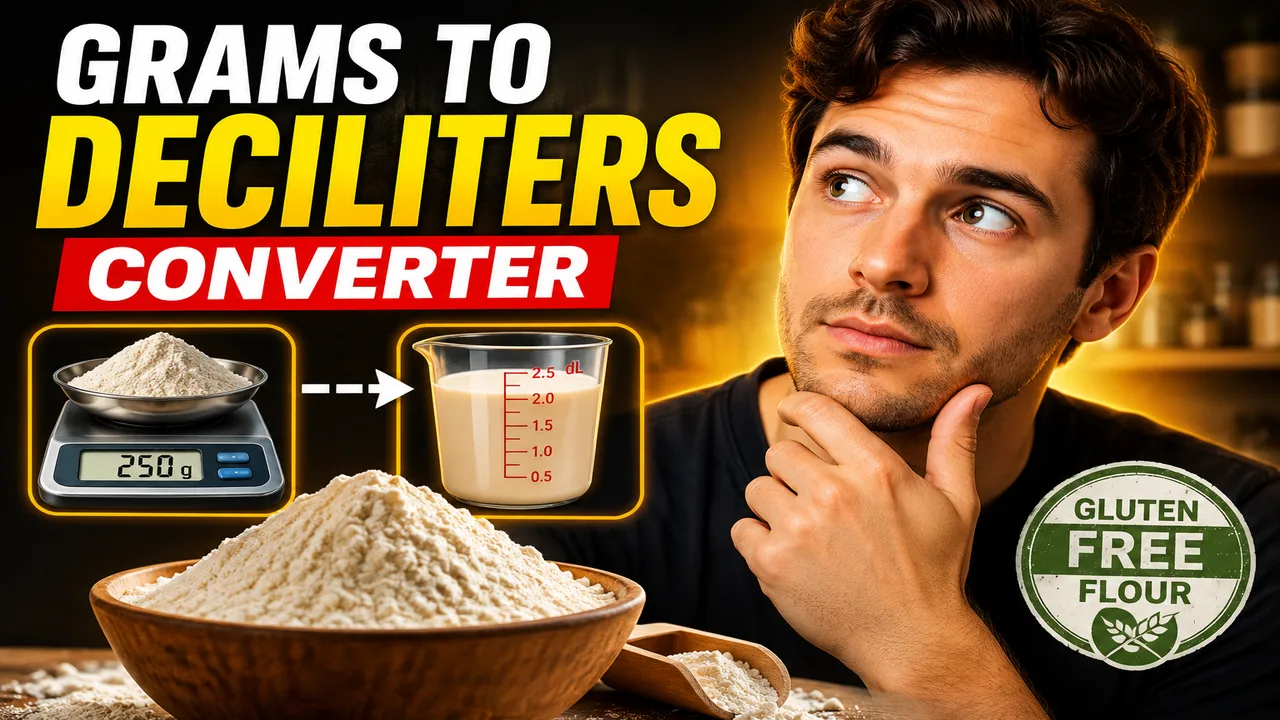
Grams To Deciliters Flour Converter
Quick answer: The Grams To Deciliters Flour Converter helps bakers convert the weight of gluten-free flour in grams (g) into volume in deciliters (dl). The conversion depends on the flour's bulk density, so rice flour, tapioca starch, almond flour, and other gluten-free ingredients can produce different volume measurements for the same weight.
This converter is designed for home bakers, people following gluten-free recipes, and anyone adapting baking instructions between weight-based and volume-based measurements. It helps translate gram quantities into deciliters, a metric volume unit commonly used in Scandinavian recipes.
Grams measure mass, while deciliters measure volume. Unlike water, gluten-free flour does not have a universal grams-to-deciliters conversion factor. Flour type, particle size, moisture, settling, and measuring technique can all influence the result.
TL;DR / Key Takeaways
- Primary Function: Convert gluten-free flour quantities from grams to deciliters.
- Input: Flour weight in grams.
- Output: Estimated flour volume in deciliters.
- Core Method: Divide the flour weight by its grams-per-deciliter value.
- Best Suited For: Gluten-free baking, recipe adaptation, and metric kitchen measurements.
How to Use Grams To Deciliters Flour Converter?
- Enter the flour weight: Use the quantity specified in your recipe, such as 100 g or 250 g.
- Identify the flour: Use the appropriate gluten-free flour or flour-blend density if the tool offers an ingredient selector or density field.
- Convert the measurement: Apply the converter to calculate the equivalent volume in deciliters.
- Measure the flour: Fill your measuring container consistently, without compressing the flour unless the recipe specifies otherwise.
The precise controls and ingredient options depend on the implemented converter. If no flour-specific selection or editable density is available, use the conversion basis documented by the tool and treat the result as an estimate.
Input and Output Example
Suppose a recipe requires 150 g of a gluten-free flour blend, and the selected reference density is 55 g per deciliter.
Input: 150 g of gluten-free flour blend
Reference density: 55 g/dl
Calculation: 150 ÷ 55 = 2.727...
Output: Approximately 2.73 dl
This is a worked example using an illustrative density, not a claim about the converter's default setting. Use the actual density associated with the selected ingredient for a corresponding result.
Grams to Deciliters Flour Conversion Formula
The conversion uses the relationship between mass, volume, and bulk density.
Volume (dl) = Weight (g) ÷ Density (g/dl)
Where:
- Weight (g): The mass of flour in grams.
- Density (g/dl): The approximate number of grams occupying one deciliter.
- Volume (dl): The estimated volume of flour in deciliters.
For the reverse conversion, multiply the volume by the same density:
Weight (g) = Volume (dl) × Density (g/dl)
One deciliter equals 100 milliliters. Therefore, a density of 55 g/dl is equivalent to 0.55 g/ml. Keep the density and quantity units consistent to avoid calculation errors.
Gluten-Free Flour Grams-to-Deciliters Reference Table
The following reference values provide illustrative kitchen estimates for common gluten-free flours and starches. Actual product weights vary by manufacturer and measurement technique. These values are reference examples, not verified built-in settings for this converter.
| Ingredient | Approximate g/dl | 100 g in dl |
|---|---|---|
| Rice flour | 50 | 2.00 |
| Tapioca starch | 55 | 1.82 |
| Potato starch | 60 | 1.67 |
| Almond flour | 50 | 2.00 |
| Oat flour | 60 | 1.67 |
| Coconut flour | 40 | 2.50 |
| Millet flour | 60 | 1.67 |
| Gluten-free flour blend | 55 | 1.82 |
How to read the table: At 50 g/dl, 100 g of flour occupies approximately 2 dl. At 60 g/dl, the same weight occupies approximately 1.67 dl. The lighter-density flour requires more volume to reach the same weight.
How Does the Conversion Work?
The converter applies a density-based calculation rather than treating grams and deciliters as interchangeable units. This distinction is important because two gluten-free ingredients can have different masses even when they occupy the same container volume.
- Rice flour: Its volume depends on the grind and how loosely it is measured.
- Tapioca starch: A starch-based ingredient that requires its own density reference.
- Almond flour: Its particle size and composition can change the amount that fits into a deciliter.
- Coconut flour: Its relatively absorbent, fibrous structure makes it especially important to follow the recipe's specified weight when possible.
- Blended gluten-free flour: Different ratios of rice flour, starches, and other ingredients can change the bulk density.
For additional context, see Virtasalmen Viljatuote's guide to grams and deciliters in gluten-free baking, which discusses ingredient-specific weights and measuring differences.
Edge Cases and Limitations
- Unknown flour type: A conversion using the wrong density may produce a misleading volume estimate.
- Mixed flour blends: A single generic value may not represent every commercial blend.
- Packed or sifted flour: Settling and aeration change the volume occupied by a given mass.
- Very small quantities: Rounding may have a proportionally greater effect on small measurements.
- Missing or invalid values: The calculation requires a valid nonnegative weight and a positive density. Exact error messages depend on the implementation.
- Recipe precision: Volume conversions are estimates; weighing flour is generally more consistent for baking.
Technical disclaimer: The reference values are approximate and should not replace a recipe's specified ingredient ratios. For reproducible gluten-free baking, use a kitchen scale and the flour manufacturer's or recipe developer's measurement guidance whenever available.
Frequently Asked Questions
How many deciliters is 100 grams of gluten-free flour?
It depends on the flour's density. At 50 g/dl, 100 g equals 2 dl; at 60 g/dl, it equals approximately 1.67 dl.
Can I use one conversion factor for all gluten-free flours?
No. Rice flour, tapioca starch, almond flour, and coconut flour can have different bulk densities. Use an ingredient-specific value when available.
What is the formula for converting grams to deciliters?
Divide the weight in grams by the ingredient's density in grams per deciliter. For example, 200 g ÷ 50 g/dl = 4 dl.
Does sifting gluten-free flour affect the result?
Yes. Sifting and settling can change the volume occupied by a given mass. The density reference and the way the flour is measured should be consistent.
Is 1 dl of gluten-free flour equal to 100 grams?
No. One deciliter equals 100 ml, but flour does not have the same density as water. The weight of 1 dl depends on the flour or starch being measured.
Should I weigh gluten-free flour instead of measuring it by volume?
Yes, when recipe accuracy matters. Weighing directly in grams avoids much of the variation caused by packing, sifting, and measuring technique.
Author
Author Name: Morgan Ellis
Author Description: Food measurement and recipe-conversion editor focused on ingredient density, metric volume, and practical baking measurements.
Technical Review: The conversion methodology is based on the mass-to-volume relationship and requires a suitable ingredient-specific density. Reference values should be verified against the flour product or recipe being used.