
Roof Solar Panel Weight Calculator For Roof Load Planning
Estimate roof solar panel weight from panel count, module weight, mounting hardware, ballast, and array area to plan added dead load before structural review.
Please complete this field to continue.
Please complete this field to continue.
Please complete this field to continue.
Please complete this field to continue.
Results
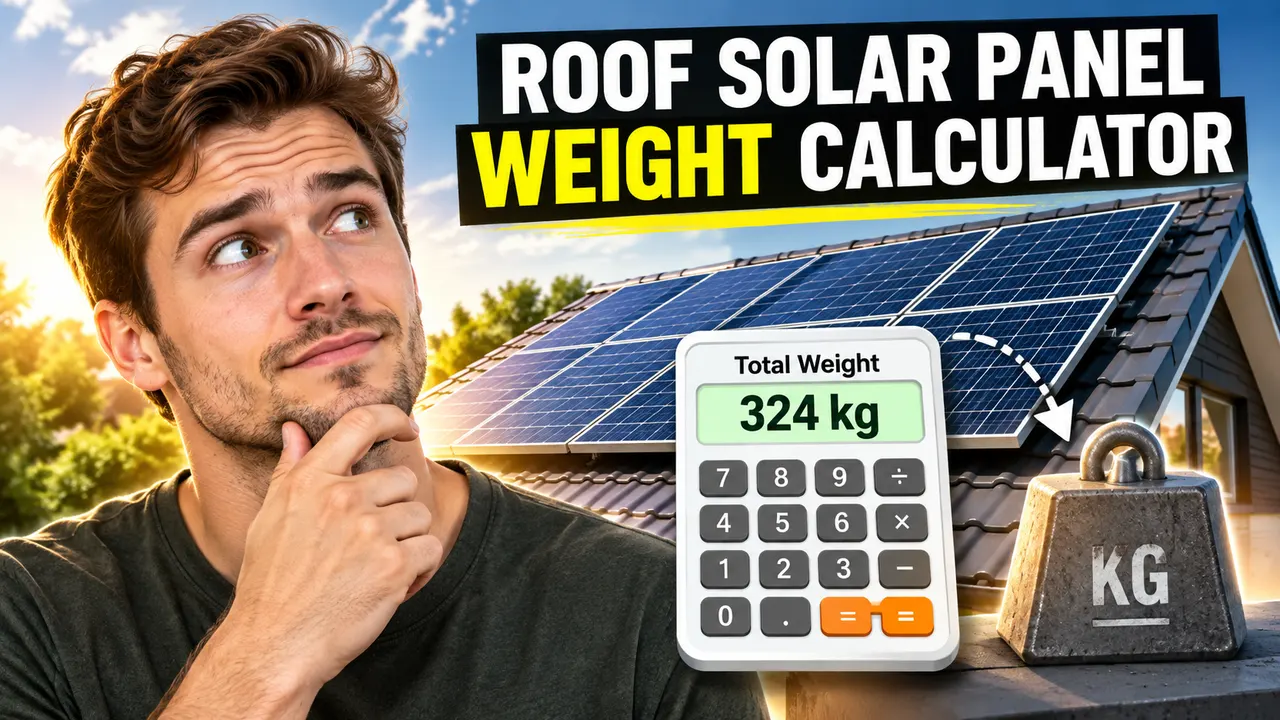
Roof Solar Panel Weight Calculator
Quick answer: The Roof Solar Panel Weight Calculator estimates the additional dead load that a rooftop solar photovoltaic (PV) system places on a roof. By combining panel count, individual panel weight, mounting hardware weight, and optional ballast weight, users can estimate the total installed system weight and average load per square foot when the relevant inputs are available.
The Roof Solar Panel Weight Calculator is an engineering-oriented planning calculator for homeowners, solar installers, roofing contractors, and building professionals evaluating rooftop solar installations. Its purpose is to make the weight contribution of a proposed solar array easier to understand before a structural assessment or installation.
Solar panels do not load a roof through panel weight alone. Rails, brackets, clamps, flashing, wiring, and other mounting components contribute additional dead load. Ballasted systems on flat roofs can add substantial weight from concrete blocks or pavers. The total load depends on the selected equipment, mounting design, array footprint, and roof configuration.
Key Takeaways
- Primary function: Estimate the combined weight of rooftop solar equipment.
- Important inputs: Panel quantity, panel weight, mounting hardware, ballast, and array area.
- Useful outputs: Estimated total weight and average distributed load, when sufficient inputs are available.
- Best suited for: Preliminary roof-load planning and comparing proposed solar system configurations.
How to Use Roof Solar Panel Weight Calculator?
Use the calculator's available input fields to describe the proposed installation. The exact fields and output depend on the implemented calculator interface.
- Enter the panel quantity. Specify the number of photovoltaic modules planned for the roof.
- Enter individual panel weight. Use the weight listed on the specific module's manufacturer datasheet.
- Account for mounting components. Include racking, rails, brackets, clamps, and other equipment if the calculator provides corresponding fields.
- Include ballast when applicable. For a ballasted installation, account for the actual design ballast rather than assuming a mechanically attached system.
- Provide the array area. Use the calculator's specified area definition and units to estimate average load per unit area.
- Review the result. Compare the estimated total weight and area-based load with the information required for a professional roof assessment.
Do not substitute a panel's shipping weight for its installed weight unless the manufacturer's documentation confirms that the figure is appropriate. Packaging, pallets, and transport materials should not be counted as permanent roof loads.
Input and Output Example
The following is an illustrative calculation showing how installed solar equipment weight can be estimated. These values are examples, not measurements or guaranteed outputs from the live calculator.
Example inputs
| Input | Example value | Unit |
|---|---|---|
| Number of solar panels | 20 | Panels |
| Weight per panel | 25 | lb |
| Total mounting hardware weight | 100 | lb |
| Additional ballast weight | 0 | lb |
| Array footprint | 400 | ft² |
Calculation
Panel weight: 20 × 25 = 500 lb
Total installed equipment weight: 500 + 100 + 0 = 600 lb
Average load over the stated footprint: 600 ÷ 400 = 1.5 lb/ft²
Illustrative result: 600 lb of equipment weight, equivalent to an average of 1.5 lb/ft² over the stated 400 ft² footprint.
This average does not describe the force at individual roof attachments. Rails, brackets, and anchors may transfer loads into small areas or particular rafters and trusses. A roof can therefore require a more detailed structural assessment even when the average load appears modest.
Roof Solar Panel Weight Formula
For a system whose component weights are known, the basic total-weight formula is:
Total system weight = (Panel count × Weight per panel) + Mounting hardware weight + Ballast weight + Other included equipment weight
Where:
- Panel count: Number of modules in the proposed array.
- Weight per panel: Installed module weight per unit, excluding packaging.
- Mounting hardware weight: Combined weight of rails, brackets, clamps, and related mounting components included in the estimate.
- Ballast weight: Additional permanent weight used to secure a ballasted mounting system.
- Other included equipment weight: Any additional rooftop equipment intentionally included in the calculation.
If the installed array footprint is known, average dead load can be estimated using:
Average dead load = Total system weight ÷ Array footprint
In US customary units, the result is expressed in pounds per square foot (lb/ft² or psf). In metric units, use kilograms for mass and square metres for area to obtain kg/m². To express that mass loading as a force per area in SI units, multiply kg/m² by approximately 9.81 to obtain N/m², or pascals.
All component weights and area measurements must use compatible units. Do not combine pounds with kilograms or square feet with square metres without conversion.
Roof Solar Panel Weight Reference Table
Use the following reference table to organize the information needed for a rooftop solar weight estimate.
| Component or measurement | How to determine it | Effect on estimate |
|---|---|---|
| Solar modules | Module datasheet weight multiplied by module quantity | Sets the panel contribution to total weight |
| Rails and mounting hardware | Manufacturer specifications or a component weight schedule | Adds permanent mounting-system weight |
| Ballast blocks or pavers | Specified ballast quantity multiplied by unit weight | Can substantially increase the dead load of flat-roof systems |
| Cables and rooftop accessories | Include components within the selected calculation scope | Refines the equipment-weight estimate |
| Array footprint | Use the area definition requested by the calculator | Provides the denominator for average load per area |
| Roof attachment locations | Use the mounting layout and structural drawings | Required for evaluating concentrated load transfer |
Manufacturer datasheets and installation manuals are preferable to generic panel-weight estimates because module dimensions, frame designs, and mounting configurations differ. The US Department of Energy provides guidance on solar photovoltaic resilience and module loading considerations in its solar photovoltaic hardening guidance.
How Roof Solar Panel Weight Affects Structural Loading
Roof-mounted solar installations introduce several distinct structural considerations. The permanent weight of the modules and mounting equipment is dead load. Wind, snow, maintenance access, and other applicable design actions must be considered separately under the governing building requirements.
- Flush-mounted arrays: Panels are positioned relatively close and parallel to the roof. Their equipment weight must still be transferred through the mounting attachments into the supporting structure.
- Tilted or elevated arrays: Additional framing and increased exposure can change load paths and wind effects.
- Ballasted flat-roof systems: Ballast contributes directly to dead load, while its distribution and placement influence local structural demands.
- Concentrated attachment loads: A system's weight may be carried by individual brackets or anchors rather than distributed uniformly across the entire roof.
- Snow and wind: These actions are not captured by a simple equipment-weight calculation and can govern structural design in some locations.
The National Renewable Energy Laboratory discusses rooftop photovoltaic loads and structural considerations in its technical report on rooftop solar structural issues. Its guidance emphasizes the importance of wind effects, mounting configuration, and verification of the supporting roof.
Technical Edge Cases and Limitations
Different units
Ensure every weight and area value uses the same measurement system. If the calculator accepts multiple units, verify that each input is interpreted correctly before comparing results.
Missing mounting or ballast weights
If the mounting hardware or ballast is omitted, the estimated total will be lower than the complete installed-system weight. Record any excluded components explicitly.
Incorrect array area
The module surface area, the combined panel footprint, and the total roof area are not interchangeable. Dividing by an area that is too large can make the average load appear lower than it actually is over the chosen footprint.
Uneven load distribution
An average lb/ft² value is not a substitute for checking individual attachment reactions, roof framing spans, fastener capacities, and load paths. Actual structural verification requires the installation layout and roof details.
Ballasted mounting systems
Do not use a zero-ballast assumption for a system that relies on concrete blocks or other weights for stability. The required ballast depends on the mounting design and applicable site-specific wind requirements.
Unverified structural capacity
This calculation estimates the load added by the solar equipment; it does not establish the remaining load capacity of the roof. Existing roof condition, framing dimensions, spans, material properties, previous alterations, and local design loads can materially affect the assessment.
Frequently Asked Questions
Does the calculator determine whether my roof is safe for solar panels?
No. A weight estimate is only one part of a roof assessment. A qualified structural professional may need to evaluate the existing framing, attachment points, wind uplift, snow loads where applicable, and the condition of the roof.
Should mounting hardware be included in the total solar panel weight?
Yes. For an estimate of installed-system weight, include the mounting rails, brackets, clamps, and other permanent components covered by the calculation. Omitting them produces a panel-only or otherwise incomplete estimate.
How is solar panel load per square foot calculated?
Divide the included total equipment weight in pounds by the stated array footprint in square feet. The result is an average load in lb/ft². This value does not represent the actual load at every roof attachment.
Why do ballasted rooftop solar systems weigh more?
Ballasted systems use additional weights, such as concrete blocks or pavers, to help resist wind forces. That ballast increases permanent roof loading and must be included when estimating total installed weight.
Does the calculator account for wind and snow loads?
A basic panel-weight calculation does not establish wind or snow design loads. Those loads depend on site conditions, roof geometry, array arrangement, and the applicable structural design requirements.
What information should I collect before using the calculator?
Collect the panel quantity, manufacturer-listed module weight, mounting-system component weights, ballast weight if applicable, and the relevant array footprint. For structural review, also gather roof framing information, mounting drawings, and site-specific design requirements.
Technical Disclaimer
The Roof Solar Panel Weight Calculator is intended for preliminary weight estimation. A calculated total or average load must not be interpreted as proof that a roof can support a proposed installation. Confirm equipment specifications, attachment design, existing structural capacity, and applicable local building requirements with qualified professionals before installation.
Author
Author Name: Daniel Mercer
Author Description: Building Systems and Structural Engineering Content Specialist focused on building-load calculations, rooftop equipment planning, and construction technical documentation.
Technical Review: The methodology described here separates equipment dead load from site-dependent structural actions and distinguishes average area loading from concentrated loads at roof attachments. The calculator's live implementation and outputs have not been independently verified.