
Gram Formula Weight Calculator For Chemical Compounds
Calculate gram formula weight from chemical formulas using atomic masses. Review worked examples and molar mass values for chemistry and stoichiometry.
Please complete this field to continue.
Please complete this field to continue.
Results
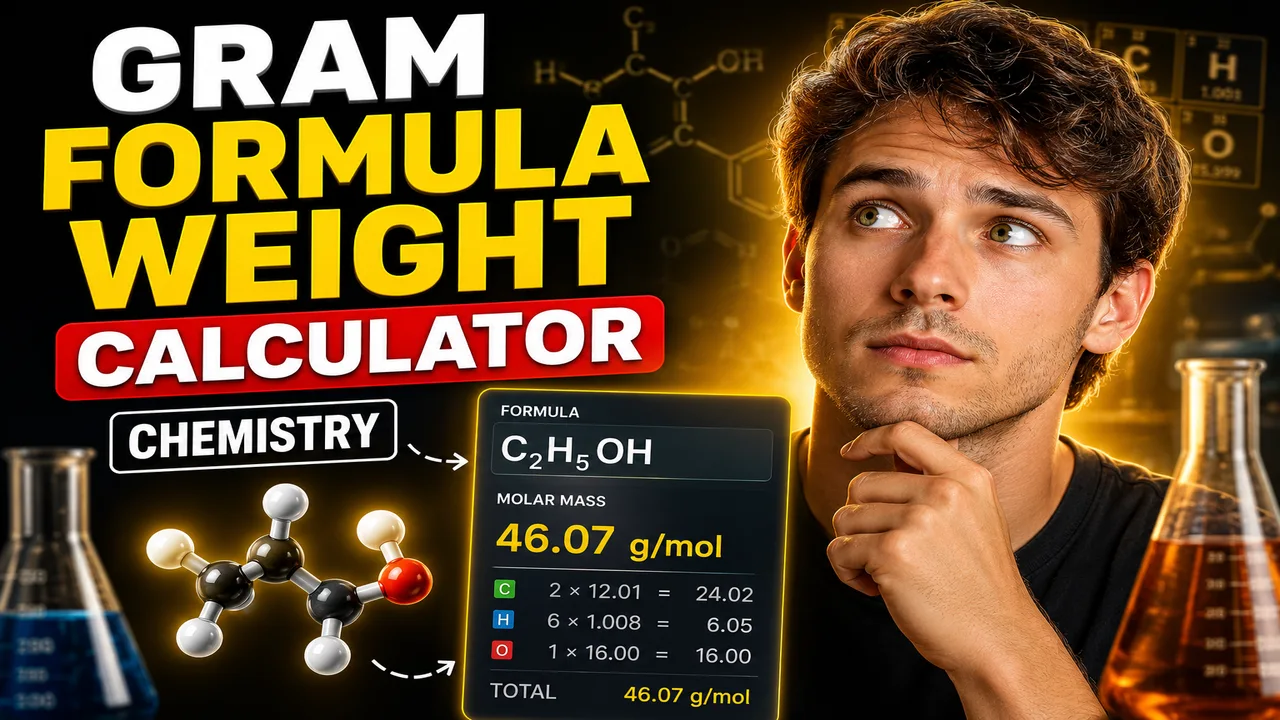
Gram Formula Weight Calculator
The Gram Formula Weight Calculator is a chemistry calculator designed to determine the formula weight of a chemical compound in grams per mole (g/mol) from its chemical formula. It is useful for students, chemistry educators, laboratory personnel, and researchers who need to calculate molar mass for stoichiometry, solution preparation, and quantitative chemical analysis.
Quick answer: Gram formula weight is calculated by adding the atomic masses of every atom represented in a chemical formula, accounting for subscripts and parentheses. The result is expressed in atomic mass units (u) per formula unit or numerically equivalently in grams per mole (g/mol).
Key Takeaways
- Primary function: Calculate chemical formula weight from atomic masses.
- Input: A chemical formula, such as H2O, NaCl, or Ca(OH)2.
- Output: The calculated formula weight, commonly reported in g/mol.
- Main applications: Stoichiometry, molar conversions, and chemical quantity calculations.
What Is Gram Formula Weight?
Gram formula weight is the mass in grams corresponding to one mole of formula units of a substance. It is numerically equivalent to the formula mass expressed in atomic mass units. For molecular compounds, the related term is often molecular weight or molar mass; for ionic compounds, formula weight is generally the more appropriate term because ionic solids consist of formula units rather than discrete molecules.
For example, sodium chloride (NaCl) contains sodium and chlorine in a 1:1 ratio. Using approximate standard atomic masses of 22.99 for sodium and 35.45 for chlorine, its formula weight is:
NaCl = 22.99 + 35.45 = 58.44 g/mol
This value means that one mole of sodium chloride has a mass of approximately 58.44 grams. The same calculation method works for molecular compounds, ionic compounds, hydrates, and formulas containing grouped atoms, provided the formula is interpreted correctly and the required atomic masses are available.
How to Use Gram Formula Weight Calculator?
- Enter the chemical formula. Type the compound using standard element symbols and numerical subscripts, such as H2O, CO2, NaCl, or Ca(OH)2.
- Check the formula structure. Confirm capitalization, element symbols, subscripts, parentheses, and any hydrate notation supported by the calculator.
- Calculate the formula weight. Run the calculation to obtain the total mass contribution from the atoms in the formula.
- Review the result. Check the reported value and units before using it in a stoichiometry or laboratory calculation.
The exact input syntax, treatment of nested parentheses, hydrate notation, and output precision depend on the calculator's implementation. Verify these capabilities in the live tool rather than assuming every chemical notation is supported.
Input and Output Example
Consider calcium hydroxide, Ca(OH)2, a compound containing one calcium atom, two oxygen atoms, and two hydrogen atoms.
Example Input
Ca(OH)2Worked Calculation
| Element | Atomic mass (approx.) | Number of atoms | Mass contribution |
|---|---|---|---|
| Calcium (Ca) | 40.08 | 1 | 40.08 |
| Oxygen (O) | 16.00 | 2 | 32.00 |
| Hydrogen (H) | 1.008 | 2 | 2.016 |
| Total | — | 5 | 74.096 g/mol |
Expected Result
Formula: Ca(OH)2
Formula weight: approximately 74.10 g/mol
The calculation expands the group (OH)2, multiplying the contribution of each atom inside the parentheses by two. The displayed result may differ slightly if the calculator uses a different atomic-mass dataset or rounding precision.
Formula Used by the Calculator
The fundamental formula for calculating gram formula weight is:
Formula weight = Σ (number of atoms of each element × atomic mass of that element)
In mathematical notation:
M = Σ nᵢAᵢ
- M = total formula weight or molar mass.
- nᵢ = number of atoms of element i in one formula unit.
- Aᵢ = atomic mass assigned to element i.
- Σ = sum of the mass contributions from every element.
For a formula such as Al2(SO4)3, the atom counts are two aluminum atoms, three sulfur atoms, and twelve oxygen atoms. The parentheses multiplier applies to every atom inside the group.
Using approximate atomic masses:
Al2(SO4)3 = 2(26.98) + 3(32.06) + 12(16.00)
= 53.96 + 96.18 + 192.00 = 342.14 g/mol
This is the standard additive method. A calculator may automate the parsing and summation, but the result depends on correct chemical notation, an appropriate atomic-mass dataset, and the treatment of rounding.
Common Chemical Formula Reference
| Compound | Formula | Approximate formula weight | Calculation note |
|---|---|---|---|
| Water | H2O | 18.02 g/mol | Two H atoms and one O atom |
| Carbon dioxide | CO2 | 44.01 g/mol | One C atom and two O atoms |
| Sodium chloride | NaCl | 58.44 g/mol | One Na atom and one Cl atom |
| Calcium carbonate | CaCO3 | 100.09 g/mol | One Ca, one C, and three O atoms |
| Calcium hydroxide | Ca(OH)2 | 74.10 g/mol | Parentheses multiplier of two |
| Sulfuric acid | H2SO4 | 98.08 g/mol | Two H atoms, one S, and four O atoms |
| Aluminum sulfate | Al2(SO4)3 | 342.14 g/mol | Grouped polyatomic ion with multiplier three |
These values are approximate reference calculations, not guaranteed outputs from the live calculator. Small differences can arise from atomic-mass conventions and rounding.
Formula Weight, Molecular Mass, and Molar Mass
These terms are closely related but describe quantities in different contexts:
- Formula mass: The sum of the atomic masses represented by a chemical formula, commonly expressed in u per formula unit.
- Molecular mass: The mass of a molecule calculated from its constituent atoms, expressed in u.
- Molar mass: The mass of one mole of a substance, expressed in g/mol.
- Gram formula weight: The mass in grams corresponding to one mole of formula units, numerically equivalent to the formula mass when the latter is expressed in u.
For ordinary chemistry calculations, the numerical formula mass in u and the molar mass in g/mol are equivalent to the precision used in the calculation. However, the quantities and units are not interchangeable in a dimensional equation.
Technical Edge Cases and Limitations
| Input condition | What to check | Why it matters |
|---|---|---|
| Incorrect element capitalization | Use symbols such as Co for cobalt and CO for carbon monoxide. | Element symbols are case-sensitive. |
| Parentheses | Verify that every opening parenthesis has a matching closing parenthesis. | Group multipliers change the counts of all atoms inside the group. |
| Missing or ambiguous subscripts | Confirm the intended chemical formula. | Incorrect atom counts produce an incorrect result. |
| Hydrates | Check whether dot notation, such as CuSO4·5H2O, is accepted. | Water of crystallization contributes to the total formula weight. |
| Charged species | Check how ionic charges are represented and whether the calculator supports them. | Charges identify chemical species but do not add the mass of an ordinary electron-scale contribution at typical classroom precision. |
| Isotopes | Determine whether a specific isotope or standard atomic mass is intended. | Isotopically specified formulas can have different masses from natural-abundance averages. |
| Rounding | Retain sufficient intermediate precision. | Rounding each atomic contribution too early can shift the final result. |
The supplied tool name does not establish the calculator's exact parsing rules, atomic-mass source, supported notation, or error-handling behavior. For unusual formulas, isotopically labeled compounds, coordination complexes, and hydrates, confirm the implementation's supported syntax and independently verify important results.
How Is Gram Formula Weight Used in Chemistry?
Formula weight connects a chemical formula to measurable laboratory quantities. Once molar mass is known, it can be used in common relationships such as:
- Mass from moles: mass (g) = amount (mol) × molar mass (g/mol).
- Moles from mass: amount (mol) = mass (g) ÷ molar mass (g/mol).
- Solution preparation: the required solute mass can be calculated from the target amount in moles and the molar mass.
- Stoichiometry: molar mass converts balanced-equation mole quantities into masses of reactants or products.
For example, 0.50 mol of NaCl corresponds to approximately 0.50 × 58.44 = 29.22 g of sodium chloride. This is a mass conversion, not a measurement of purity, concentration, or reaction yield.
Scientific References
- IUPAC Periodic Table of Elements — a recognized reference for element identities and atomic-weight information.
- NIST Atomic Weights and Isotopic Compositions — reference data for atomic weights and isotopic compositions.
Author Information
Author Name: Daniel Mercer
Author Description: Chemistry Education Specialist with a background in general chemistry, stoichiometry, and quantitative laboratory calculations.
Technical Review: The formula-weight methodology, unit conventions, worked examples, and atom-counting rules are presented using standard chemical mass calculations. Verify the live calculator's supported notation and atomic-mass source before relying on tool-specific behavior.
Technical Disclaimer: Calculated formula weights are estimates based on the atomic masses and chemical formula used. Laboratory preparation should account for reagent purity, hydration state, isotopic composition, and applicable experimental requirements.