
Hvac Cooling Load Calculator For Commercial Kitchen
Estimate commercial kitchen HVAC cooling load from space, outdoor-air, and cooking heat inputs to support preliminary equipment sizing and design checks.
Please complete this field to continue.
Please complete this field to continue.
Please complete this field to continue.
Please complete this field to continue.
Please complete this field to continue.
Please complete this field to continue.
Please complete this field to continue.
Please complete this field to continue.
Please complete this field to continue.
Please complete this field to continue.
Please complete this field to continue.
Please complete this field to continue.
Please complete this field to continue.
Please complete this field to continue.
Please complete this field to continue.
Please complete this field to continue.
Please complete this field to continue.
Please complete this field to continue.
Please complete this field to continue.
Please complete this field to continue.
Please complete this field to continue.
Please complete this field to continue.
Please complete this field to continue.
Results
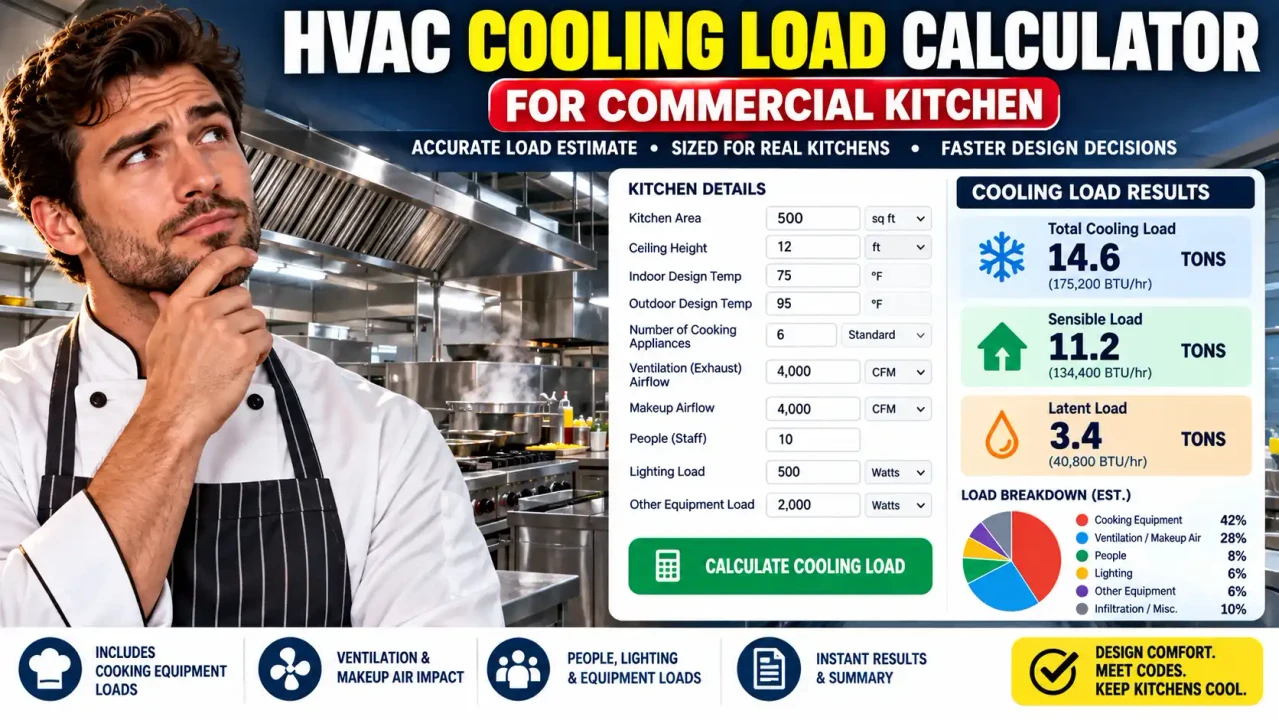
HVAC Cooling Load Calculator for Commercial Kitchen
Quick answer: The HVAC Cooling Load Calculator for Commercial Kitchen is a preliminary engineering calculator for estimating the cooling demand associated with a commercial kitchen. It is intended to organize the major heat-load contributors that affect kitchen air-conditioning requirements, including space conditions, outdoor-air effects, and heat generated by cooking operations.
Commercial kitchens are different from ordinary conditioned rooms because cooking equipment, exhaust hoods, replacement air, dishwashing activity, occupants, lighting, and outdoor-air conditions can all influence the cooling requirement. A useful cooling-load estimate therefore needs to consider more than the floor area of the kitchen.
TL;DR / Key Takeaways
- Primary Function: Estimate preliminary HVAC cooling demand for a commercial kitchen.
- Key Inputs: Cooling-load and kitchen operating parameters supported by the calculator.
- Core Output: A cooling-load estimate for preliminary HVAC assessment.
- Best Suited For: Early-stage commercial-kitchen HVAC planning and engineering checks.
How to Use HVAC Cooling Load Calculator for Commercial Kitchen?
Enter the kitchen conditions and operating information requested by the calculator, then run the calculation. Review the resulting cooling-load estimate together with the assumptions used for the calculation.
For an engineering workflow, use project-specific information rather than relying on generic assumptions wherever actual equipment, ventilation, or operating data are available. Cooking-appliance heat gain can vary substantially with appliance type, operating condition, hood arrangement, and usage. ASHRAE specifically distinguishes between hooded and unhooded appliance loads and between sensible radiant, sensible convective, and latent heat gains.
What Does the Cooling Load Represent?
The cooling load represents the rate at which heat and moisture must be removed to maintain the selected kitchen design conditions. Conceptually, the total load can be considered as a combination of sensible and latent components:
Total Cooling Load = Sensible Cooling Load + Latent Cooling Load
Sensible load changes the air temperature, while latent load is associated with moisture that must be removed through dehumidification. Commercial-kitchen design can contain both components because cooking and warewashing can introduce substantial heat and moisture.
Why Are Cooking Appliances Important?
Cooking appliances can contribute radiant, convective, and latent heat. Equipment installed beneath an effective exhaust hood does not necessarily transfer all of its generated heat into the conditioned kitchen space; the portion entering the space depends on the equipment and ventilation arrangement. Unhooded equipment can contribute a larger combination of sensible and latent gains to the room.
ASHRAE's nonresidential cooling-load guidance notes that appliance heat-gain calculations should account for appliance-specific characteristics and usage rather than assuming that all of an appliance's rated energy input becomes room cooling load. Appliance diversity and simultaneous operation also matter when establishing a design condition.
Commercial Kitchen Cooling-Load Reference
| Load Contributor | Typical Role in the Calculation | Important Consideration |
|---|---|---|
| Cooking equipment | Internal sensible and, for some equipment, latent heat gain | Appliance type, hooding, operating condition, and usage affect the load |
| Outdoor / replacement air | Can add sensible and latent cooling demand | Outdoor temperature, humidity, airflow, and indoor design conditions matter |
| Dishwashing equipment | Potential sensible and latent contribution | Equipment type, insulation, vapor control, and ventilation influence heat and moisture release |
| Occupants | Internal sensible and latent heat gain | Occupancy and activity level affect the design condition |
| Lighting and other equipment | Additional internal sensible heat gain | Installed load and operating schedule should be considered |
Worked Example: Interpreting a Cooling-Load Estimate
Suppose a preliminary kitchen calculation produces a sensible component of 24,000 Btu/h and a latent component of 6,000 Btu/h. The combined cooling requirement represented by those components is:
24,000 + 6,000 = 30,000 Btu/h
This is equivalent to approximately 2.5 refrigeration tons because 1 ton of refrigeration is conventionally 12,000 Btu/h.
The example illustrates the relationship between sensible and latent load; it does not establish the actual inputs or calculation assumptions of a particular project.
Important Edge Cases and Limitations
- Hooded versus unhooded equipment: The room heat gain can differ substantially depending on whether cooking equipment is served by an effective exhaust system.
- Recirculating or ductless hoods: Heat and moisture that remain in the kitchen can materially change the room cooling requirement.
- Appliance diversity: Assuming every appliance operates at full output simultaneously can produce a substantially different result from a design condition based on realistic simultaneous use.
- Outdoor-air conditions: Hot or humid outdoor air can add both sensible and latent load when introduced for ventilation or replacement air.
- Dishroom loads: Dishwashing equipment can introduce significant heat and moisture, particularly when vapor is not effectively captured.
- Preliminary estimates: A calculator result should not automatically be treated as a final HVAC equipment selection or construction design.
How Should the Result Be Used?
Use the calculated value as a preliminary design reference and compare it with the actual project requirements, equipment schedules, ventilation design, indoor design conditions, outdoor design conditions, and applicable codes or standards. Final HVAC sizing should account for the complete building and kitchen design rather than relying on a single simplified calculation.
ASHRAE identifies commercial-kitchen ventilation as an integrated design problem involving cooling, replacement air, exhaust, pressurization, air distribution, and food-service equipment. Its guidance also notes that determining appliance heat gain requires consideration of the kitchen design team's operating assumptions.
Technical Disclaimer: This calculator should be treated as a preliminary estimating aid unless its implementation and project inputs have been specifically validated for the intended design application. Final commercial-kitchen HVAC sizing should be checked against applicable codes, standards, manufacturer data, actual ventilation conditions, and qualified engineering judgment.
Technical Review: The methodology described for this page follows established commercial-kitchen cooling-load concepts, including the distinction between sensible and latent loads and the importance of appliance heat gain, ventilation, and operating conditions. The exact calculation behavior depends on the inputs and formulas implemented in the calculator.
Reference: ASHRAE Handbook guidance on commercial kitchen ventilation and nonresidential cooling-load calculations provides technical background for appliance heat gain, outdoor-air effects, and kitchen HVAC system design.