
Voltage Stabilizer Sizing Calculator For Ac Unit
Calculate AC voltage stabilizer capacity using electrical load, voltage, and power factor. Check startup demand and ratings to choose a suitable stabilizer.
Please complete this field to continue.
Please complete this field to continue.
Please complete this field to continue.
Please complete this field to continue.
Please complete this field to continue.
Please complete this field to continue.
Please complete this field to continue.
Results
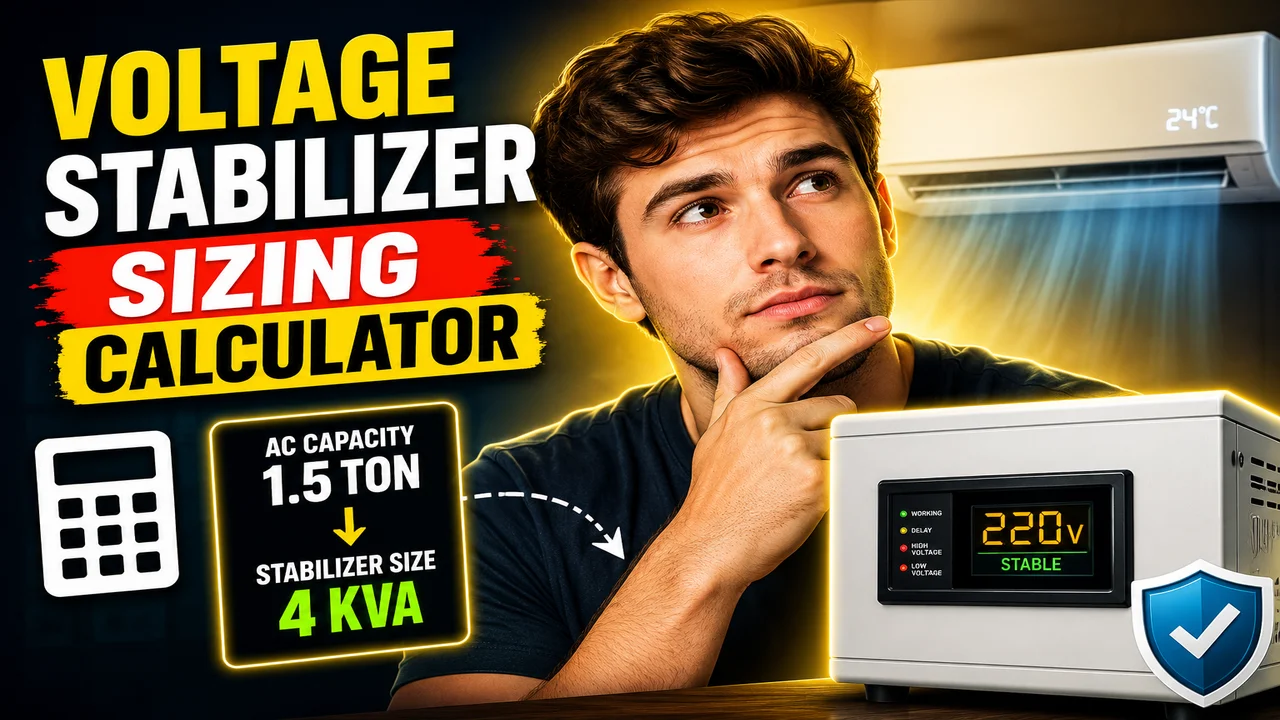
Voltage Stabilizer Sizing Calculator For AC Unit
A Voltage Stabilizer Sizing Calculator For AC Unit is an electrical sizing utility designed to help estimate the appropriate voltage stabilizer capacity for an air conditioner. It helps users understand how an AC unit's electrical load, operating voltage, compressor startup requirements, and stabilizer operating range affect capacity selection.
Quick answer: To size a voltage stabilizer for an air conditioner, check the AC nameplate's rated input power or current, supply voltage, power factor where available, and compressor startup requirements. Calculate the required apparent power in VA or kVA, then select a stabilizer that meets the load and the manufacturer's operating and surge specifications.
TL;DR / Key Takeaways
- Primary Function: Estimate the stabilizer capacity required for an AC unit.
- Key Inputs: AC electrical ratings, supply voltage, power factor when available, and starting-current information.
- Core Output: An estimated stabilizer capacity in VA or kVA, with the final selection subject to equipment specifications.
- Best Suited For: Homeowners, electricians, HVAC technicians, and people comparing stabilizers for split or window air conditioners.
How to Use Voltage Stabilizer Sizing Calculator For AC Unit?
Use the calculator's available fields to enter the electrical information for your air conditioner. The AC's tonnage alone does not determine the required stabilizer capacity because cooling capacity and electrical input are different measurements.
- Check the AC nameplate: Find rated input power in watts, rated current in amperes, and rated voltage. Use the manufacturer's electrical specifications rather than estimating from cooling capacity alone.
- Identify the compressor type: Determine whether the AC uses an inverter or a fixed-speed compressor. Startup current and overload behavior can differ significantly between models.
- Check the supply voltage: Establish the lowest and highest expected mains voltage. This helps determine whether the stabilizer's input operating range suits the installation.
- Account for startup and capacity margin: Use the manufacturer's starting-current and overload specifications to select a suitable kVA rating rather than relying exclusively on normal running power.
- Review the result: Compare the estimated capacity with available stabilizer ratings, voltage correction limits, and the AC manufacturer's recommendations before purchasing or installing equipment.
The exact fields and outputs depend on the calculator's implemented configuration. Enter only the units and parameters requested by the interface.
Input and Output Example
The following worked example illustrates the electrical calculations used when evaluating an AC stabilizer. It is an explanatory sizing example, not a claim about a particular calculator's implemented output.
Example Input
- AC rated input power: 1,800 W
- Nominal supply voltage: 230 V
- Assumed power factor: 0.90
- Illustrative continuous capacity margin: 25%
Step 1: Estimate Running Apparent Power
For a single-phase AC load, when rated input power and power factor are known:
Running apparent power (VA) = Input power (W) ÷ Power factor
Using the example values:
1,800 ÷ 0.90 = 2,000 VA = 2.00 kVA
Step 2: Apply an Illustrative Capacity Margin
Preliminary capacity = Running apparent power × (1 + margin)
2.00 × 1.25 = 2.50 kVA
Illustrative Output
The preliminary continuous-load estimate is 2.50 kVA. This is not automatically the final recommended stabilizer size. The selection must also account for compressor starting current, the stabilizer's surge capability, its output rating at low input voltage, and manufacturer requirements. A stabilizer that meets the running-load calculation may still be unsuitable if it cannot handle the AC's starting demand.
Voltage Stabilizer Sizing Formula
Stabilizer capacity is generally expressed in volt-amperes (VA) or kilovolt-amperes (kVA). Apparent power is useful because stabilizer ratings account for electrical loading rather than just useful real power.
Method 1: Using Rated Power and Power Factor
Required running capacity (kVA) = Input power (W) ÷ [Power factor × 1,000]
- Input power: The AC's electrical input in watts.
- Power factor: The ratio of real power to apparent power, expressed between 0 and 1 for a typical load.
- 1,000: The conversion factor from VA to kVA.
This formula is appropriate when the power factor and electrical input power are known. It should not be applied directly to cooling capacity measured in BTU/h or refrigeration tons.
Method 2: Using Rated Current
For a single-phase AC, an alternative estimate is:
Apparent power (VA) = Rated voltage (V) × Rated current (A)
Apparent power (kVA) = Voltage × Current ÷ 1,000
For example, a load drawing 10 A at 230 V has a nominal apparent power of 2,300 VA, or 2.30 kVA. This calculation estimates running apparent power from the stated voltage and current; it does not determine the startup surge or the stabilizer's low-input-voltage capability.
Method 3: Starting-Load Assessment
For a fixed-speed compressor, the starting current may be substantially higher than the running current. Where the manufacturer supplies locked-rotor current or another startup-current rating, the corresponding apparent-power estimate can be calculated as:
Startup apparent power (VA) = Voltage (V) × Startup current (A)
Use this value to assess the stabilizer's documented short-duration overload or surge capability. Do not assume that every stabilizer can continuously deliver its nominal kVA rating during motor startup, or that its surge rating alone guarantees compatibility.
AC Voltage Stabilizer Capacity Reference
The table below shows illustrative running-load calculations at a nominal voltage of 230 V. These are electrical examples, not universal stabilizer recommendations for particular AC tonnages.
| AC Electrical Example | Running Calculation | Estimated Apparent Power |
|---|---|---|
| 5 A at 230 V | 230 × 5 | 1.15 kVA |
| 8 A at 230 V | 230 × 8 | 1.84 kVA |
| 10 A at 230 V | 230 × 10 | 2.30 kVA |
| 12 A at 230 V | 230 × 12 | 2.76 kVA |
| 15 A at 230 V | 230 × 15 | 3.45 kVA |
These values represent running apparent power only. The appropriate stabilizer may need a higher rating depending on compressor starting requirements, input voltage, correction range, temperature, and manufacturer derating specifications.
What Affects the Correct Stabilizer Size?
1. AC Tonnage and Electrical Input
Air-conditioner tonnage indicates cooling capacity, not electrical input power. Two AC units with the same tonnage may have different electrical requirements because of their compressor design, efficiency, rated current, and operating conditions. Use tonnage as a preliminary identifier, not as the sole sizing input.
2. Inverter Versus Fixed-Speed AC
Inverter ACs regulate compressor speed electronically and can have different startup characteristics from fixed-speed units. Fixed-speed compressors may draw a large starting current. The stabilizer must be compatible with the actual AC model rather than selected solely from a generic inverter or non-inverter label.
3. Minimum Input Voltage
A stabilizer supplying a given output load may draw more input current when the mains voltage falls. Its output capacity may also be reduced at low input voltage. Check the manufacturer's capacity-versus-input-voltage specifications, particularly in locations with frequent voltage dips.
4. Voltage Operating Range
The stabilizer's working range must cover the expected supply-voltage fluctuations. A unit with an unsuitable range may disconnect the AC or fail to maintain the required output voltage. Select the range according to measured supply conditions and the AC manufacturer's permissible voltage limits.
5. Protection and Installation
Check for appropriate overload protection, thermal protection, time delay where required, earthing, cable sizing, and circuit protection. Stabilizer capacity alone does not establish that an electrical installation is safe or that the equipment is compatible.
Technical Edge Cases and Limitations
- Missing power factor: If only watts are available, exact apparent power cannot be calculated without power factor or suitable current and voltage information.
- Missing startup current: A running-load estimate cannot establish whether a stabilizer can start the compressor reliably.
- Low mains voltage: Do not assume that a stabilizer delivers its full rated output throughout its input range.
- Unusual supply conditions: Severe voltage dips, frequent interruptions, distorted waveforms, or surges may require a broader electrical assessment beyond basic capacity sizing.
- Multiple appliances: If more than the AC is connected to the stabilizer, the combined load and simultaneous startup requirements must be evaluated.
- Conflicting nameplate values: If power, current, and voltage values appear inconsistent, verify the AC model documentation rather than selecting the largest calculated value without investigation.
Technical Disclaimer: This sizing methodology provides preliminary engineering estimates. Final stabilizer selection should be verified against the AC manufacturer's specifications, stabilizer derating and surge ratings, local electrical requirements, and installation conditions by a qualified electrical professional where necessary.
Authoritative Technical References
- Bureau of Indian Standards: Indian Standard IS 8448 for Automatic Line Voltage Correctors — reference material concerning domestic automatic voltage stabilizers, their operating characteristics, and safety requirements.
- Samsung India: Is a Voltage Stabilizer Required for an Air Conditioner? — manufacturer guidance on stabilizer requirements and the importance of local supply conditions.
Frequently Asked Questions
How do I calculate the stabilizer capacity for an AC unit?
Use the AC's rated electrical input and power factor to estimate running apparent power, or multiply rated voltage by rated current. Then evaluate compressor startup demand, low-voltage derating, and the stabilizer manufacturer's overload specifications before choosing a rated capacity.
Is AC tonnage enough to determine stabilizer size?
No. Tonnage describes cooling capacity rather than electrical consumption. Rated current, input power, compressor type, startup demand, and voltage conditions provide more useful information for selecting a compatible stabilizer.
What is the difference between watts and kVA?
Watts measure real electrical power, while volt-amperes measure apparent power. For a typical AC load, apparent power in VA is real power in watts divided by power factor when both quantities are measured under compatible conditions. Stabilizers are commonly rated in kVA.
Does an inverter AC require a different stabilizer?
Potentially. Inverter and fixed-speed compressors can have different current profiles and operating requirements. Follow the AC manufacturer's guidance and verify compatibility with the stabilizer's voltage range, continuous capacity, and transient-load specifications.
Why can an undersized stabilizer trip when the AC starts?
A compressor may briefly draw more current during startup than during normal operation. If the resulting demand exceeds the stabilizer's permitted surge capability or the available input current, its protection may activate or its output voltage may fall. Confirm startup requirements and the manufacturer's overload ratings before installation.
Does a higher kVA rating always mean better protection?
No. Capacity must be sufficient, but the voltage correction range, output regulation, overload performance, protection features, and compatibility with the AC also matter. An oversized stabilizer with an unsuitable operating range may still be a poor choice.
Can a stabilizer protect an AC from every electrical problem?
No. A voltage stabilizer addresses voltage variation within its specified operating limits. It should not be treated as a substitute for proper earthing, circuit breakers, surge protection where needed, correct wiring, or protection against prolonged power interruptions.
Author: Michael Carter, Electrical Engineering Specialist
Author Description: An electrical engineering professional focused on power systems, voltage regulation, and residential electrical equipment selection.
Technical Review: The sizing methodology distinguishes running apparent power from compressor startup demand and considers the stabilizer's voltage range, capacity derating, and manufacturer specifications. Final equipment selection requires verification against the actual AC and stabilizer documentation.