
Solar Panel Lease Vs Buy Calculator - Compare Costs
Compare solar panel lease and purchase costs, payments, electricity savings, and long-term value with the Solar Panel Lease Vs Buy Calculator. Review your options.
Please complete this field to continue.
Please complete this field to continue.
Please complete this field to continue.
Please complete this field to continue.
Please complete this field to continue.
Please complete this field to continue.
Please complete this field to continue.
Please complete this field to continue.
Please complete this field to continue.
Please complete this field to continue.
Please complete this field to continue.
Please complete this field to continue.
Results
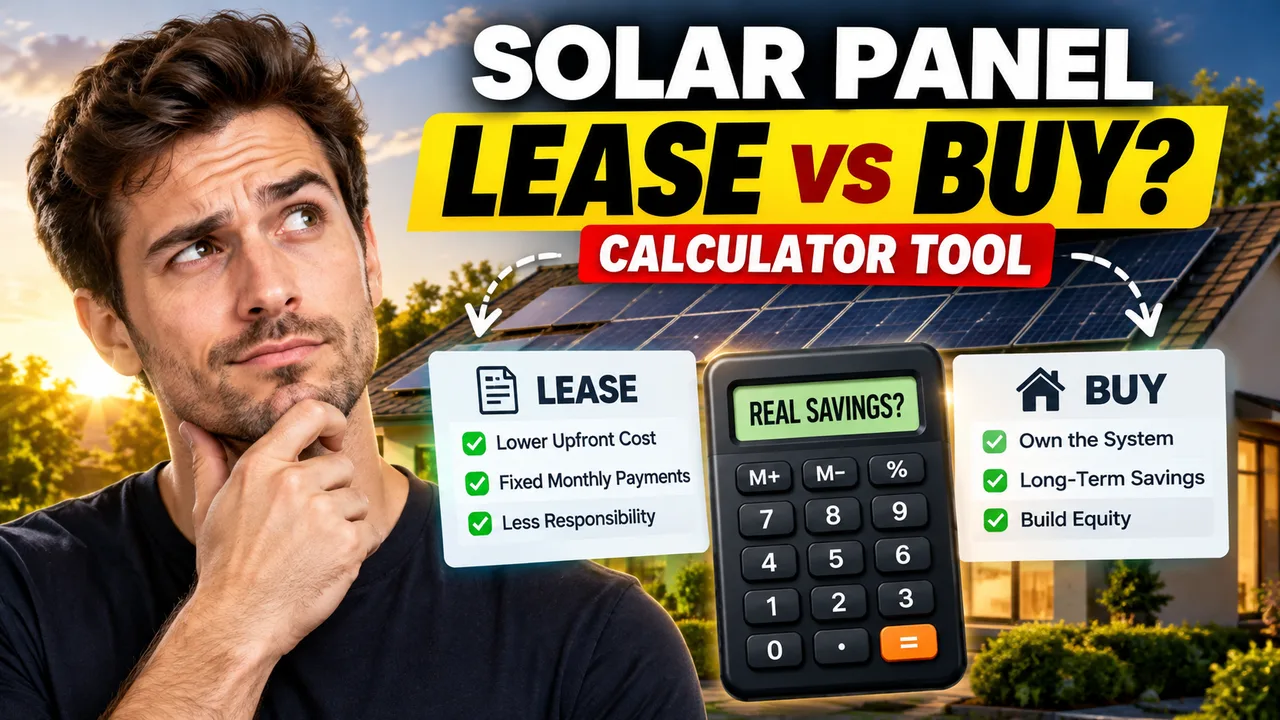
Solar Panel Lease Vs Buy Calculator
Quick answer: The Solar Panel Lease Vs Buy Calculator is a financial comparison tool designed to help homeowners evaluate leasing solar panels versus purchasing a solar energy system. By comparing estimated installation costs, lease payments, electricity savings, financing costs, and long-term expenses, users can assess which option may offer better financial value over a chosen period.
Leasing and buying solar panels can produce different financial outcomes, even when both options provide electricity from the same rooftop system. Buying generally involves an upfront purchase or loan payments, while leasing typically involves recurring payments under a contract. The right choice depends on the installed system price, electricity rates, lease terms, maintenance responsibilities, financing costs, and how long the homeowner expects to stay in the property.
The Solar Panel Lease Vs Buy Calculator provides a structured way to compare these costs. The exact fields, supported financing options, and calculation outputs depend on the calculator's implementation. The framework below explains the financial variables and comparison methodology that should be used to evaluate the two alternatives.
Key Takeaways
- Primary function: Compare the estimated financial consequences of leasing and purchasing a residential solar system.
- Important inputs: System price, down payment, loan terms, lease payments, annual electricity savings, and comparison period.
- Useful outputs: Estimated cumulative costs, net savings, break-even timing, and the difference between the two ownership options, when supported by the calculator.
- Best suited for: Homeowners comparing solar proposals before signing a lease, loan, or purchase agreement.
How to Use Solar Panel Lease Vs Buy Calculator?
- Gather your solar quotes. Obtain the cash purchase price, any proposed loan terms, the lease payment schedule, and the estimated annual electricity bill savings.
- Enter comparable financial assumptions. Use the same system capacity, estimated electricity production, utility rates, and evaluation period for both alternatives wherever possible.
- Include ongoing costs. Account for loan interest, lease escalators, maintenance responsibilities, insurance, inverter replacement, and other costs when applicable and supported by the calculation method.
- Compare the results. Review cumulative costs and estimated savings over the same period. Confirm whether the calculator includes residual equipment value, tax incentives, utility rate changes, or home-sale considerations.
Input and Output Example
The following illustrative example shows how a lease-versus-buy comparison can be structured. These are example assumptions, not results generated by a verified live calculator.
Example inputs
| Financial variable | Illustrative value | Meaning |
|---|---|---|
| Solar purchase price | $24,000 | Total installed cost before any applicable incentives. |
| Purchase financing | $4,000 down payment | Initial cash contribution toward the purchased system. |
| Loan principal | $20,000 | Amount financed after the down payment. |
| Loan term | 10 years | Illustrative repayment period. |
| Initial monthly lease payment | $150 | Starting payment under a hypothetical lease. |
| Annual electricity bill savings | $2,400 | Estimated avoided electricity costs for either alternative. |
| Comparison period | 20 years | Period used to evaluate cumulative financial outcomes. |
Example interpretation
For a cash purchase, the initial system outlay is $24,000. If annual electricity bill savings remain at $2,400 for 20 years, the simplified cumulative savings would be $48,000 before maintenance, degradation, financing, taxes, utility charges, and other adjustments. Subtracting the initial price produces $24,000 in simplified net savings.
For a lease, an initial payment of $150 per month corresponds to $1,800 in the first year. If that payment remained constant for 20 years, cumulative lease payments would total $36,000. With the same simplified $48,000 in avoided electricity costs, the difference would be $12,000 before other costs and contract terms. This is not a valid final comparison unless the lease actually lasts 20 years, the payment remains constant, and the savings estimate is applicable to the leased system.
The example demonstrates why lease escalators, loan interest, equipment maintenance, ownership-related incentives, and system performance must be considered before drawing a conclusion.
Solar Lease Vs Buy: Financial Reference Table
| Comparison factor | Buying solar panels | Leasing solar panels |
|---|---|---|
| Initial expense | May require the full purchase price or a down payment. | May require little or no upfront payment, depending on the contract. |
| Recurring payment | Cash buyers have no solar loan payment; financed buyers repay principal and interest. | Payments follow the lease agreement and may increase over time. |
| Equipment ownership | The homeowner generally owns the system after purchase, subject to financing terms. | The leasing company generally retains ownership during the lease. |
| Maintenance | The owner may be responsible for repairs and component replacement. | The contract may assign some maintenance and repair obligations to the lessor. |
| Tax incentives | Eligibility depends on current law, ownership, and individual circumstances. | Incentives associated with system ownership generally depend on the owner and applicable rules. |
| Home sale | An owned system may be transferred with the property or handled as part of the sale. | A lease may require transfer approval, assumption by the buyer, or another contractual arrangement. |
| Long-term value | May provide greater lifetime financial value when ownership costs are reasonable and the system performs as expected. | May offer predictable payments or reduced maintenance responsibilities, but contract costs affect total value. |
How the Solar Lease Vs Buy Calculation Works
A useful comparison estimates total costs and electricity savings for both alternatives over the same analysis period. It should distinguish cash flow from net financial value: paying less during the first year does not necessarily mean paying less over the system's full life.
1. Total cost of buying
For a cash purchase, a simplified calculation is:
Net Cost of Buying = Purchase Price + Ownership Costs − Applicable Incentives
For a financed purchase, include the down payment and scheduled loan repayments, including interest and applicable fees. Avoid counting both the full purchase price and all loan principal repayments as separate expenses, because that would double-count the principal.
2. Total cost of leasing
A simplified lease calculation is:
Total Lease Cost = Upfront Fees + Sum of Scheduled Lease Payments + Other Owner-Paid Costs
For a lease with a fixed annual escalation rate, payments can be modeled as:
Monthly Payment in Year t = Initial Monthly Payment × (1 + Escalation Rate)t − 1
Here, t is the lease year, starting at 1. The escalation formula applies only when the agreement specifies a consistent percentage increase each year. Actual contracts may use a different schedule.
3. Net financial benefit
For either option, a simplified cumulative net benefit is:
Net Benefit = Cumulative Electricity Bill Savings − Net System Costs
To compare buying and leasing fairly, calculate the difference using the same evaluation period and consistent assumptions. For a more rigorous comparison, discount future cash flows to present value and account for the time value of money.
Technical Assumptions and Limitations
- Electricity savings are estimates. Actual savings depend on solar production, self-consumption, utility tariffs, export compensation, fixed utility charges, and future rate changes.
- Lease payments may escalate. A flat monthly payment assumption can materially understate the cost of a lease with scheduled annual increases.
- Loan costs matter. Interest rates, loan fees, dealer fees, repayment duration, and any balloon payment affect the purchase scenario.
- System output can decline. Panel degradation, shading, inverter performance, equipment failure, and local weather can affect projected savings.
- Tax benefits are conditional. Eligibility depends on jurisdiction, applicable law, ownership structure, and the user's circumstances. Do not assume an incentive automatically applies.
- Contract terms can change the result. Early termination, lease transfer, buyout provisions, roof repairs, and end-of-term removal may create additional costs.
- Comparison periods must match. Comparing a 10-year loan with 25 years of lease payments without accounting for post-loan ownership and residual system value can misrepresent the result.
Important implementation note: The supplied tool name and image URL do not establish the live calculator's actual input fields, formulas, output labels, or processing behavior. The examples and formulas above are explanatory financial methods, not a claim that the current implementation supports every listed variable or output.
Author Information
Author: Daniel Brooks — Solar Finance and Energy Economics Writer.
Technical Review: The comparison methodology should be reviewed by a qualified solar finance professional before being used to support consumer financial decisions. This statement describes a recommended review standard, not confirmation that the live calculator has undergone such a review.
Technical Disclaimer: This calculator is intended to support preliminary financial comparisons, not guarantee savings or provide individualized tax, legal, or investment advice. Validate proposal details, current incentive rules, utility tariffs, financing documents, and lease obligations before making a commitment.
Authoritative References