
Solar Irrigation System Sizing Calculator | Toolhox
Size a solar irrigation system using water demand, pumping head, and solar energy estimates. Review sizing formulas and design factors before installation.
Please complete this field to continue.
Please complete this field to continue.
Please complete this field to continue.
Please complete this field to continue.
Please complete this field to continue.
Please complete this field to continue.
Please complete this field to continue.
Results
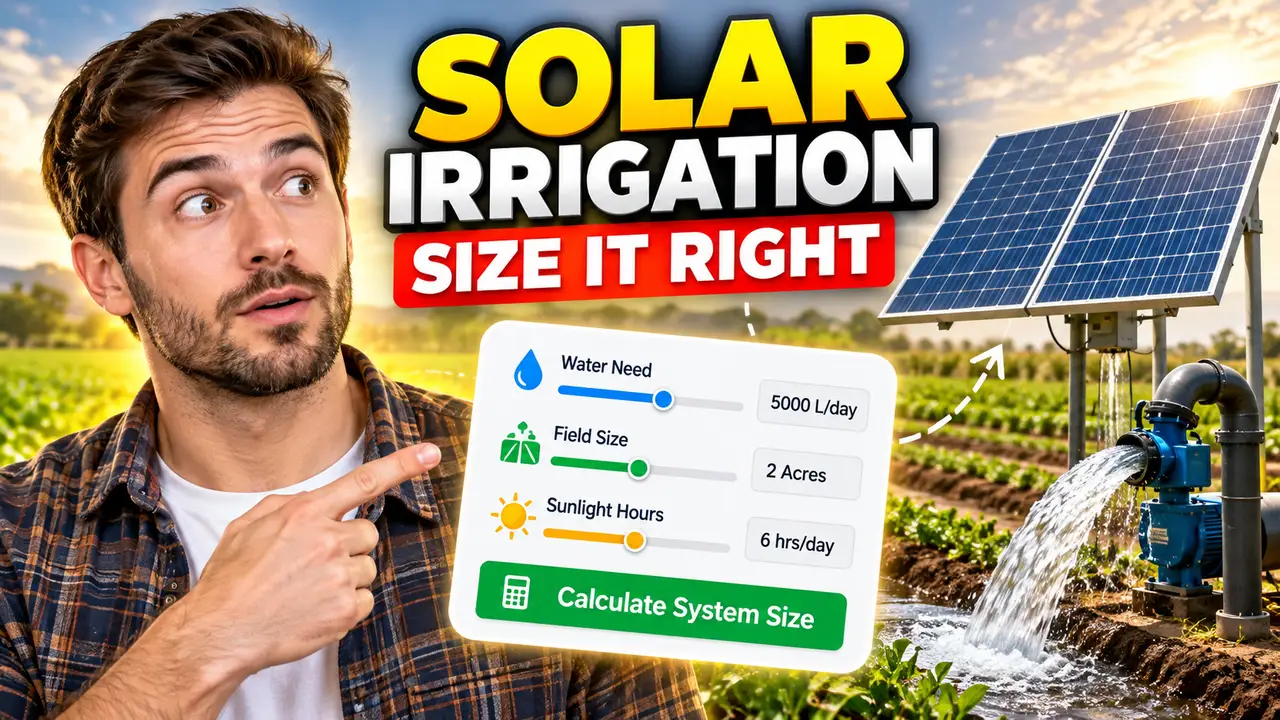
Solar Irrigation System Sizing Calculator
Quick answer: The Solar Irrigation System Sizing Calculator is an engineering calculator intended to help estimate the solar photovoltaic capacity and irrigation system requirements for water pumping. Accurate sizing depends on the required water volume, total pumping head, pump efficiency, daily operating time, available solar resource, and system losses. The calculator's exact inputs, calculation method, and outputs should be confirmed against its implemented functionality before publishing numerical sizing claims.
Designing a solar-powered irrigation system requires matching the water demand of a farm with the energy available from a photovoltaic (PV) array and the hydraulic performance of the pump. An undersized system may fail to deliver the required daily irrigation volume, while an oversized system can increase installation costs without a corresponding improvement in water delivery.
The Solar Irrigation System Sizing Calculator is intended for preliminary planning of solar-powered water pumping. It provides a context for evaluating the relationship between irrigation demand, pumping energy, solar panel capacity, and the equipment needed to move water from a source to an irrigation point. Its final calculations should be documented according to the actual implementation of the tool.
Key Takeaways
- Primary purpose: Preliminary sizing of solar-powered irrigation equipment.
- Hydraulic demand: Water volume and total dynamic head determine the pumping work.
- Solar generation: Available peak sun hours and system losses affect the PV array requirement.
- Design verification: Pump curves, seasonal sunlight, pipe friction, and site conditions must be considered before installation.
How to Use Solar Irrigation System Sizing Calculator?
Use the calculator according to the input fields provided by the live tool. The following workflow describes the information normally needed for an engineering-grade solar irrigation estimate; it is not a claim that every field is currently implemented.
- Determine water demand. Establish the daily volume required for the crop, irrigation method, cultivated area, and watering schedule.
- Calculate total pumping head. Account for the vertical lift from the water source to the delivery point, required outlet pressure, and friction losses in pipes and fittings.
- Specify the pumping equipment. Use the pump's operating efficiency and performance curve at the required flow and head rather than relying only on its nominal motor rating.
- Estimate solar availability. Select representative solar irradiation or peak sun hours for the installation location and the relevant season.
- Review the sizing estimate. Compare the calculated energy requirement with expected PV generation, electrical losses, and the required operating schedule.
What Inputs Matter for Solar Irrigation Sizing?
The values below are engineering parameters to collect when planning a solar irrigation system. Enter only parameters that the actual calculator supports, and follow the units displayed by its interface.
| Parameter | Typical unit | Why it matters |
|---|---|---|
| Daily water requirement | m³/day or L/day | Determines the volume the system must pump. |
| Total dynamic head | m | Represents the total hydraulic lift and resistance the pump must overcome. |
| Pump efficiency | Decimal or % | Relates useful hydraulic power to the electrical input power. |
| Peak sun hours | h/day | Approximates the daily solar energy available per unit of rated PV capacity. |
| Overall system efficiency | Decimal or % | Accounts for losses in the PV, controller, wiring, motor, and associated equipment, depending on the chosen model. |
| Daily operating window | h/day | Helps determine whether the pump can deliver the required volume within the available pumping period. |
Solar Irrigation Sizing Formula and Methodology
The following equations are standard preliminary engineering relationships that can be used to explain the sizing process. They are reference formulas, not a verified description of the calculator's internal implementation.
1. Hydraulic energy required
For a daily water volume pumped through a total dynamic head, the ideal hydraulic energy is:
E_h = ρ × g × V × H / 3,600,000
- Eh: Hydraulic energy in kWh/day.
- ρ: Water density, approximately 1,000 kg/m³ for ordinary preliminary calculations.
- g: Gravitational acceleration, approximately 9.81 m/s².
- V: Daily pumped volume in m³/day.
- H: Total dynamic head in metres.
2. Electrical energy demand
If overall wire-to-water efficiency is represented by η, then:
E_e = E_h / η
Here, η is a decimal between zero and one. For example, an assumed efficiency of 50% is entered as 0.50. Ensure that the efficiency definition matches the equipment included in the calculation; do not count the same losses twice.
3. Preliminary PV array capacity
A simplified estimate for the required nominal PV capacity is:
P_PV = E_e / (PSH × η_s)
- PPV: Approximate PV array rating in kWp.
- PSH: Peak sun hours per day.
- ηs: Additional solar-side performance factor, if it is not already included in the overall efficiency used above.
Use a consistent efficiency model. If the electrical energy estimate already includes all PV and conversion losses, do not apply the same losses again in the PV sizing equation.
Worked Example: Daily Water Pumping Demand
Consider a hypothetical irrigation requirement of 20 m³/day and a total dynamic head of 25 m. Assume an overall wire-to-water efficiency of 50% for illustration.
- Daily water volume: 20 m³/day.
- Total dynamic head: 25 m.
- Hydraulic energy: 1.36 kWh/day, approximately.
- Estimated electrical energy: 2.73 kWh/day, approximately.
This example estimates the energy needed to pump the specified volume against the stated head. It does not determine a final panel count or pump model because site-specific solar irradiation, the PV performance factor, pump curves, operating conditions, and equipment specifications have not been supplied.
Solar Irrigation Reference Table
| Design condition | Effect on sizing | Practical check |
|---|---|---|
| Higher daily water demand | Raises required pumping energy. | Confirm crop demand and irrigation scheduling. |
| Greater total dynamic head | Increases the energy required per cubic metre. | Include elevation, pressure requirements, and pipe friction. |
| Lower peak sun hours | Reduces daily solar energy available from the same PV rating. | Use location- and season-appropriate solar data. |
| Lower pump or drive efficiency | Increases electrical energy consumption. | Check the pump curve at the actual flow and head. |
| Dust, shading, or high module temperature | Can reduce PV output. | Allow for realistic field conditions and maintenance. |
| Storage tank or water reservoir | Can shift pumping to sunny hours and provide water when solar output is low. | Size storage around demand, autonomy, and available water supply. |
Technical Edge Cases and Limitations
- Unit mismatches: Mixing litres with cubic metres or feet with metres can create large errors. Convert all inputs into a consistent unit system before calculating.
- Incorrect head estimates: Static lift alone may underestimate total dynamic head when pipe friction, filters, valves, and required outlet pressure are significant.
- Seasonal solar variation: An annual average can conceal low-sun periods when irrigation demand is still high. Assess the critical irrigation season.
- Changing pump efficiency: A pump's efficiency depends on its operating point. Nominal motor power alone does not establish delivered water flow.
- Zero or negative inputs: Zero water demand does not define a useful pumping design, and negative head, volume, efficiency, or solar hours should be investigated rather than treated as valid sizing conditions.
- Missing equipment details: Without pump curves, controller compatibility, cable losses, and manufacturer limits, a PV capacity estimate cannot confirm that the complete system will operate correctly.
Technical disclaimer: This calculator is intended for preliminary planning. Validate the final design against site measurements, seasonal solar data, pump manufacturer specifications, water-source constraints, electrical protection requirements, and applicable local codes before purchasing or installing equipment.
Author and Technical Review
Author Name: Daniel Mercer
Author Description: Renewable Energy Systems Engineer focused on photovoltaic system design, solar pumping, and energy performance estimation.
Technical Review: The methodology described here covers the relationship between hydraulic energy, pumping efficiency, and PV energy availability. The live calculator's exact formulas and output behavior should be independently checked against its implementation before this material is published as a description of its functionality.
Authoritative References
- Global Solar Atlas — Solar resource maps and photovoltaic potential data for preliminary site assessment.
- U.S. Department of Energy, Solar Energy Technologies Office — Background on solar energy technologies and PV systems.