
Hvac Air Changes Per Hour Calculator - Online Tool
Calculate HVAC air changes per hour from room dimensions and airflow. Use the ACH formula to estimate ventilation rates for HVAC planning.
Please complete this field to continue.
Please complete this field to continue.
Please complete this field to continue.
Please complete this field to continue.
Please complete this field to continue.
Results
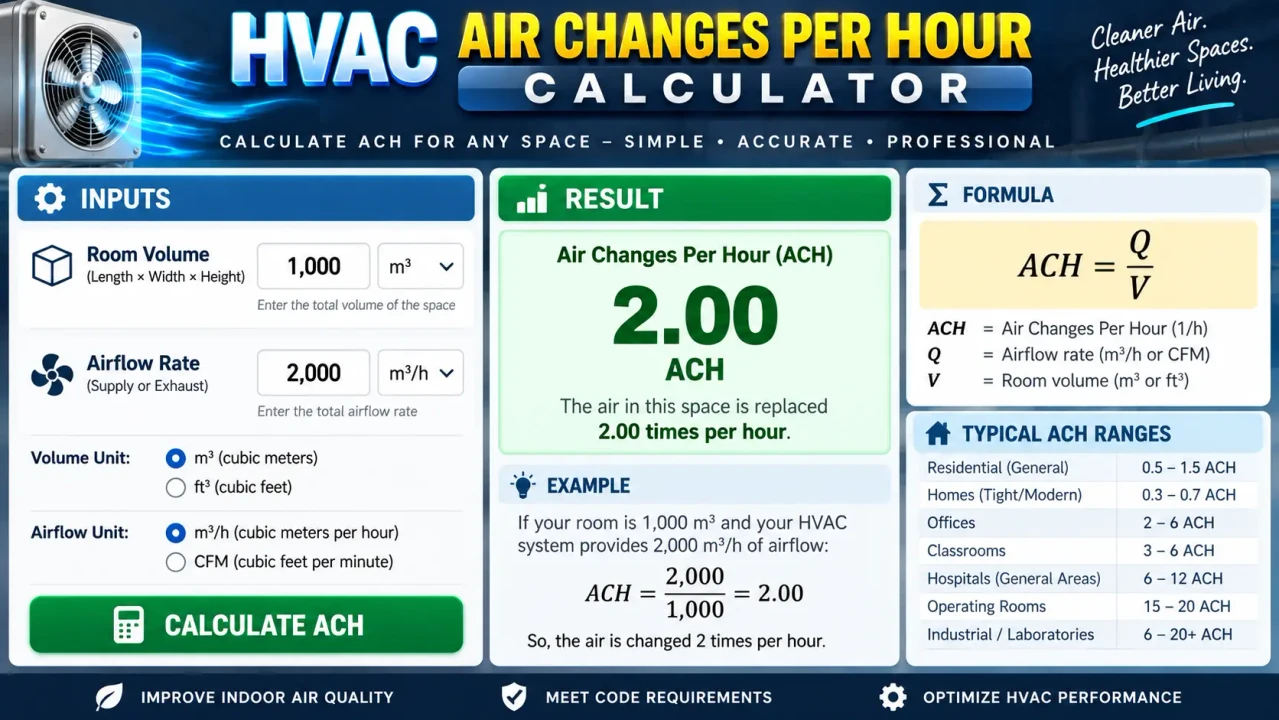
Hvac Air Changes Per Hour Calculator Online Now
Quick answer: The Hvac Air Changes Per Hour Calculator estimates air changes per hour (ACH) from room volume and airflow. ACH expresses how many times an amount of air equal to the room volume is supplied or exhausted in one hour.
TL;DR / Key Takeaways
- Primary Function: Calculate HVAC air changes per hour (ACH).
- Core Inputs: Room dimensions and airflow in cubic feet per minute (CFM), where applicable.
- Core Formula: ACH = (CFM × 60) ÷ room volume.
- Best Suited For: Preliminary ventilation-rate calculations and HVAC airflow checks.
Air changes per hour (ACH) is a ventilation metric that compares the volume of air moving through a space with the volume of the space itself. To calculate the room volume in cubic feet, multiply length by width by ceiling height. When airflow is measured in cubic feet per minute (CFM), multiplying it by 60 converts the airflow to cubic feet per hour.
The resulting relationship is:
ACH = (CFM × 60) ÷ Room Volume
For example, a 20 ft × 15 ft × 10 ft room has a volume of 3,000 ft³. With an airflow rate of 500 CFM, the calculated air-change rate is:
ACH = (500 × 60) ÷ 3,000 = 10 ACH
This means the measured airflow is equivalent to 10 room volumes of air per hour under the calculation's stated assumptions.
How to Use Hvac Air Changes Per Hour Calculator Online Now?
- Measure the room: Enter the room length, width, and height using consistent units.
- Determine airflow: Enter the relevant HVAC airflow rate in CFM.
- Calculate room volume: Multiply length × width × height to obtain cubic feet.
- Calculate ACH: Multiply CFM by 60 and divide by room volume.
What Inputs Are Used?
Room length, width, and height determine the enclosed room volume. If dimensions are entered in feet, the resulting volume is in cubic feet.
Airflow in CFM represents cubic feet of air moved per minute. The hourly airflow is obtained by multiplying CFM by 60.
The calculator therefore connects the physical size of the space with the measured or specified airflow rather than treating ACH as an independent value.
Input and Output Example
| Input | Example Value |
|---|---|
| Room length | 20 ft |
| Room width | 15 ft |
| Room height | 10 ft |
| Airflow | 500 CFM |
Room volume: 20 × 15 × 10 = 3,000 ft³
Hourly airflow: 500 × 60 = 30,000 ft³/hour
ACH: 30,000 ÷ 3,000 = 10 ACH
ACH Formula and Methodology
The standard airflow relationship used for a basic ACH calculation is:
ACH = (Q × 60) ÷ V
- ACH = air changes per hour.
- Q = airflow in CFM.
- 60 = minutes per hour.
- V = room volume in cubic feet.
Room volume is calculated as:
V = Length × Width × Height
The reverse calculation can also be used when a target ACH is known and the required airflow is being estimated:
CFM = (ACH × Room Volume) ÷ 60
For example, a 3,000 ft³ room requiring a calculated target of 6 ACH would require:
CFM = (6 × 3,000) ÷ 60 = 300 CFM
HVAC ACH Reference Table
| Room Volume | Airflow | Calculated ACH |
|---|---|---|
| 1,000 ft³ | 100 CFM | 6 ACH |
| 2,000 ft³ | 200 CFM | 6 ACH |
| 3,000 ft³ | 300 CFM | 6 ACH |
| 3,000 ft³ | 500 CFM | 10 ACH |
| 4,000 ft³ | 800 CFM | 12 ACH |
The table illustrates an important property of ACH: for the same room volume, doubling the airflow doubles the calculated ACH. For the same airflow, increasing room volume decreases the calculated ACH.
Technical Considerations, Edge Cases, and Limitations
Unit consistency
Length, width, and height must produce a room volume in the same volume units used by the airflow calculation. The basic formula above assumes cubic feet and CFM. Mixing feet with meters without conversion produces an incorrect result.
Zero or invalid room volume
A room volume of zero cannot be used because the ACH calculation divides airflow by room volume. Negative dimensions are also physically invalid inputs for a room-volume calculation.
Supply versus exhaust airflow
A space can have separate supply and exhaust airflow measurements. The appropriate airflow value depends on the purpose of the calculation and the ventilation arrangement. CDC guidance notes that, in certain ventilation assessments, the larger supply or exhaust value is used rather than simply adding the two together.
ACH is not automatically equivalent to effective contaminant removal
A calculated ACH describes an airflow-to-volume relationship. It does not by itself prove uniform air mixing or a particular contaminant-removal time. Air distribution, room mixing, filtration, leakage, airflow direction, and the presence of pollutant sources can affect real-world performance.
Target ACH is application-dependent
There is no single ACH value that is appropriate for every room or HVAC application. Design targets depend on the building, occupancy, ventilation objective, applicable code, and engineering requirements. CDC guidance, for example, discusses 5 or more ACH as a clean-air target in certain workplace infection-control contexts, while healthcare spaces can have substantially different requirements.
Engineering disclaimer
Technical Disclaimer: This calculator provides a preliminary airflow-to-room-volume calculation. Final HVAC design, ventilation compliance, equipment selection, and safety decisions should be checked against applicable building codes, project specifications, manufacturer data, and qualified HVAC engineering judgment.
Technical References
The CDC defines ACH as the ratio between airflow through a space and the volume of that space. Its ventilation guidance provides the same basic relationship of airflow multiplied by 60 and divided by room volume. :chatgpt-content-reference{index="0"}
CDC technical guidance also explains that actual airborne-contaminant removal can differ from the simple ACH calculation because the commonly used removal-time assumptions involve air mixing and other conditions. :chatgpt-content-reference{index="1"}
Author
Author Name: Daniel R. Whitmore
Author Description: HVAC systems engineer specializing in building ventilation, airflow measurement, and mechanical-system calculations.
Technical Review: Reviewed for consistency between room-volume calculations, CFM-to-hourly airflow conversion, and the standard ACH relationship used for preliminary HVAC ventilation calculations.