
Hvac Refrigerant Charge Calculator By Weight Online
Calculate HVAC refrigerant charge by weight using system target and current charge in lb or kg. Estimate refrigerant to add with a clear charge summary.
Please complete this field to continue.
Please complete this field to continue.
Please complete this field to continue.
Please complete this field to continue.
Please complete this field to continue.
Please complete this field to continue.
Please complete this field to continue.
Please complete this field to continue.
Results
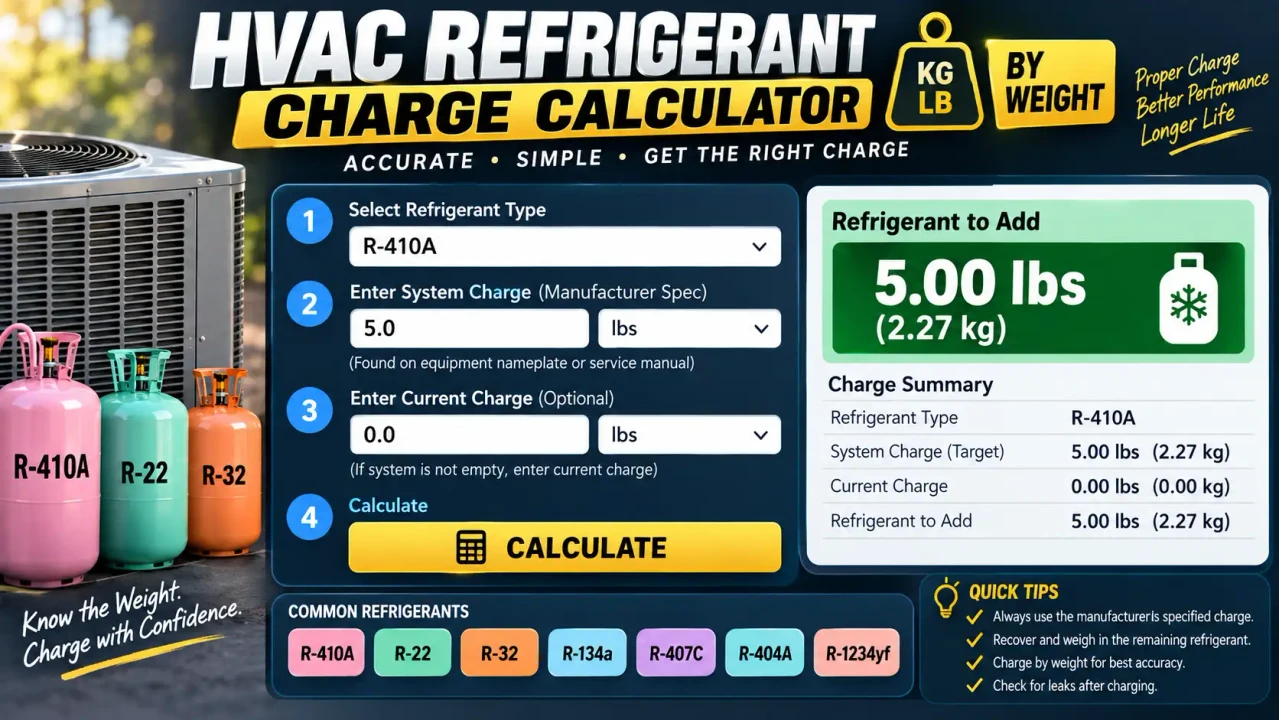
HVAC Refrigerant Charge Calculator by Weight
Quick answer: The HVAC Refrigerant Charge Calculator by Weight determines how much refrigerant should be added to an HVAC system by comparing the manufacturer's specified system charge with the current refrigerant charge. It accepts a refrigerant type, target system charge, and optional current charge in pounds or kilograms, then reports the refrigerant amount to add.
This calculator is designed for a straightforward mass-based refrigerant charge calculation. Instead of estimating charge from pressure alone, it uses the system's specified target charge and the amount of refrigerant currently in the system. The result is presented as the refrigerant quantity to add, together with a charge summary showing the refrigerant type, target charge, current charge, and calculated addition.
TL;DR / Key Takeaways
- Primary Function: Calculates refrigerant to add by comparing target and current charge.
- Key Inputs: Refrigerant type, manufacturer-specified system charge, and optional current charge.
- Units: Pounds (lb) or kilograms (kg).
- Core Output: Refrigerant to add plus a charge summary.
- Best Suited For: Weight-based HVAC refrigerant charge calculations and service planning.
How to Use HVAC Refrigerant Charge Calculator by Weight?
1. Select the refrigerant type. Choose the refrigerant identified for the equipment. The available choices shown by the tool include R-410A, R-22, R-32, R-134a, R-407C, R-404A, and R-1234yf.
2. Enter the system charge. Enter the manufacturer's specified target charge from the equipment nameplate or applicable service documentation. The calculator accepts the charge in pounds or kilograms.
3. Enter the current charge when known. If the system already contains refrigerant, enter its current measured charge. This field is optional; when the current charge is zero, the calculated addition equals the target system charge.
4. Calculate. The tool compares the target charge with the current charge and displays the amount of refrigerant to add. The result also provides a summary of the selected refrigerant and both charge values.
Input and Output Example
For example, select R-410A, enter a manufacturer-specified system charge of 5.00 lb, and enter a current charge of 0.00 lb.
| Input / Output | Value |
|---|---|
| Refrigerant type | R-410A |
| Target system charge | 5.00 lb (2.27 kg) |
| Current charge | 0.00 lb (0.00 kg) |
| Refrigerant to add | 5.00 lb (2.27 kg) |
The calculation is:
Refrigerant to Add = Target System Charge − Current Charge
Using the example:
5.00 lb − 0.00 lb = 5.00 lb
The same mass can be represented in kilograms after unit conversion. The calculator's result therefore identifies both the required addition and the underlying target/current charge values.
How the Weight Calculation Works
The core calculation is a simple mass balance:
Qadd = Qtarget − Qcurrent
- Qadd: Refrigerant quantity to add.
- Qtarget: Manufacturer-specified full system charge.
- Qcurrent: Refrigerant currently present in the system.
The refrigerant selection identifies the refrigerant being charged; the arithmetic itself is based on mass. The manufacturer's specified charge should therefore be used rather than substituting a generic charge value for a particular equipment model.
Technical Reference: Supported Refrigerants and Charge Inputs
| Tool Element | Available Choice / Input | Purpose |
|---|---|---|
| Refrigerant type | R-410A, R-22, R-32 | Identifies the refrigerant being charged |
| Refrigerant type | R-134a, R-407C, R-404A | Identifies the refrigerant being charged |
| Refrigerant type | R-1234yf | Identifies the refrigerant being charged |
| System charge | lb or kg | Manufacturer-specified target charge |
| Current charge | lb or kg | Existing refrigerant quantity, when known |
| Result | lb and kg | Calculated refrigerant quantity to add |
Edge Cases and Limitations
- Empty system: If current charge is zero, the required addition equals the target system charge.
- Partial charge: Entering an existing charge subtracts that quantity from the target.
- Current charge greater than target: The arithmetic produces a negative addition, indicating that the entered current quantity exceeds the stated target rather than indicating that more refrigerant should be added.
- Missing manufacturer specification: The calculator cannot determine a reliable equipment-specific target without a valid target charge.
- Unit consistency: Target and current quantities should be entered using compatible mass units before calculating.
- Refrigerant identification: Selecting a refrigerant does not replace the equipment manufacturer's charge specification or service requirements.
Technical Disclaimer: This calculator provides a weight-based charge calculation from the values entered by the user. It does not independently determine the correct manufacturer charge for a particular HVAC model, diagnose leaks, or replace applicable service procedures. Refrigerant handling and charging should follow the equipment manufacturer's documentation, applicable regulations, and qualified technician practice.
Related Technical Guidance
Manufacturer documentation can specify the correct full charge and, for some equipment, adjustments associated with system configuration. For example, manufacturer documentation from Trane and Carrier demonstrates that equipment-specific charge information can depend on the matched equipment and line-set configuration. The target value entered into this calculator should therefore come from the applicable equipment documentation rather than a generic refrigerant quantity.
Processing: The calculation described here is based on the numerical inputs supplied to the calculator. No claim about server-side or client-side processing is made without implementation evidence.
Technical Review: Jordan Ellis reviewed the page methodology for consistency with weight-based HVAC refrigerant charge calculations, including target-versus-current charge arithmetic and the distinction between a calculated mass addition and equipment-specific charging procedures.
Author: Jordan Ellis — HVAC technical specialist focused on refrigerant charging, service calculations, and equipment documentation.