
Hvac Heat Pump Balance Point Calculator - Thermal Point
Use the HVAC Heat Pump Balance Point Calculator to estimate outdoor balance temperature from building heat loss and heat-pump heating capacity data.
Please complete this field to continue.
Please complete this field to continue.
Please complete this field to continue.
Please complete this field to continue.
Please complete this field to continue.
Please complete this field to continue.
Results
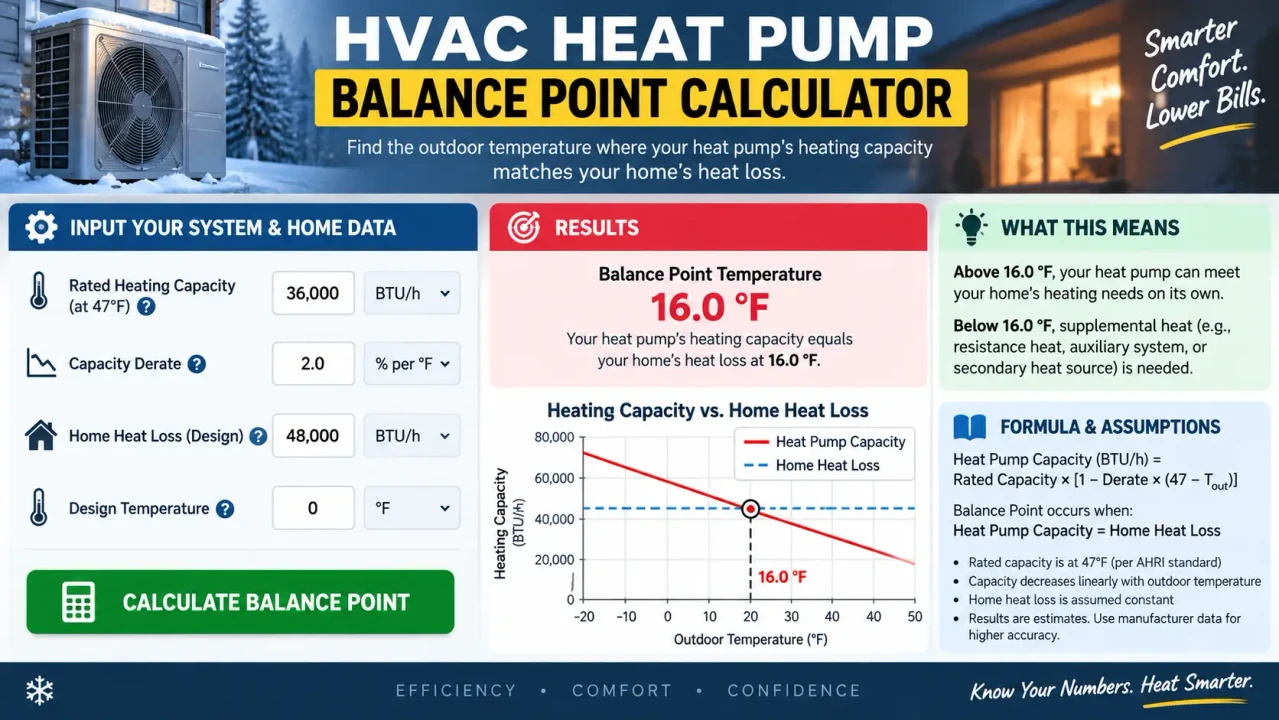
Hvac Heat Pump Balance Point Calculator
Quick answer: The Hvac Heat Pump Balance Point Calculator estimates the outdoor temperature at which a heat pump's available heating capacity matches a building's heating load. Above that temperature, the modeled heat pump can meet the load; below it, supplemental heat may be required.
The Hvac Heat Pump Balance Point Calculator is an HVAC engineering utility for evaluating the thermal balance between a building and an air-source heat pump. The balance point is not a universal temperature: it depends on the building's design heat loss, outdoor design condition, indoor design temperature, and the heat pump's capacity at the temperatures being evaluated.
TL;DR / Key Takeaways
- Primary Function: Estimate the outdoor thermal balance temperature.
- Key Inputs: Building heating-load data, design temperatures, and heat-pump heating-capacity data.
- Core Output: Estimated outdoor balance-point temperature.
- Best Suited For: HVAC planning, equipment evaluation, and supplemental-heating analysis.
What Is a Heat Pump Balance Point?
The thermal balance point is the outdoor temperature at which the building's calculated heat loss equals the heat pump's available heating output. The calculation compares two temperature-dependent relationships: building heat loss generally increases as outdoor temperature falls, while available air-source heat-pump heating capacity generally decreases as outdoor temperature falls.
This distinction matters because a heat pump's nominal tonnage does not by itself establish its heating capacity at a cold outdoor temperature. A model-specific performance table or other documented capacity data should be used when available. The balance point therefore depends on the actual design load and equipment performance rather than a fixed rule such as “30°F is the balance point.”
How to Use Hvac Heat Pump Balance Point Calculator?
- Enter the building load: Use the heating load for the space served by the equipment at the selected outdoor design temperature.
- Enter design temperatures: Provide the indoor design temperature and the outdoor design temperature associated with the heating load.
- Enter heat-pump capacity: Use comparable manufacturer heating-capacity data at the applicable outdoor temperatures.
- Calculate and review: Read the modeled balance point and compare any resulting capacity shortfall with the planned supplemental-heating strategy.
What Should the Building Heat-Loss Value Represent?
The design heat-loss input should represent the heating demand of the conditioned space at its specified outdoor design temperature. A formal building-load calculation is preferable to estimating heat loss from floor area alone because envelope construction, infiltration, ventilation, windows, and other load components affect the result.
Why Does Outdoor Temperature Matter?
As outdoor temperature falls, the temperature difference between indoors and outdoors generally increases, increasing the building's heat loss. At the same time, an air-source heat pump may deliver less heating capacity at colder outdoor temperatures. The balance point is where these two effects intersect.
Input and Output Example
Consider a hypothetical system with an indoor design temperature of 70°F, an outdoor design temperature of 17°F, and a design heating load of 30,000 BTU/hr. Suppose the matched heat pump provides 24,000 BTU/hr at 17°F and 36,000 BTU/hr at 47°F.
These values illustrate the type of relationship the calculator evaluates. The actual result depends on the calculation model and the complete set of values entered into the tool. The example is illustrative rather than a rating for a particular heat-pump model.
Example inputs
Indoor design temperature:       70°F
Outdoor design temperature:      17°F
Building design heat loss:       30,000 BTU/hr
Heat-pump capacity at 17°F:     24,000 BTU/hr
Heat-pump capacity at 47°F:     36,000 BTU/hr

Interpretation
At the 17°F design condition, the example heat pump
has less capacity than the stated building load, so
supplemental capacity would be needed at that condition.
How the Balance-Point Calculation Works
A simplified thermal balance calculation represents the building load as a temperature-dependent load line and compares it with the heat pump's heating-capacity relationship. In its simplest form, the balance condition is:
Q_loss(T_balance) = Q_HP(T_balance)Where:
- Q_loss(T_balance) = building heating demand at the balance temperature, in BTU/hr.
- Q_HP(T_balance) = heat-pump heating capacity at the same outdoor temperature, in BTU/hr.
- T_balance = outdoor thermal balance-point temperature.
For a simplified linear building-load model, the heat loss can be represented from the design load and temperature difference. One commonly used form is:
Q_loss(T) = Q_design × (T_zero − T) / (T_zero − T_design)Here, Q_design is the building's design heat loss, T_design is its associated outdoor design temperature, and T_zero represents the assumed outdoor temperature at which the modeled heating load reaches zero. The appropriate zero-load assumption depends on the calculation methodology and building conditions; it should not automatically be equated with the thermostat setting.
Heat-pump capacity can likewise be represented from documented equipment performance points. When two comparable temperature points are used in a simplified model, interpolation between those points can estimate capacity at an intermediate outdoor temperature. Manufacturer data should take precedence over a generic interpolation model when more detailed performance information is available.
Heat-Pump Capacity Reference
| Data Item | Unit | Purpose |
|---|---|---|
| Building design heat loss | BTU/hr | Represents the heating demand at the selected design outdoor temperature. |
| Indoor design temperature | °F | Defines the desired indoor design condition used by the load model. |
| Outdoor design temperature | °F | Identifies the outdoor condition associated with the design heating load. |
| Heat-pump heating capacity | BTU/hr | Represents available equipment output at a stated outdoor condition. |
| Balance-point temperature | °F | Temperature where modeled heat-pump output and building heat loss intersect. |
Thermal Balance vs. Economic Balance
A thermal balance point should not automatically be treated as an economic switchover temperature. Thermal balance asks whether the heat pump can meet the modeled heating load. Economic balance asks whether operating the heat pump costs less or more than another heat source at a particular energy price and efficiency.
A dual-fuel system can therefore have a thermal balance point and an economic changeover point that occur at different outdoor temperatures. Energy prices, heat-pump efficiency, backup-fuel efficiency, and operating controls are relevant to an economic analysis.
Technical Edge Cases and Limitations
- Nominal tonnage: Nominal equipment size should not be treated as equivalent to heating output at every outdoor temperature.
- Capacity data outside its tested range: Extending a straight-line capacity relationship beyond documented manufacturer data can produce an unreliable result.
- Variable-speed equipment: Minimum, rated, and maximum operating capacities can differ at the same outdoor temperature. The selected capacity point must match the intended analysis.
- Defrost: Defrost behavior can affect delivered heating performance and should be considered when interpreting manufacturer performance data.
- System matching: Outdoor-unit capacity can depend on the matched indoor equipment, airflow, controls, and operating conditions.
- Building-load assumptions: A balance-point estimate is only as meaningful as the heat-loss data used to generate it.
- No universal temperature: There is no single balance-point temperature that applies to every building or heat pump.
Supported Calculation Concept
- Comparison of building heating demand against heat-pump heating capacity.
- Temperature-based thermal balance analysis.
- Use of documented equipment capacity data where available.
Limitations
- The result should not be interpreted as a substitute for a complete building load calculation or equipment-selection procedure.
- Manufacturer performance data should be used for actual equipment decisions.
- A thermal balance point is not automatically a thermostat setting or an economic fuel-changeover temperature.
- Final HVAC design should account for applicable codes, manufacturer requirements, controls, defrost operation, and qualified professional judgment.
Technical Disclaimer: This calculator is intended for planning and engineering estimation. Verify the building load, matched-equipment performance data, operating conditions, and applicable HVAC design requirements before using the result for equipment selection or field changes.
Reference framework: HVAC balance-point analysis is commonly discussed in relation to building heat-loss calculations, manufacturer heat-pump performance data, and HVAC design methodologies such as ACCA Manual J and Manual S and the ASHRAE Handbook—Fundamentals.
Related HVAC Analysis
For a complete equipment decision, balance-point analysis should be considered alongside building heating-load calculations, manufacturer performance data, equipment sizing, and supplemental-heat requirements. These analyses answer different questions and should not be treated as interchangeable.
Author: Daniel R. Mercer, P.E.
Author Description: HVAC mechanical engineer specializing in building thermal loads, heat-pump system analysis, and residential mechanical-system design.
Technical Review: Reviewed for consistency of thermal balance terminology, heat-loss/capacity relationships, temperature-dependent capacity interpretation, and the distinction between thermal and economic balance points.