
Ppm To Grams Per Liter Calculator - Converter Tool
Convert ppm to grams per liter using a clear formula, worked examples, and density guidance. Calculate water-based concentrations and check conversion assumptions.
Please complete this field to continue.
Please complete this field to continue.
Results
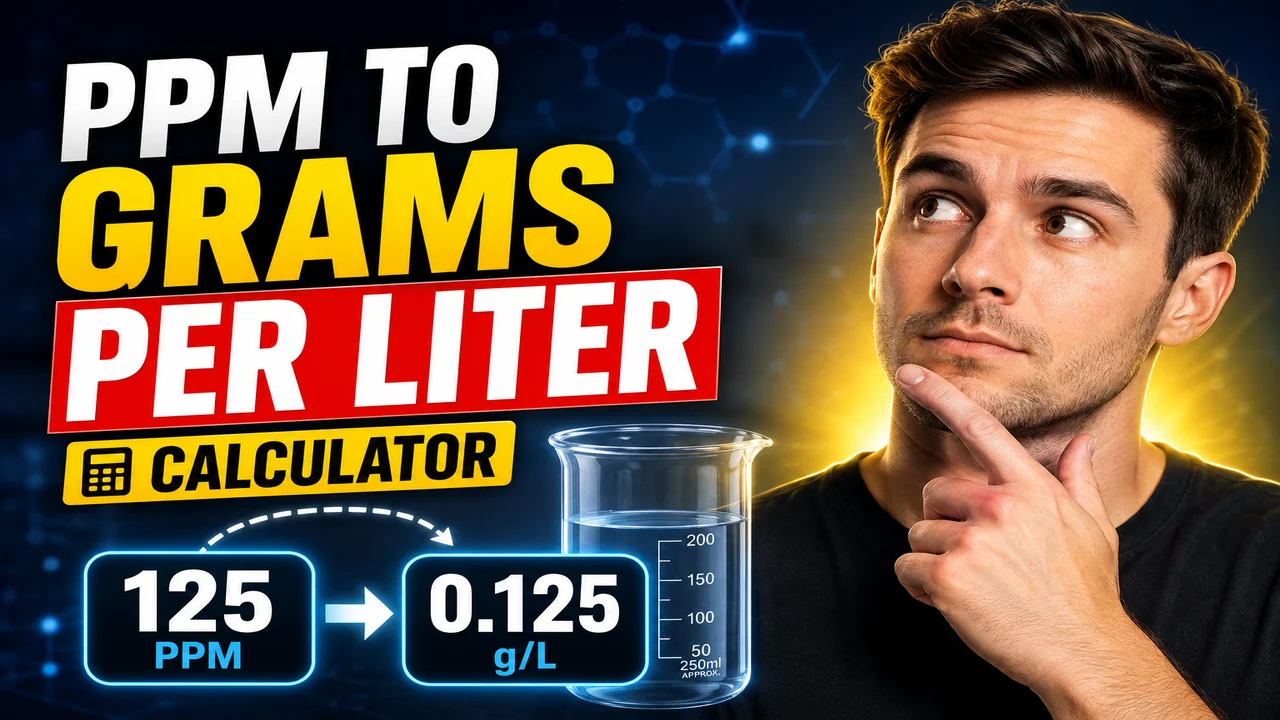
Ppm To Grams Per Liter Calculator
Quick answer: The Ppm To Grams Per Liter Calculator converts concentration values expressed in parts per million (ppm) into grams per liter (g/L). For dilute water-based solutions, the conversion is approximately g/L = ppm ÷ 1000 because 1 ppm is approximately equal to 1 mg/L.
The Ppm To Grams Per Liter Calculator is a concentration conversion utility for chemistry, water quality testing, laboratory calculations, nutrient solutions, and other applications involving dissolved substances. It helps users express a concentration in grams per liter instead of parts per million, making it easier to compare measurements and calculate the mass of a substance in a known volume of solution.
Parts per million (ppm) is commonly used to express very small concentrations. Grams per liter (g/L) expresses the mass of a substance contained in one liter of solution. The conversion is straightforward for dilute aqueous solutions, where the density is approximately 1 kilogram per liter. For solutions with significantly different densities, the density assumption must be considered.
Key Takeaways
- Primary function: Convert ppm concentration to grams per liter.
- Input: A concentration value in ppm.
- Output: An equivalent concentration in g/L.
- Common application: Dilute aqueous solutions and water-quality measurements.
- Important assumption: The simple conversion assumes approximately 1 kg/L solution density.
How to Use Ppm To Grams Per Liter Calculator?
- Enter the ppm value. Use the concentration reported by a laboratory test, measurement instrument, product specification, or calculation.
- Calculate the conversion. Apply the ppm-to-g/L formula using the appropriate density assumption.
- Read the result. Express the converted concentration in grams per liter.
- Check the assumptions. Confirm whether the original ppm value represents mass-based concentration and whether the solution can reasonably be treated as water-like.
For example, entering 250 ppm for a dilute water-based solution gives approximately 0.25 g/L. The result represents about 0.25 grams of the specified substance per liter of solution.
Input and Output Example
Consider a water sample with a measured concentration of 750 ppm. Assuming the sample has a density close to 1 kg/L, the conversion is:
Input: 750 ppm
Formula: g/L = ppm ÷ 1000
Calculation: 750 ÷ 1000 = 0.75
Output: 0.75 g/L
This means the concentration is approximately 0.75 grams of the measured substance per liter of solution. It does not mean that the entire solution contains only 0.75 grams of material; the result refers to the specified solute.
Formula for Converting Ppm to Grams Per Liter
For dilute aqueous solutions where 1 ppm is approximately 1 mg/L, use:
Grams per liter = Parts per million ÷ 1000
In mathematical notation:
g/L ≈ ppm × 0.001
The factor 0.001 converts milligrams into grams because 1 gram equals 1000 milligrams.
Density-Corrected Formula
When ppm represents a mass fraction in mg/kg and the solution density is known, use the more general relationship:
g/L = ppm × ρ ÷ 1000
Where:
- ppm: Mass-based concentration in milligrams of solute per kilogram of solution.
- ρ: Solution density in kilograms per liter (kg/L).
- g/L: Mass concentration in grams of solute per liter of solution.
- 1000: Conversion factor from milligrams to grams.
This density-corrected formula follows from multiplying mg/kg by kg/L to obtain mg/L, then dividing by 1000 to obtain g/L. Density in g/mL has the same numerical value as density in kg/L.
For water-like solutions, use ρ ≈ 1 kg/L, which simplifies the formula to g/L ≈ ppm ÷ 1000. For a solution with density 1.20 kg/L and a mass-based concentration of 500 ppm, the density-corrected result is 500 × 1.20 ÷ 1000 = 0.60 g/L.
Ppm to Grams Per Liter Conversion Table
The following reference values use the dilute aqueous solution approximation, with density treated as approximately 1 kg/L.
| Concentration (ppm) | Equivalent (mg/L) | Equivalent (g/L) |
|---|---|---|
| 1 | 1 | 0.001 |
| 10 | 10 | 0.01 |
| 25 | 25 | 0.025 |
| 50 | 50 | 0.05 |
| 100 | 100 | 0.1 |
| 250 | 250 | 0.25 |
| 500 | 500 | 0.5 |
| 750 | 750 | 0.75 |
| 1000 | 1000 | 1 |
| 5000 | 5000 | 5 |
| 10000 | 10000 | 10 |
These values are approximate when ppm is defined by mass. If the solution density differs materially from 1 kg/L, use the density-corrected formula rather than relying on this table.
How Does Ppm Differ From Grams Per Liter?
PPM and g/L describe concentration in different ways. Mass-based ppm measures the mass of solute relative to the mass of the complete solution, whereas g/L measures solute mass relative to a fixed volume of solution.
- PPM: Commonly interpreted as milligrams of solute per kilogram of solution for mass-based concentration.
- Milligrams per liter: Measures milligrams of solute in one liter of solution.
- Grams per liter: Measures grams of solute in one liter of solution.
For dilute water samples, one liter of solution has a mass close to one kilogram, so ppm and mg/L are numerically similar. However, this equivalence is not universal. The U.S. Geological Survey explains that concentration conversions depend on solution or water density and that the equivalence is a close approximation at low concentrations.
Reference: USGS Water-Quality Units and Conversion Factors.
Technical Edge Cases and Limitations
When Is the Simple Formula Appropriate?
The simple formula is suitable when the ppm value represents a mass fraction and the solution is sufficiently dilute and water-like that its density can reasonably be approximated as 1 kg/L. It is commonly used for routine freshwater concentration estimates.
When Should Density Be Included?
Use a density-corrected calculation for concentrated brines, syrups, solvents, or other solutions whose density differs significantly from water. Omitting density can produce a systematic difference between the calculated g/L value and the actual mass concentration per liter.
What About Gas-Phase PPM?
This conversion does not directly apply to gas-phase ppm by volume (ppmv). Gas concentrations may require molecular weight, temperature, pressure, and the appropriate gas-law relationship. Confirm the definition of ppm used by the measurement source before converting.
Zero, Negative, and Very Large Values
- Zero ppm: Converts to 0 g/L under either formula.
- Negative ppm: Usually does not represent a physical concentration and should be checked for data-entry or measurement errors.
- Very large ppm values: May indicate a concentrated solution for which the water-density approximation is inappropriate.
- Excess decimal places: Do not imply greater measurement accuracy. Report results according to the precision of the original measurement.
Technical Disclaimer
This calculator's conversion methodology should be applied with the correct definition of ppm and the appropriate solution density. For regulated laboratory measurements, chemical preparation, water-treatment dosing, or safety-critical applications, verify the calculation against the relevant analytical method and actual solution properties.
Frequently Asked Questions
How many grams per liter is 1 ppm?
For a dilute water-based solution, 1 ppm is approximately 0.001 g/L, because 1 ppm is approximately 1 mg/L and 1000 mg equals 1 g.
What is the formula to convert ppm to g/L?
For dilute aqueous solutions, use g/L ≈ ppm ÷ 1000. When ppm is mass-based and solution density is known, use g/L = ppm × density in kg/L ÷ 1000.
How many grams per liter is 1000 ppm?
For a water-like solution, 1000 ppm is approximately 1 g/L. A density correction may be required for solutions that differ significantly from water.
Is ppm always equal to mg/L?
No. Mass-based ppm and mg/L are different concentration units. They are approximately numerically equal for dilute water-based solutions because one liter of water has a mass close to one kilogram.
Can I convert gas ppm to grams per liter with this formula?
Not directly. Gas-phase ppm by volume requires a different conversion method that can depend on molecular weight, temperature, and pressure. The simple formula here assumes mass-based ppm in a liquid solution.
Why does solution density change the result?
PPM by mass is based on solution mass, while g/L is based on solution volume. Density determines the mass of solution in each liter, so a density different from 1 kg/L changes the converted concentration.
Author: Daniel Brooks, Chemical Engineering and Concentration Calculations Specialist.
Technical Review: The conversion methodology is based on mass-fraction definitions, unit conversion between milligrams and grams, and density-corrected concentration relationships. The assumed density should be checked against the actual solution when precision matters.