
Grams To Ml Honey Converter For Kitchen Measurements
Convert grams of honey to milliliters using an approximate density of 1.42 g/mL. Check common honey measurements and simplify your cooking and baking.
Please complete this field to continue.
Results
Grams To Ml Honey Converter
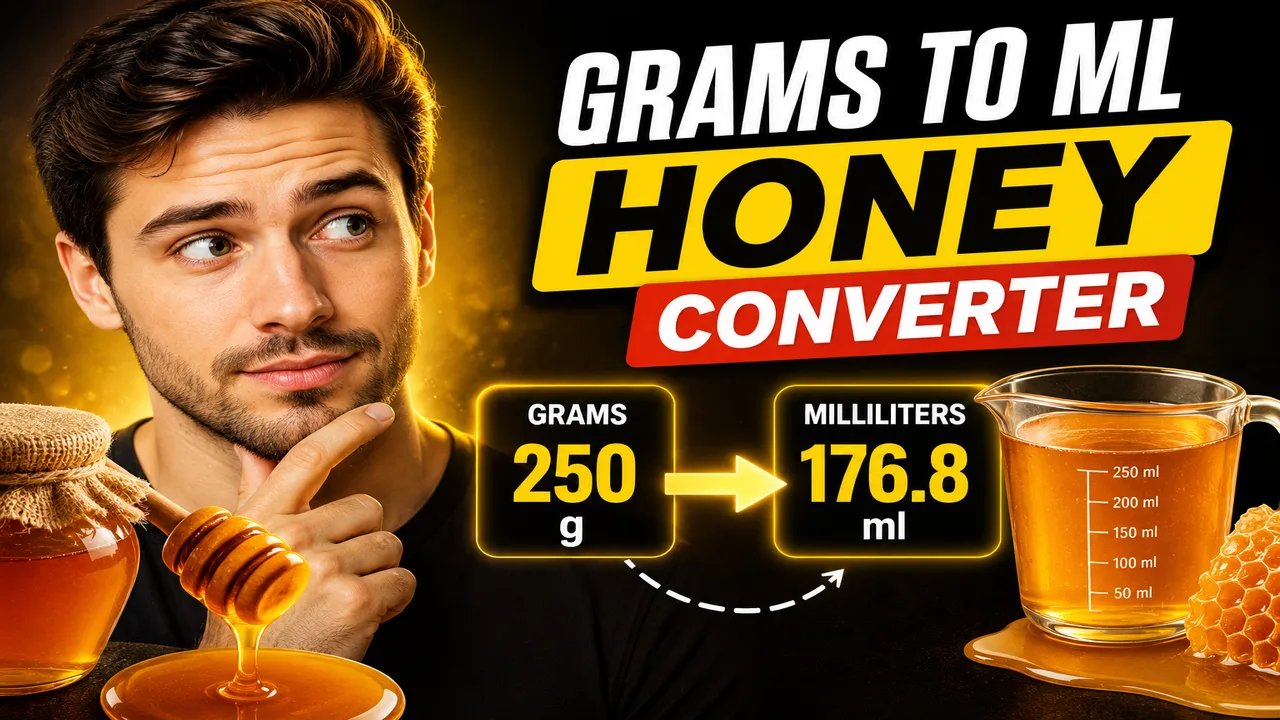
The Grams To Ml Honey Converter converts the weight of honey in grams (g) into an estimated volume in milliliters (mL). It uses an assumed honey density of 1.42 grams per milliliter to help home cooks, bakers, and food professionals translate weight-based recipes into volume measurements.
Quick answer: To convert grams of honey to milliliters, divide the honey's weight in grams by 1.42. For example, 100 grams of honey is approximately 70.42 mL using this reference density.
Key Takeaways
- Primary Function: Convert honey weight in grams to estimated volume in milliliters.
- Input: Honey mass in grams.
- Output: Approximate honey volume in mL.
- Reference Density: 1.42 g/mL, an approximate kitchen conversion value.
- Best Suited For: Baking, cooking, recipe scaling, and ingredient measurement.
How to Use Grams To Ml Honey Converter?
Use the converter to determine how much space a measured quantity of honey occupies. This is useful when a recipe lists honey by weight but your measuring equipment uses milliliters.
- Enter the weight: Input the amount of honey in grams, such as 50 g, 100 g, or 250 g.
- Convert the measurement: Apply the honey density reference of 1.42 g/mL.
- Read the volume: Obtain the estimated equivalent in milliliters.
- Measure the honey: Use the result as a practical guide for your recipe.
Enter a positive numerical weight for an ordinary cooking measurement. If your implementation supports decimal inputs, values such as 37.5 g can also be converted. The exact input validation and displayed precision depend on the implemented calculator.
Grams to Milliliters Honey Conversion Formula
The conversion relies on density, which describes the mass contained in a given volume. Grams measure mass, while milliliters measure volume, so a density value is needed to connect these two units.
Formula:
Volume (mL) = Mass (g) ÷ Density (g/mL)
Using the reference density for honey:
Volume (mL) = Mass (g) ÷ 1.42
- Volume: The estimated amount of space occupied by the honey, expressed in milliliters.
- Mass: The quantity of honey measured in grams.
- Density: The assumed honey density, expressed in grams per milliliter.
Grams to mL Honey Conversion Examples
For a practical example, convert 100 grams of honey into milliliters.
Input: 100 g of honey
Calculation: 100 ÷ 1.42 = 70.4225...
Output: Approximately 70.42 mL of honey.
The same formula applies to larger and smaller quantities. The following reference table uses the same assumed density of 1.42 g/mL throughout.
Honey Grams to Milliliters Conversion Chart
| Honey Weight (g) | Estimated Volume (mL) | Calculation |
|---|---|---|
| 5 g | 3.52 mL | 5 ÷ 1.42 |
| 10 g | 7.04 mL | 10 ÷ 1.42 |
| 25 g | 17.61 mL | 25 ÷ 1.42 |
| 50 g | 35.21 mL | 50 ÷ 1.42 |
| 75 g | 52.82 mL | 75 ÷ 1.42 |
| 100 g | 70.42 mL | 100 ÷ 1.42 |
| 150 g | 105.63 mL | 150 ÷ 1.42 |
| 200 g | 140.85 mL | 200 ÷ 1.42 |
| 250 g | 176.06 mL | 250 ÷ 1.42 |
| 500 g | 352.11 mL | 500 ÷ 1.42 |
| 1000 g | 704.23 mL | 1000 ÷ 1.42 |
These values are rounded to two decimal places. They are estimates rather than universal measurements because honey density can vary with water content, temperature, and product composition.
Why Is Honey Heavier Than Water?
Honey generally has a higher density than water. Water has a reference density close to 1 g/mL under ordinary conditions, while honey is commonly estimated at approximately 1.4 g/mL for kitchen conversions. Consequently, the same volume of honey weighs substantially more than the same volume of water.
This distinction explains why a direct one-to-one conversion between grams and milliliters is inappropriate for honey. Dividing the mass by the selected density produces a more suitable volume estimate.
Technical Limitations and Measurement Accuracy
- Density variation: The reference value of 1.42 g/mL is an approximation. Actual honey may have a different density.
- Temperature: Temperature changes can affect honey density and viscosity.
- Honey composition: Moisture content, sugar composition, and processing can change the mass-to-volume relationship.
- Rounding: Displayed decimal places can cause small differences when the result is compared with an unrounded calculation.
- Measuring equipment: Honey that remains on a spoon or measuring cup can affect the amount transferred into a recipe.
- Input boundaries: Negative weights are not meaningful for ordinary ingredient measurements. Zero grams corresponds to zero milliliters under the formula.
For baking, use a kitchen scale when the recipe specifies honey by weight. Weight-based measurements are generally more reproducible than estimating the volume of a sticky liquid. For commercial production or laboratory work, use a density value appropriate to the particular honey and measurement conditions.
Authoritative Measurement References
For broader food-composition and measurement context, consult these resources:
- USDA FoodData Central — food composition and food measurement reference data.
- USDA Agricultural Research Service — food and agricultural research, including food-composition resources.
Technical Disclaimer: This converter provides an estimated kitchen measurement based on an assumed density. It is not a substitute for a measured product-specific density when precision is critical.
Author: Jordan Miller, Food Measurement Specialist with a focus on culinary conversions and ingredient measurement.
Technical Review: The conversion methodology uses the relationship between mass, volume, and density. The reference density and rounding assumptions should be checked against the calculator's implemented settings before publication.