
Voltage Regulation Percentage Calculator Interactive
Calculate voltage regulation percentage from no-load and full-load voltage values. Apply the standard formula to evaluate transformer and power-supply voltage changes.
Please complete this field to continue.
Please complete this field to continue.
Results
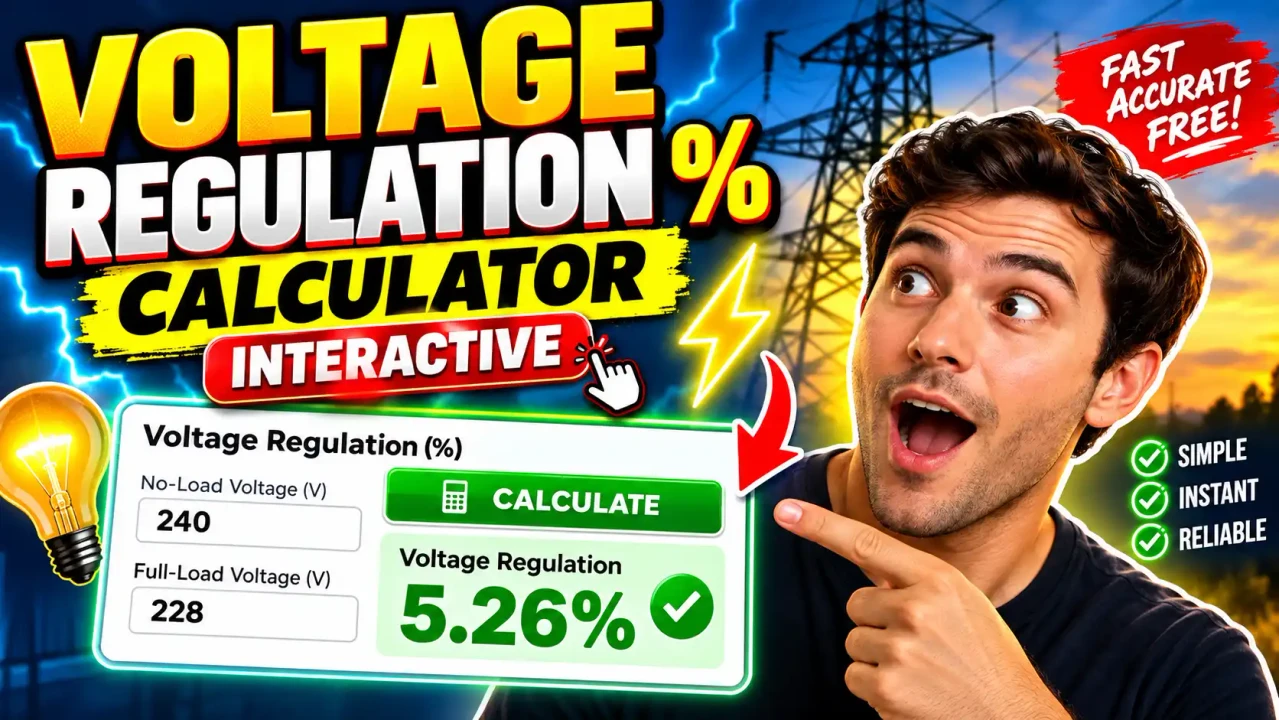
Voltage Regulation Percentage Calculator Interactive
Quick answer: The Voltage Regulation Percentage Calculator Interactive is an electrical engineering calculator designed to determine the percentage change in voltage between a no-load condition and a loaded condition. It helps users evaluate voltage stability in transformers, power supplies, generators, and electrical distribution systems using voltage measurements and the percentage voltage regulation formula.
Voltage regulation percentage describes how much a device's output voltage changes when its load changes, relative to a specified reference voltage. It is an important parameter for evaluating transformer performance, power supply stability, and electrical equipment operating conditions.
The Voltage Regulation Percentage Calculator Interactive is intended for electrical engineering students, technicians, educators, and engineers who need to calculate voltage regulation from measured or specified voltage values. The calculation can help compare equipment performance, assess voltage drop under load, and understand how electrical loads affect delivered voltage.
What Is Voltage Regulation Percentage?
Voltage regulation percentage expresses the difference between no-load voltage and full-load voltage as a percentage of the full-load voltage in the conventional transformer voltage-regulation definition. A larger positive value generally indicates a greater reduction in terminal voltage when the load is applied.
For a transformer operating at a specified primary voltage and frequency, voltage regulation is commonly evaluated by comparing its secondary terminal voltage at no load with its secondary terminal voltage at a defined load. The result depends on operating conditions, including load magnitude, power factor, and the equipment's internal impedance.
How to Use Voltage Regulation Percentage Calculator Interactive?
- Enter the no-load voltage: Provide the measured or specified output voltage when the equipment is operating without its intended load.
- Enter the loaded voltage: Provide the output voltage measured under the chosen load condition, such as full load.
- Check the voltage units: Use consistent units for both measurements, such as volts for both inputs.
- Calculate and review: Read the resulting voltage regulation percentage and compare it with the applicable equipment specification or design requirement.
The exact input fields and output presentation depend on the calculator's implemented interface. Use the field labels displayed by the interactive calculator as the definitive guide to its supported inputs.
Voltage Regulation Percentage Formula
A commonly used transformer voltage regulation formula is:
Voltage Regulation (%) = [(VNL − VFL) / VFL] × 100
Where:
- VNL: Output or secondary terminal voltage at no load, measured in volts.
- VFL: Output or secondary terminal voltage at full load, measured in volts.
- Voltage Regulation (%): The calculated percentage voltage change relative to the full-load voltage.
Both voltage measurements must use the same unit. Because the formula divides by the full-load voltage, that voltage must be nonzero.
Worked Example: Transformer Voltage Regulation
Consider a transformer with a no-load secondary voltage of 240 V and a full-load secondary voltage of 230 V.
- No-load voltage: 240 V
- Full-load voltage: 230 V
- Voltage difference: 240 − 230 = 10 V
- Percentage calculation: (10 / 230) × 100
Result: approximately 4.35% voltage regulation.
This means that the no-load voltage is approximately 4.35% higher than the full-load voltage when the full-load voltage is used as the reference.
Voltage Regulation Calculation Reference Table
| No-Load Voltage | Full-Load Voltage | Voltage Regulation |
|---|---|---|
| 240 V | 230 V | 4.35% |
| 230 V | 220 V | 4.55% |
| 120 V | 115 V | 4.35% |
| 230 V | 230 V | 0% |
| 220 V | 230 V | −4.35% |
The examples use the formula above and are rounded to two decimal places. A negative result indicates that the loaded voltage is higher than the no-load voltage under the stated reference convention. Such a result may occur under certain operating conditions, including capacitive loading, but should be checked against the actual measurement setup and definition being used.
How the Calculation Works
The calculator's mathematical method is based on the difference between the two voltage values and the selected reference voltage. The conventional formula above uses full-load voltage as the denominator. Other technical references may define percentage voltage change using no-load voltage as the reference, so the denominator should always be checked before comparing results from different sources.
For example, the same 240 V no-load and 230 V full-load measurements produce approximately 4.17% if the difference is divided by the no-load voltage, rather than 4.35% using the full-load reference. Both calculations describe the same 10 V difference, but they use different percentage bases.
Technical Edge Cases and Limitations
- Equal voltages: If no-load and full-load voltages are equal, the calculated regulation is 0%.
- Higher loaded voltage: If the loaded voltage exceeds the no-load voltage, the formula produces a negative result.
- Zero reference voltage: A full-load voltage of zero makes the stated formula undefined.
- Inconsistent units: Mixing volts and kilovolts without conversion can produce an incorrect result.
- Different loading conditions: Results are not directly comparable unless the load level, power factor, and measurement conditions are sufficiently consistent.
- Measurement uncertainty: Small voltage differences can be affected by instrument resolution, calibration, and measurement variation.
This calculation does not, by itself, establish whether a transformer or power supply complies with a particular standard. It also does not independently calculate efficiency, power loss, winding temperature rise, or permissible loading.
Engineering Interpretation and Safety
Voltage regulation is one factor in assessing electrical equipment performance. The acceptable value depends on equipment type, rated load, power factor, application, and applicable design requirements. A low regulation percentage can indicate relatively stable output voltage, but it does not automatically mean the equipment is safe or suitable for every application.
Technical Disclaimer: Use verified voltage measurements and the formula specified for your application. Confirm results against the manufacturer's documentation and applicable electrical engineering requirements before using them for equipment selection, commissioning, or safety-critical decisions.
For additional background, consult the transformer voltage regulation explanation and the IEC Electropedia electrical terminology reference.
Frequently Asked Questions
What does a voltage regulation percentage of 4.35% mean?
Using the full-load voltage as the reference, 4.35% means the no-load voltage is approximately 4.35% higher than the full-load voltage. It describes the voltage difference relative to the selected reference, not the efficiency of the equipment.
Can voltage regulation be negative?
Yes. Under the formula used here, regulation is negative when the loaded voltage is higher than the no-load voltage. This can occur under certain load and power-factor conditions.
Should the formula divide by no-load voltage or full-load voltage?
The denominator depends on the definition being followed. The conventional transformer formula presented here divides by full-load voltage. Always use the definition required by your reference, specification, or application.
Can I enter volts and kilovolts together?
Convert both measurements to the same unit first. For example, convert 0.23 kV to 230 V before comparing it with a voltage entered in volts.
Does voltage regulation percentage measure transformer efficiency?
No. Voltage regulation measures the change in output voltage between specified loading conditions. Transformer efficiency compares useful output power with input power and requires power measurements or an appropriate loss calculation.
What if the full-load voltage is zero?
The formula is undefined because it divides by the full-load voltage. Check the input values and measurement conditions rather than interpreting the result as a valid percentage.
Can this calculation confirm electrical equipment compliance?
No. The percentage is a calculation based on the supplied voltages and chosen definition. Compliance requires checking the applicable equipment specification, test conditions, and relevant engineering standards.
Author Information
Author Name: Daniel Brooks
Author Description: Electrical engineering content specialist focused on power systems, transformer performance, and electrical calculations.
Technical Review: The formula, reference-voltage convention, worked example, and interpretation of positive and negative voltage regulation are explained for educational use. Verify the calculator's actual implementation and input fields against the deployed tool before publication.