
Voltage To Watts Calculator Dc Online | Dc Power
Calculate DC watts from voltage and current or resistance using standard electrical formulas. Check worked examples and power values for common DC circuits.
Please complete this field to continue.
Please complete this field to continue.
Results
Voltage To Watts Calculator Dc Online
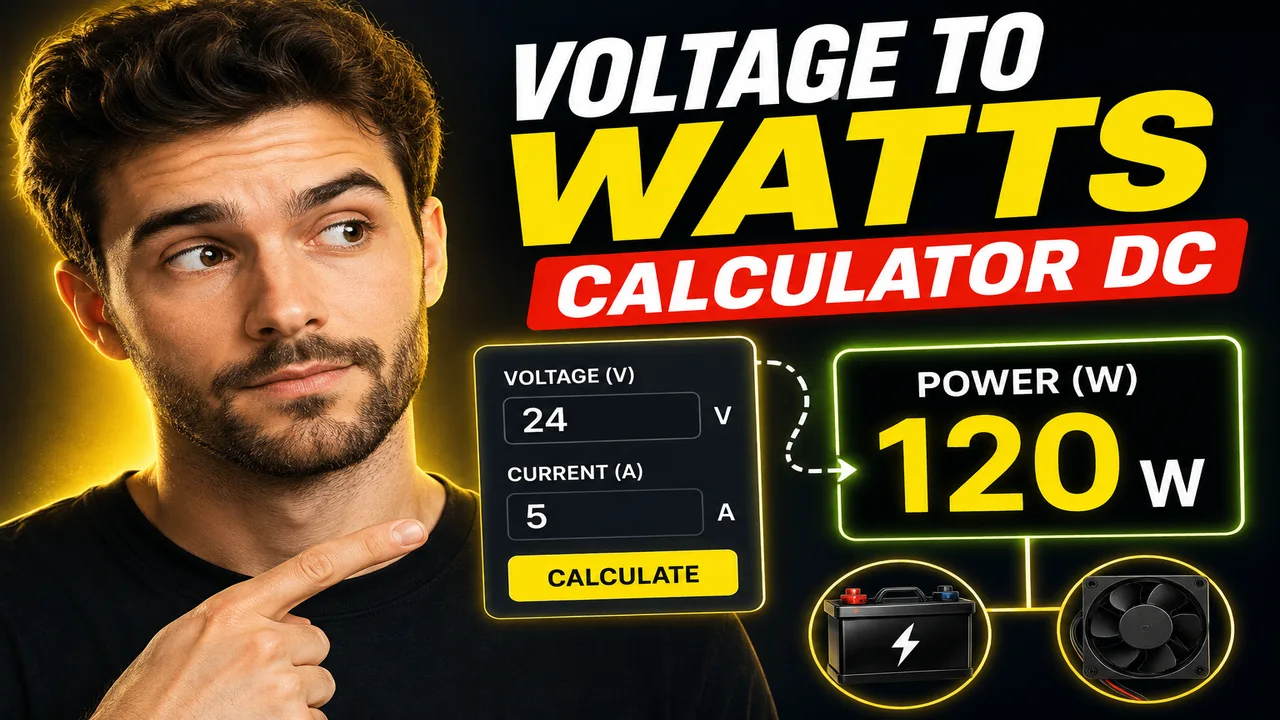
Quick answer: The Voltage To Watts Calculator Dc Online calculates electrical power in a direct-current (DC) circuit using voltage and current, or voltage and resistance when the relevant values are known. Power is expressed in watts (W). The correct formula depends on which electrical quantities are available.
The Voltage To Watts Calculator Dc Online is a DC electrical power calculator for estimating how many watts a circuit or electrical component consumes or delivers. It is useful for electronics students, electricians, electrical technicians, hobbyists, solar-system planners, and anyone working with DC power supplies, batteries, motors, LED circuits, or other direct-current equipment.
Voltage and watts describe different electrical properties. Voltage, measured in volts (V), represents the electrical potential difference. Power, measured in watts (W), represents the rate at which electrical energy is transferred. To calculate power, you also need current or resistance, unless the necessary information is already provided through an equivalent electrical relationship.
TL;DR / Key Takeaways
- Primary function: Calculate DC electrical power in watts.
- Voltage and current: Multiply volts by amperes to calculate watts.
- Voltage and resistance: Divide squared voltage by resistance to calculate watts.
- Important limitation: Voltage alone is insufficient to determine power.
- Best suited for: DC circuits, battery-powered devices, electronics, and preliminary power estimates.
How to Use Voltage To Watts Calculator Dc Online?
- Identify the known values. Determine the DC voltage and whether current or resistance is available.
- Enter voltage. Use the voltage measured across the relevant component or circuit, expressed in volts.
- Enter the additional electrical quantity. Supply current in amperes or resistance in ohms, according to the calculator's available input mode.
- Calculate and review. Read the resulting power in watts and verify that the inputs use compatible units.
The exact fields and input modes depend on the implemented calculator interface. Use only the inputs actually provided by the tool.
What Inputs Are Needed to Calculate DC Watts?
The additional electrical quantity required depends on the selected calculation method.
- Voltage (V): The potential difference across the DC load, measured in volts.
- Current (I): The electrical current flowing through the load, measured in amperes (A).
- Resistance (R): The electrical resistance of the load, measured in ohms (Ω).
- Power (P): The calculated electrical power, measured in watts (W).
If the current is known, use the voltage-current formula. If resistance is known and the load can be modeled using Ohm's law, use the voltage-resistance formula. Do not assume that voltage alone identifies the power consumption of a device.
DC Voltage to Watts Formula
The basic DC electrical power formula is:
P = V × I
Where:
- P = power in watts (W)
- V = voltage in volts (V)
- I = current in amperes (A)
When current is not directly available but resistance is known, Ohm's law gives the equivalent relationship:
P = V² / R
Where:
- V² = voltage multiplied by itself
- R = resistance in ohms (Ω)
These equations are equivalent for a resistive circuit when Ohm's law applies. For loads with electronic controllers or changing operating conditions, use the actual operating voltage and current whenever possible.
Voltage to Watts: Worked Examples
Example 1: Calculate Watts from Voltage and Current
Suppose a DC device operates at 12 V and draws 2 A.
- Voltage = 12 V
- Current = 2 A
- Calculation = 12 × 2
- Result = 24 W
The device transfers electrical power at a rate of 24 watts under these operating conditions.
Example 2: Calculate Watts from Voltage and Resistance
Suppose a resistive DC load has a voltage of 24 V and resistance of 12 Ω.
- Voltage = 24 V
- Resistance = 12 Ω
- Calculation = 24² / 12 = 576 / 12
- Result = 48 W
This calculation assumes the resistance remains approximately constant at the operating temperature and voltage.
Example 3: A Low-Voltage Electronics Circuit
A 5 V DC circuit drawing 0.5 A consumes:
P = 5 × 0.5 = 2.5 W
This estimate can help when comparing the electrical demand of small electronic circuits or selecting an appropriately rated power supply. Allow suitable headroom for startup current, changing loads, and conversion losses where applicable.
DC Voltage and Watts Reference Table
The following table shows illustrative power values for common DC voltages at selected current levels. Each result uses P = V × I. These are mathematical examples, not guaranteed operating values for any specific device.
| DC Voltage | Current | Power Calculation | Power Output |
|---|---|---|---|
| 3.3 V | 0.1 A | 3.3 × 0.1 | 0.33 W |
| 5 V | 0.5 A | 5 × 0.5 | 2.5 W |
| 9 V | 1 A | 9 × 1 | 9 W |
| 12 V | 2 A | 12 × 2 | 24 W |
| 24 V | 3 A | 24 × 3 | 72 W |
| 48 V | 5 A | 48 × 5 | 240 W |
How the DC Power Calculation Works
The calculator's intended mathematical operation is to apply the appropriate electrical power equation to the supplied values. When voltage and current are used, multiplying them gives power directly. When voltage and resistance are used, squaring the voltage and dividing by resistance gives power for an ohmic load.
For example, increasing current while keeping voltage constant increases calculated power proportionally. Doubling current doubles the calculated power. For a fixed resistance, doubling voltage increases calculated power by a factor of four because voltage is squared in the equation P = V² / R.
Keep the units consistent. Voltage should be in volts, current in amperes, and resistance in ohms. If the available current is expressed in milliamperes, convert it to amperes before using the basic formula: 500 mA = 0.5 A.
Technical Edge Cases and Limitations
- Voltage without current or resistance: A unique wattage cannot be calculated from voltage alone.
- Zero current: P = V × 0 gives 0 W at that instant, assuming the entered values describe the same operating condition.
- Zero resistance: P = V² / R is undefined at R = 0. An ideal short circuit cannot be treated as an ordinary resistive load for this calculation.
- Negative input values: Negative values may describe a chosen measurement direction or signed circuit convention, but they require interpretation rather than automatic treatment as ordinary positive consumption.
- Unit mismatch: Entering milliamperes as if they were amperes creates a result that is 1,000 times too high.
- Changing loads: Motors, switching converters, and electronically controlled devices may draw varying current. Use voltage and current measured at the same operating point.
- Efficiency losses: Calculated electrical input power is not necessarily the useful mechanical or delivered output power. Account for efficiency when estimating a system's useful output.
The supplied tool name does not establish its exact validation rules, input fields, rounding precision, or error messages. Those implementation details should be documented only after the live calculator has been checked.
Electrical Safety and Technical Disclaimer
Use appropriately rated measuring equipment and observe the voltage, current, and polarity limits of the circuit. High-current battery systems can cause burns, fire, or equipment damage if short-circuited. A power calculation does not establish whether a wire, fuse, connector, battery, or power supply is safely rated for an application.
Technical Disclaimer: This calculator content explains standard DC power relationships and provides preliminary mathematical estimates. Confirm real-world measurements, component ratings, thermal conditions, and applicable electrical requirements before making equipment or safety decisions.
Author Information
Author Name: Michael Turner
Author Description: Electrical engineering content specialist focused on circuit fundamentals, DC power calculations, and practical electronics education.
Technical Review: The calculation methodology is based on the standard relationship between voltage, current, resistance, and electrical power. The live calculator's implementation and validation behavior should be independently checked before being represented as verified.
Authoritative References
- All About Circuits — Electric Power: Explanation of DC power and its relationship to voltage and current.
- NIST Special Publication 811: Reference for SI units and consistent electrical measurement units.