
Grams To Deciliters Converter For Ingredient Volumes
Convert grams to deciliters using ingredient density. Check practical examples for water, flour, sugar, oil, and honey to estimate recipe volumes with clearer measurements.
Please complete this field to continue.
Please complete this field to continue.
Results
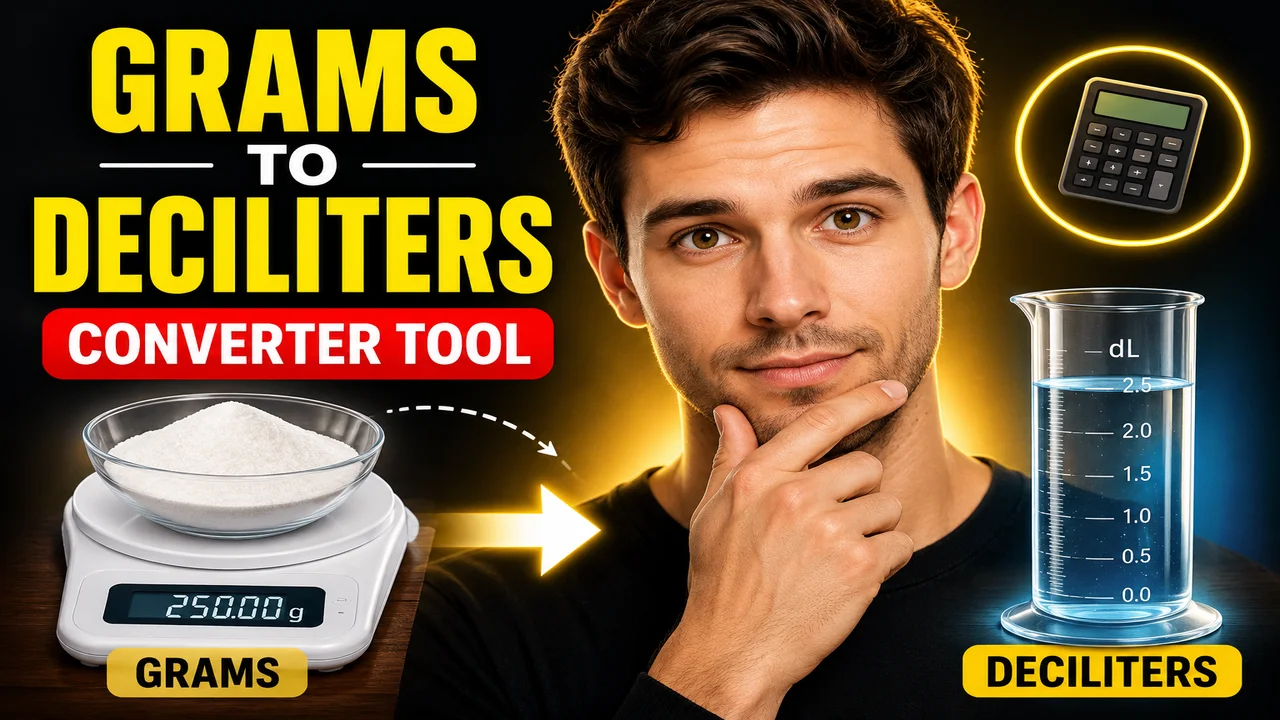
Grams To Deciliters Converter
Quick answer: The Grams To Deciliters Converter helps convert a mass measured in grams (g) into a volume measured in deciliters (dL). Because grams measure mass and deciliters measure volume, the conversion depends on the density of the ingredient or substance being measured.
The Grams To Deciliters Converter is a unit-conversion utility for cooking, baking, recipe adjustments, and other everyday measurement tasks. It helps users understand how much volume a given mass occupies when expressed in deciliters. The key requirement is a suitable density value for the material.
For water, 100 grams is approximately 1 deciliter under ordinary conditions. The same mass of flour, granulated sugar, honey, or cooking oil occupies a different volume because these substances have different densities. A reliable conversion must account for this difference instead of treating grams and deciliters as interchangeable units.
What Does the Converter Calculate?
The conversion relates three quantities: mass, density, and volume. Grams describe how much mass a substance contains, while deciliters describe the space it occupies. Density connects the two measurements.
- Input: Mass in grams.
- Required conversion factor: Density in grams per milliliter (g/mL), or an equivalent density unit.
- Output: Volume in deciliters.
- Typical use cases: Recipe conversion, ingredient measurement, kitchen preparation, and basic volume estimation.
The specific interface options and built-in ingredient presets for this tool have not been established here. If the converter accepts only a gram value, the selected or assumed density must still be appropriate for the substance to produce a meaningful result.
How to Use Grams To Deciliters Converter?
- Identify the substance. Determine whether you are measuring water, flour, sugar, oil, or another material.
- Enter the mass. Type the required amount in grams.
- Use the correct density. Select an ingredient preset if the actual tool provides one, or use a suitable known density where supported.
- Read the volume. Interpret the result in deciliters and consider the precision of the density value.
For the most dependable result, use a density that matches the specific ingredient and its physical condition. For example, sifted flour and compacted flour can occupy different volumes at the same mass.
Grams to Deciliters Formula
The standard conversion formula is:
Volume (dL) = Mass (g) ÷ Density (g/mL) ÷ 100
This formula first calculates volume in milliliters and then converts milliliters to deciliters. One deciliter equals 100 milliliters.
- Mass (g): The measured quantity in grams.
- Density (g/mL): The mass contained in one milliliter of the substance.
- Volume (dL): The calculated volume in deciliters.
An equivalent formula uses density in grams per deciliter:
Volume (dL) = Mass (g) ÷ Density (g/dL)
Use only matching units. If density is expressed in kilograms per cubic meter, convert it to a compatible unit before applying the formula.
Grams to Deciliters: Worked Examples
Example 1: Water
Suppose you have 250 grams of water and use an approximate density of 1.00 g/mL.
- Mass = 250 g
- Density = 1.00 g/mL
- Volume = 250 ÷ 1.00 = 250 mL
- Deciliters = 250 ÷ 100 = 2.5 dL
Result: 250 g of water is approximately 2.5 dL.
Example 2: Granulated Sugar
Suppose 100 grams of granulated sugar has an approximate bulk density of 0.85 g/mL.
- Mass = 100 g
- Density = 0.85 g/mL
- Volume = 100 ÷ 0.85 ≈ 117.65 mL
- Deciliters = 117.65 ÷ 100 ≈ 1.18 dL
Result: 100 g of granulated sugar is approximately 1.18 dL. The actual volume varies with grain size and how the sugar is packed.
Common Ingredient Conversion Reference
The following table provides illustrative conversions using approximate reference densities. These are examples for understanding the calculation, not a claim about the converter's built-in density database.
| Ingredient | Approximate Density (g/mL) | 100 g in Deciliters |
|---|---|---|
| Water | 1.00 | 1.00 dL |
| Whole milk | 1.03 | 0.97 dL |
| Vegetable oil | 0.92 | 1.09 dL |
| Honey | 1.42 | 0.70 dL |
| Granulated sugar | 0.85 | 1.18 dL |
| All-purpose flour, loosely measured | 0.53 | 1.89 dL |
These values are rounded approximations. Different reference tables may use different densities, especially for powders and ingredients affected by packing. For further reading, consult NIST Special Publication 811 for unit-conversion guidance and USDA FoodData Central for food composition reference data.
How the Conversion Works
Grams and deciliters belong to different measurement categories, so there is no universal conversion factor between them. The calculation requires density, which expresses mass per unit volume.
First, divide the mass in grams by density in grams per milliliter. This produces milliliters. Next, divide the milliliter result by 100 to obtain deciliters.
For water, the approximate density of 1 g/mL makes the arithmetic straightforward: the number of grams is approximately the same as the number of milliliters. For denser substances such as honey, the same mass occupies less volume. For low-density ingredients such as loosely measured flour, it occupies more volume.
Important Limitations and Edge Cases
- Missing density: A gram value alone is insufficient for a general mass-to-volume conversion. Identify the substance or supply a suitable density.
- Incorrect ingredient selection: Using water's density for flour, oil, or honey can produce a substantially incorrect result.
- Powder packing: Flour, cocoa powder, and similar ingredients vary in bulk density depending on settling, sifting, and measuring technique.
- Temperature: Liquids can change density with temperature. For everyday cooking, a suitable approximate density is often adequate.
- Rounding: A displayed result with many decimal places does not make an approximate density more precise.
- Invalid values: A negative mass or a zero or negative density is not meaningful for this ordinary conversion formula. Empty fields and invalid text should be checked before interpreting a result.
What This Converter Cannot Establish by Itself
A mathematical conversion cannot determine the actual density of an unknown substance. It also cannot correct an inaccurate ingredient measurement or account automatically for every variation in composition, temperature, moisture, or packing. The available tool documentation does not establish its exact validation rules, rounding settings, ingredient presets, or processing architecture, so those implementation details should not be assumed.
For baking, weighing ingredients directly is generally preferable when a recipe specifies grams. Volume conversions are useful when a deciliter measure is more convenient, but they can introduce variability for powders and other ingredients whose bulk density changes with handling.
Frequently Asked Questions
How many deciliters are in 100 grams?
It depends on the substance. For water, 100 grams is approximately 1 dL. For 100 grams of granulated sugar, the volume is about 1.18 dL using a density of 0.85 g/mL.
Can grams be converted to deciliters without density?
Not for a general substance. Grams measure mass and deciliters measure volume. A density value is needed to connect the two, except when using a known approximation such as water at about 1 g/mL.
What is the formula for grams to deciliters?
When density is measured in grams per milliliter, divide the mass in grams by density and then divide by 100: dL = g ÷ density (g/mL) ÷ 100.
Why does 100 grams of flour occupy more volume than 100 grams of water?
Loosely measured flour has a much lower bulk density than water. As a result, the same mass of flour occupies more space. The exact amount depends on the flour and how it is measured.
Is 1 gram always equal to 1 milliliter?
No. This is approximately true for water under ordinary conditions, but not for most substances. Honey is denser than water, while many dry powders have a lower bulk density.
How accurate are ingredient conversions to deciliters?
The arithmetic can be precise, but the result depends on the density used. Ingredient composition, temperature, and packing can affect real-world volume, so treat conversions based on typical densities as estimates.
Author
Author Name: Daniel Brooks
Author Description: Measurement and conversion content specialist focused on practical metric-unit calculations and clear explanations of mass, volume, and density.
Technical Review: The conversion methodology is explained using the standard relationship between mass, volume, and density. Ingredient examples are approximate and should be checked against a suitable reference density when precision matters.