
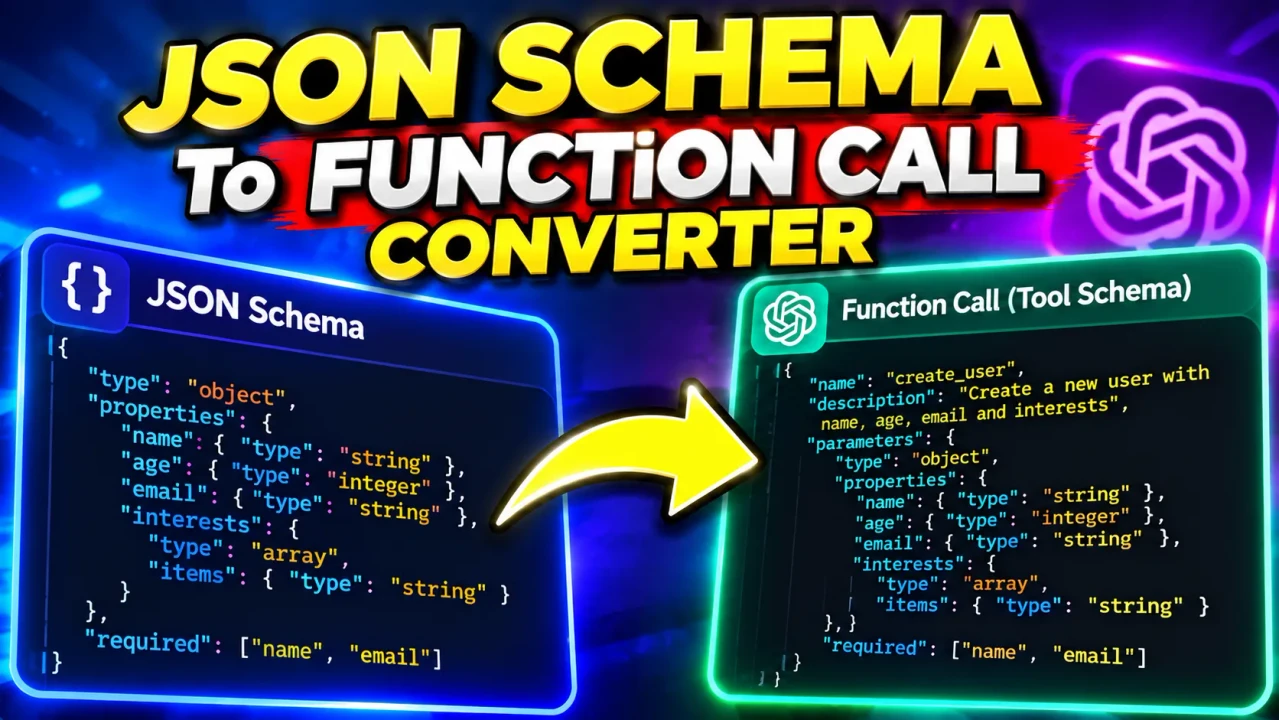
Json Schema To Function Call Converter
Quick answer: Json Schema To Function Call Converter is a developer utility intended to transform JSON Schema definitions into function-call tool definitions for AI applications. The target structure typically includes a function name, description, parameter schema, and optional strict-mode configuration. The exact conversion behavior and supported input options depend on the implementation of the deployed tool.
JSON Schema To Function Call Converter helps developers prepare structured input definitions for AI function calling. Instead of manually rewriting a JSON Schema into a function definition, developers can use a conversion workflow to organize the schema into a format suitable for a compatible API integration.
Function calling allows an AI model to request an application-defined function and provide arguments that the application can process. The model does not automatically execute the underlying business logic: the application typically receives the function call, validates or parses its arguments, executes the corresponding operation, and returns the result to the model.
Important: The exact input format, output format, supported options, and processing behavior of this particular converter have not been independently established. The technical examples below illustrate a representative JSON Schema-to-function-definition mapping rather than a verified output capture from the deployed utility.
Key Takeaways
- Primary purpose: Prepare JSON Schema definitions for function-calling integrations.
- Input: A JSON Schema describing function arguments, subject to the converter's actual input requirements.
- Expected output: A function definition containing a name, description, and parameter schema.
- Target audience: AI application developers, API integrators, and software engineers.
- Important distinction: Converting a schema does not implement or execute the function itself.
How to Use Json Schema To Function Call Converter?
Use the following general workflow if the deployed converter accepts a JSON Schema input and generates a function-call definition.
- Prepare the schema. Define the argument object, property types, descriptions, and required fields. Ensure the input is valid JSON.
- Enter the input. Paste the schema into the converter's input area if text input is supported.
- Run the conversion. Use the available conversion control to generate the corresponding function definition.
- Review the output. Check the function name, description, parameter structure, and any strict-mode settings before integrating the result into your application.
- Validate against your API. Confirm that the resulting definition follows the requirements of the API and model configuration you intend to use.
These steps describe a typical workflow for this category of developer utility. They do not establish the actual interface controls or export options provided by the specific implementation.
Input and Output Example
Consider a JSON Schema for a function that retrieves the weather for a specified city. The schema describes the arguments the function expects, not the weather service implementation.
Example input: JSON Schema
{
  "type": "object",
  "properties": {
    "location": {
      "type": "string",
      "description": "City name to retrieve weather for"
    },
    "unit": {
      "type": "string",
      "enum": ["celsius", "fahrenheit"],
      "description": "Temperature unit"
    }
  },
  "required": ["location", "unit"],
  "additionalProperties": false
}
Illustrative output: Function definition
{
  "type": "function",
  "name": "get_weather",
  "description": "Retrieve the weather for a specified city.",
  "parameters": {
    "type": "object",
    "properties": {
      "location": {
        "type": "string",
        "description": "City name to retrieve weather for"
      },
      "unit": {
        "type": "string",
        "enum": ["celsius", "fahrenheit"],
        "description": "Temperature unit"
      }
    },
    "required": ["location", "unit"],
    "additionalProperties": false
  },
  "strict": true
}
This example demonstrates a common function-tool representation used by compatible OpenAI API configurations. The function name and description are additional metadata; they are not fields in the input argument schema itself. The parameters member contains the argument schema, while strict controls whether strict schema adherence is requested where supported.
The example assumes the converter or developer supplies the function name, description, and strict-mode setting. A converter that accepts only a standalone JSON Schema may need separate configuration for those fields. OpenAI's function-calling guide documents the function definition and its supported configuration.
JSON Schema to Function Definition: Mapping Reference
The following table explains how common JSON Schema elements relate to the parameter definition used by function-calling APIs. These are conceptual mappings, not a guarantee that every keyword is accepted by the converter or by every target API.
| JSON Schema element | Typical function-definition location | Purpose and consideration |
|---|---|---|
type: object |
parameters.type |
Defines an object containing function arguments. |
properties |
parameters.properties |
Describes each argument, including its name and schema. |
required |
parameters.required |
Identifies fields required by the schema. Strict mode may require every declared property to appear in this list. |
description |
Function description or property description | Explains the function's purpose or the meaning of an argument. |
enum |
Property schema | Restricts an argument to a specified set of values when supported. |
additionalProperties: false |
Object schema | Disallows undeclared object properties and is required for objects in OpenAI strict function schemas. |
strict: true |
Function definition | Requests strict adherence to the supported schema subset; it is not a standard JSON Schema keyword for an argument object. |
name |
Top-level function definition | Identifies the function. It is function metadata rather than an ordinary argument property. |
For OpenAI strict function calling, nested object schemas must also satisfy the relevant strict-mode constraints. All fields declared in an object's properties must be marked as required, and objects must set additionalProperties to false. An optional value can often be represented using a nullable type, where supported. Not every JSON Schema keyword is supported by strict mode. See the official Structured Outputs guide before relying on advanced schema features.
How the Conversion Works
A JSON Schema-to-function-definition transformation generally separates argument validation rules from function metadata.
- Parse the JSON: Read the input and verify that its JSON syntax is valid.
- Identify the argument schema: Locate the object type, properties, required fields, and applicable constraints.
- Construct the function wrapper: Place the argument schema in the target definition's
parametersmember and provide the required function metadata. - Check compatibility: Validate the completed definition against the supported API schema and any strict-mode requirements.
This describes a general conversion model, not a confirmed account of the converter's internal algorithm. The actual tool may use different validation rules, require extra fields, or support only a subset of JSON Schema.
Edge Cases and Limitations
Invalid JSON
A missing comma, unmatched brace, or incorrectly quoted string makes the input invalid JSON. A conversion workflow cannot reliably interpret the intended schema without resolving the syntax problem. The exact error message and recovery behavior depend on the implementation.
Optional properties and strict mode
Ordinary JSON Schema can describe optional properties by leaving them out of the required array. OpenAI strict function calling has additional requirements: all properties must be listed as required. A nullable field can represent a value that is required to be present but may contain null. This distinction matters when translating an existing schema.
Unsupported keywords
Keywords such as advanced composition rules, conditional schemas, or complex validation constraints may not be supported by a target function-calling configuration. Do not assume that preserving a keyword in the output means the target API will accept or enforce it.
Nested objects and arrays
Nested structures require their own type definitions and constraints. In strict mode, nested objects must follow the applicable object restrictions. Arrays must use a supported item schema. Validate the entire schema tree rather than checking only the top-level object.
Function metadata
A JSON Schema does not necessarily specify a function's name, purpose, or execution behavior. These may need to be supplied separately. A generated definition can describe valid arguments, but it cannot create a working API endpoint, database operation, or application function by itself.
Privacy and processing
The deployed converter's data-processing location, retention policy, and upload behavior have not been verified. Avoid entering secrets, API keys, private customer information, or proprietary schemas unless the tool's privacy and processing practices are known.
Frequently Asked Questions
What does Json Schema To Function Call Converter produce?
It is intended to produce a function-call definition from a JSON Schema. A typical target structure includes a function name, description, parameter schema, and optionally a strict-mode setting. The actual output fields depend on the deployed implementation.
Is JSON Schema the same as a function definition?
No. JSON Schema describes the structure and constraints of data. A function definition wraps an argument schema with metadata that identifies the callable function and explains its purpose. The application must still implement the function's behavior.
Can the generated definition use strict mode?
Strict mode can be requested in compatible OpenAI function definitions. The parameter schema must satisfy the supported subset and its restrictions, including required fields and additionalProperties: false on objects. The converter's ability to configure strict mode has not been verified.
How should optional arguments be represented?
For ordinary JSON Schema, an argument can be optional by omitting it from the object's required array. In OpenAI strict function schemas, every declared property must be required; a nullable type can be used when the application needs to accept a null value. Missing and null values are not equivalent.
Does converting a schema make the function executable?
No. The definition tells a compatible model how a function can be called and what arguments it accepts. Your application must handle the resulting call, execute the intended code or service, and return its output.
Does this converter support every JSON Schema keyword?
That capability has not been established. In addition, the target API may support only a subset of JSON Schema, especially when strict mode is enabled. Review the target API documentation and validate the generated definition before deployment.
Is the input processed locally or uploaded to a server?
The converter's processing architecture has not been verified. Check the site's privacy policy and implementation documentation before submitting confidential schemas or other sensitive data.
Author
Author Name: Michael Turner
Author Description: Software engineering content specialist focused on API integration, JSON data structures, and developer tooling.
Technical Review: The technical explanation distinguishes JSON Schema argument validation from function metadata and highlights the strict-mode constraints documented by OpenAI. The deployed converter's implementation and supported features have not been independently verified.