
Gram To Milliliter Ink Converter For Accurate Ink Volume
Convert printer ink grams to milliliters with the Gram To Milliliter Ink Converter. Use ink density to estimate liquid volume for refilling and measurement tasks.
Please complete this field to continue.
Please complete this field to continue.
Results
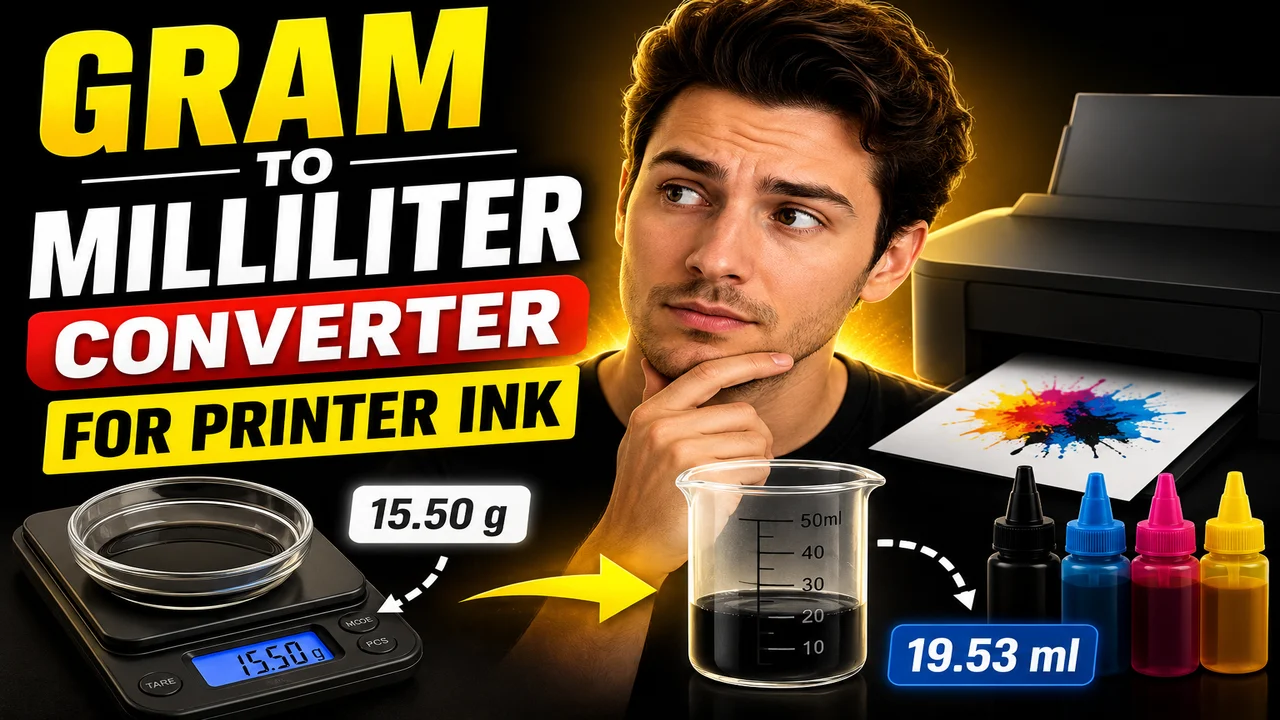
Gram To Milliliter Ink Converter
The Gram To Milliliter Ink Converter is a unit conversion calculator that estimates the volume of printer ink in milliliters (mL) from its mass in grams (g). It uses the ink's density to convert weight into volume, helping printer owners, refill technicians, and ink-handling professionals estimate liquid quantities more accurately.
Quick answer: To convert printer ink grams to milliliters, divide the ink's mass in grams by its density in grams per milliliter (g/mL). The result is the estimated ink volume in milliliters.
How Does Gram to Milliliter Conversion Work for Printer Ink?
Grams measure mass, while milliliters measure volume. These units cannot be converted directly for every liquid because different liquids have different densities. Printer ink formulations may contain water, solvents, pigments, dyes, and other ingredients, so the volume corresponding to a given mass depends on the particular ink formulation.
The Gram To Milliliter Ink Converter uses the relationship between mass, density, and volume. When the ink density is known, the calculator can estimate how many milliliters correspond to a measured quantity of ink. For the most reliable result, use the density specified on the ink manufacturer's technical data sheet or product documentation.
Formula for Converting Ink Grams to Milliliters
Volume (mL) = Mass (g) ÷ Density (g/mL)
- Mass: The measured weight of the printer ink in grams.
- Density: The mass of the ink per unit volume, expressed in grams per milliliter.
- Volume: The calculated quantity of ink in milliliters.
For example, suppose a printer ink has a mass of 50 grams and a density of 1.25 g/mL.
Calculation: 50 ÷ 1.25 = 40 mL
Result: 50 grams of this ink corresponds to approximately 40 milliliters.
This result depends on the assumed density. It should not be treated as a universal conversion for every printer ink.
Input and Output Example
| Input Parameter | Example Value | Purpose |
|---|---|---|
| Ink mass | 100 g | Amount of ink by weight |
| Ink density | 1.20 g/mL | Mass per milliliter |
| Calculated volume | 83.33 mL | Estimated liquid volume |
Using the example values, 100 ÷ 1.20 = 83.33 mL. The calculation assumes the density remains applicable to the ink being measured.
Printer Ink Density Reference Table
The following table shows how different assumed densities affect the conversion of common ink masses. These values are illustrative calculation references, not guaranteed density specifications for any particular printer ink.
| Ink Mass (g) | Density (g/mL) | Estimated Volume (mL) |
|---|---|---|
| 10 | 1.00 | 10.00 |
| 10 | 1.10 | 9.09 |
| 10 | 1.20 | 8.33 |
| 10 | 1.30 | 7.69 |
| 50 | 1.00 | 50.00 |
| 50 | 1.10 | 45.45 |
| 50 | 1.20 | 41.67 |
| 50 | 1.30 | 38.46 |
| 100 | 1.00 | 100.00 |
| 100 | 1.10 | 90.91 |
| 100 | 1.20 | 83.33 |
| 100 | 1.30 | 76.92 |
The table demonstrates an important relationship: at a fixed mass, a denser ink occupies less volume. For example, 50 g of ink at 1.30 g/mL occupies less volume than 50 g at 1.00 g/mL.
How to Use Gram To Milliliter Ink Converter?
- Enter the ink mass: Measure the printer ink and enter its weight in grams.
- Provide the density: Use the ink's documented density in g/mL. Avoid assuming that all inks have the same density.
- Calculate the volume: Apply the formula by dividing mass by density.
- Review the result: Read the estimated volume in milliliters and retain suitable precision for your application.
If your particular converter interface provides a preset density or a density input, use the available controls accordingly. The actual controls and their default values should be confirmed against the deployed tool interface.
Why Ink Density Matters
Printer ink is not a single uniform substance. Inkjet inks, pigment dispersions, dye-based inks, and industrial printing inks can have different formulations and physical properties. Consequently, equal masses of two inks may occupy different volumes.
For example, a technical specification for one ink might report a density of 1.20 g/mL, while another formulation might have a density of 1.30 g/mL. Using the first value to convert the second ink's mass would introduce a systematic volume estimation error.
For laboratory or production applications, density measurements must also be interpreted in relation to temperature and the manufacturer's specified measurement conditions. A density value measured at one temperature may not exactly represent the ink at another temperature.
Conversion Examples for Everyday Use
- 10 grams of ink at 1.20 g/mL: 10 ÷ 1.20 = 8.33 mL.
- 25 grams of ink at 1.25 g/mL: 25 ÷ 1.25 = 20 mL.
- 75 grams of ink at 1.20 g/mL: 75 ÷ 1.20 = 62.5 mL.
- 200 grams of ink at 1.30 g/mL: 200 ÷ 1.30 = 153.85 mL.
These examples illustrate the mathematical conversion only. They do not specify the density of any particular commercial ink.
Edge Cases and Limitations
- Unknown density: An accurate volume cannot be determined from mass alone unless a suitable density is known or assumed.
- Zero mass: Zero grams corresponds to zero milliliters when the density is positive.
- Negative mass: Negative physical mass is not meaningful for an ordinary ink quantity and should not be used as a real measurement.
- Zero or negative density: These are invalid for this conversion because the formula requires a positive density.
- Rounding: Displayed decimal places affect presentation, not the underlying physical accuracy.
- Mixed or changing formulations: Do not assume a density remains valid if the ink has been diluted, mixed, contaminated, or otherwise altered.
The calculation estimates liquid volume from mass and density. It does not determine printer cartridge compatibility, ink quality, remaining ink levels, or the suitability of an ink for a particular printhead.
Technical Reference
The relationship between density, mass, and volume is a standard physical measurement principle. The National Institute of Standards and Technology's historical reference on inks explains that liquid volumes can be calculated from weights when the liquid's density is known.
Reference: NIST Letter Circular 331: Inks.
For a particular ink product, consult the manufacturer's technical data sheet for its applicable density and measurement conditions.
Frequently Asked Questions
Can grams be converted to milliliters without knowing ink density?
No. Grams measure mass and milliliters measure volume. A density value or an explicitly stated approximation is needed to calculate the volume.
Is 1 gram of printer ink always equal to 1 milliliter?
No. That approximation is appropriate for water under specified conditions, but printer ink may have a different density.
What density should I use for printer ink?
Use the density supplied by the ink manufacturer for the exact formulation, ideally under the stated measurement conditions. Do not treat one density value as suitable for all ink types.
Does ink color determine its density?
Not by itself. Density depends on the complete formulation, including its ingredients and concentrations, rather than color alone.
Can this conversion be used for industrial printing ink?
Yes, the same mass-density-volume relationship applies to liquids generally, provided the density value is appropriate for the industrial ink being measured.
Author Information
Author Name: Daniel Brooks
Author Description: Technical Content Specialist focused on measurement calculations, unit conversions, and practical engineering reference content.
Technical Review: The conversion methodology is based on the relationship between mass, volume, and density. Product-specific density values should be checked against manufacturer documentation before operational use.